Gamechanger Audio Motor Pedal review – a radical synth pedal for sonic extremists
€329/£299/$399, gamechangeraudio.com
I’m going to be very careful to avoid hyperbole here. The Gamechanger Audio Motor Pedal is almost certainly the wildest, hairiest, scariest stompbox I have ever used. Now imagine what that sentence would have been like with the hyperbole left in…
READ MORE: Warm Audio WA-TS Tube Squealer review: “it offers a great deal in a small enclosure”
To be clear, while the Latvian mavericks’ latest concoction very much comes under the ‘synth’ category, we’re not dealing with boops, bleeps, moving filters or emulated organ sounds here. This is a whole different kettle of piranhas.
Image: Adam Gasson
Gamechanger Audio Motor Pedal – what is it?
Okay, here’s the easy part: it’s a monophonic synthesizer pedal for guitar. More specifically, according to the manual, this is “the world’s first electromechanical synth engine in pedal format”. It’s built around a spinning motor oscillator with three rotating coils and a fixed electromagnetic pickup, driven by a pitch-tracking engine.
For anyone thinking that might as well be written in Greek, you’re not far off – it’s written in geek. And here’s what it means in basic English: the higher the note you play, the faster the motor spins, and that’s what generates the output signal. It’s an idea taken from the desktop Motor Synth, but now offered in much-simplified (and guitarified) form.
Image: Adam Gasson
Gamechanger Audio Motor Pedal – is it easy to use?
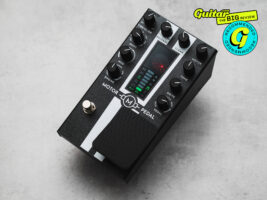
Ten knobs looks like a lot, especially when they’re crowded around a bamboozling display of multicoloured lights, but they’re ripe for picking off one at a time.
Begin with the ones at bottom left and right, which aren’t really knobs at all but five-way rotary switches: one for selecting the synth mode, and one for assigning the function of the built-in expression pedal. Between those two you’ve got plenty of housemate-horrifying power on tap even with everything else parked at halfway.
Let’s not forget the other controls, though. There’s a seven-way switch for setting a pitch-shift interval between one octave down and one octave up, dials for dry and wet volume plus tone and drive, and three more for tweaking the synthesized signal.
And then, of course, you’ve got the expression pedal. This looks and feels like a car’s accelerator, and I don’t think that’s a decision Gamechanger has made just to fit in with the automotive theme: push it down and it will spring back up when you let go, which is useful, and you can also squeeze it down harder to push through into ‘floor-it’ mode. Intriguing, no? Better buckle up…
Image: Adam Gasson
Gamechanger Audio Motor Pedal – sounds
Sure, the vroomy-vroom concept is cute and all – it’s even got racing stripes! – but if you pop it in the first mode and note-bend your way along the low E string, the Motor Pedal can sound uncannily like an F1 car going through the gears. It’s a ‘synth’ sound, yes, but with a grindingly atonal thickness that’s distinctive and exhilarating, if not exactly musical in any familiar sense of the word.
Some of the other sounds are more traditionally synthy – throw away your keyboards now, Gary Numan fans! – but you always have the feeling that unpredictable overtones are just waiting to grab the wheel and drag you into the crash barriers. The knob marked ‘mod’ can make this even more pronounced, while you also have the option of cranking the drive for maximum furiousness.
There’s a wonderfully wobbly vibrato on board, as well as adjustable sustain for softening the in-built gating effect – which is helpful, but can’t always stop it cutting off a hanging note when you really don’t want it to. This can be absolutely maddening, and will make you envy those key-prodders with their un-decaying notes.
For the real high-octane thrills, though, you need to step on the expression pedal. It can be set to go up or down an octave, engage infinite sustain, add momentary vibrato or serve as a volume pedal. Push down extra-hard in vibrato mode and it increases the speed; in either of the octave modes it will soar beyond its range like a satanically possessed Whammy. All of this happens without any distracting latency or tracking issues, and with the entertaining visual bonus of a spinning chequered wheel to distract you from all your mistakes.
Image: Adam Gasson
Gamechanger Audio Motor Pedal – should I buy one?
The Motor Pedal pushes at the boundaries of what a guitar stompbox can do before it becomes simply a generator of unpleasant noises. Its practical uses, unless you’re in some sort of neo-industrial electro-goth dada-brutalist ensemble, are limited. It’s large, heavy and somewhat expensive. Worst of all, it sounds better with keyboards than it does with guitars. Still with me after all that? Then yes, you probably should buy it.
Gamechanger Audio Motor Pedal – alternatives
Nothing else will take you anywhere quite like this, but other unapologetically rebellious stompboxes for noisemongers include the Noise Engineering Dystorpia ($299/£299), Electro-Harmonix POG3 ($645/£599) and Mantic Flex Pro ($269/£230).
The post Gamechanger Audio Motor Pedal review – a radical synth pedal for sonic extremists appeared first on Guitar.com | All Things Guitar.
Source: www.guitar-bass.net