Neural DSP Archetype: John Mayer review – is this the Mayer tone plugin we’ve been waiting for?
€199, neuraldsp.com
Back in the early 2000s, I was a woefully underqualified student on a music college guitar course, powerfully unenthused by the guitar heroes I was encouraged to emulate. In truth, I was probably struggling to see myself in the Mount Rushmore shredders because well, I was and remain a witheringly average guitar player. But a few months into the first semester, one of the tutors switched us onto this new young American lad who was taking an unconventional route to guitar success.
READ MORE: Poly Effects Trails review – probably the world’s most inspiring multi-effects pedal
This kid had landed himself a spot on the Billboard top 40 with a fairly dreadful song about someone’s body being a wonderland. But, listen to his new album, Room For Squares, we were told – there’s a serious guitar player lurking underneath the radio-friendly pop songs.
I’m telling you this not to flaunt my John Mayer credentials – as if such a thing exists – but to explain that I am something of a greybeard when it comes to Mayer tone chasing. But obviously, I’m not alone.
Mayer is probably the most influential guitar player of the last two decades, with some of the biggest artists on the planet citing him as a huge inspiration on their tone, technique and artistry. There are whole websites devoted to analysing every piece of gear in an attempt to emulate his sound. This then, is a big ol’ deal.
Because while Mayer has had signature products before – the wildly popular PRS Silver Sky being the most notable – he’s often been quite secretive about his actual signal chain. Now however, he’s pulling the curtain back and presenting any guitar player with a laptop and an audio interface the opportunity to experience a high-end emulation of his guitar amps and pedals, and presets to show you how he puts it all together.
Whisper it, but this might be the most asked-for new artist-related product the guitar world has seen in a very, very long time.
Image: Press
Neural DSP Archetype: John Mayer – what is it?
Archetype: John Mayer is the latest in Neural DSP’s – maker of the Cortex pedals and a bunch of other high-end digital guitar stuff – series of wildly popular artist-focused guitar plugins.
For the most part, these Archetypes have focused heavily on the shredder, metallic end of the guitar spectrum – John Petrucci, Gojira, Tim Henson and the like – with the occasional flirtations with non-heavy guys like Mateus Asato and Cory Wong.
Landing a bluefin tuna of a fish like Mayer then, is a big deal not just for guitar fans who have been crying out for an official Mayer plugin, but also for Neural DSP. While the Quad Cortex has become hugely popular with fans and artists across the musical spectrum for its remarkably realistic amp profiles (including Mayer himself), the company has struggled to fully cater to the non-heavy audience at times – this is quite the statement of intent that they’re going to change that.
So, what actually is it? Well it’s a guitar plugin, which will work standalone or with your DAW of choice, that offers a bunch of amps and effects exhaustively modelled on Mayer’s own gear, plus a bunch of presets for that gear created not only by the man himself but by a boatload of other artists, too. Yep, if you’ve ever wondered what John Petrucci, Lee Malia or Plini would do if they were plonked down in front of John Mayer’s rig – wonder no more.
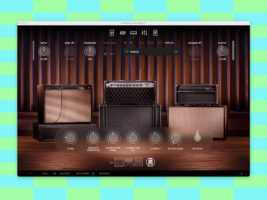
Specifically, what we get here are replications of John’s three most beloved and commonly used amps – a 1964 Fender Vibroverb, John’s #002 Dumble Steel String Singer, and the prototype of his signature Two-Rock head. All three come with corresponding cabs, and there’s an interesting fourth option, “The Three-In-One Amplifier”, which combines all three together as Mayer himself would do, under one streamlined control panel.
You can run each of the amps through any of the connected speaker options – and there are a boatload of mic options, both in terms of type and placement, as you’d expect with any high-end guitar plugin.
Image: Press
Effects-wise, the signal chain offers 11 effects in total, split up into various stages in the chain. And if you ever doubted that Mayer was both extremely online and extremely aware of the internet’s feverish obsession with his signal chain, the fact that all the pedals here are rendered as if clumsily covered in black paint – a nod to Mayer’s habit of ‘blacking out’ certain pedals on his real ‘board to throw off the tonehounds – should remove them conclusively.
In terms of actual pedals, we have five Mayer staples in the pre-effects slot – a Keeley Katana, EHX Q-tron, Way Huge Aqua-Puss, Klon Centaur and a combined Bluesbreaker/TS-10 Tube Screamer. At the other end we also have a Providence Chrono Delay and the reverb bit of a Strymon Flint, and there’s also a studio EQ and compressor after the amp stage.
The most interesting part of the rig, however, is the ‘Gravity Tank’ a Neural-designed hybrid harmonic tremolo and spring reverb tank that puts together the sound of John’s favourite units in a bespoke unit that sits between the pre-effects and the amps.
You also get a transpose function that enables you to go up or down 12 full steps, a noise gate, doubler, plus a built-in tuner, metronome and all the MIDI jiggery you’d expect.
There are 18 built-in Mayer-designed presets, plus multiple presets from over 40 different artists, and a shedload from Neural itself – you can of course, create and save your own too.
Image: Press
Neural DSP Archetype: John Mayer – usability
Neural’s Archetype platform is a mature one at this point and if you’ve used any of Neural’s plugins before the basic setup is as you’d expect. Even if you’ve never used one before however, the interface is extremely straightforward and intuitive.
Across the top of the interface, no matter what you click on, you have the five editable parts of the signal chain – pre-fx, verb & trem, amp, cab, EQ and comp, and post-fx. Below that you have another permanent bar with the input and output level, noise gate, transpose, doubler and a menu to select presets. At the bottom you have an outlined depiction of the four amp and cab options so you can see at a glance what you’re playing through anywhere, while the big space in the middle is devoted to a suitably WYSIWYG depiction of whatever it is you’re currently editing.
Each effect and amp is clearly laid out in the manner you’d expect from the originals, though the blacked-out thing isn’t the most helpful at a glance. The coloured labels don’t exactly pop with their slightly washed-out colour palette, while the labels for the controls are scrawled in what you assume is Mayer’s fair hand. Again, it’s not the most legible thing I’ve ever seen, and from an accessibility standpoint it would be helpful to be able to alter the font to something more legible – but they’re hardly the first pedals, virtual or otherwise, to put form over function in that regard.
Speaking of pedals, as is the nature with all other Archetypes, the signal chain is fixed to Mayer’s preference in terms of both the overarching chain and the individual components therein. That means if you wanted to move, say, your Aqua Puss to your post fx bank, it’s a no-go – it’s sat at the end of your pre fx slot and that’s where it will stay.
Image: Press
The fixed chain has other limitations too – not least the decision to have an either/or situation with the TS-10/Bluesbreaker pedal – and then there’s the amps. Each amp has its own tone stack when selected independently, but it defaults to whatever Mayer’s preferred option for the three-in-one option. In this mode you also only get the ability to tweak the level of each amp, a master gain, plus output and room send.
What’s more, each amp only offers a single channel, and the tone stack is obviously condensed quite considerably from what’s on the front of the real thing – for example, the Vibroverb only has four controls (volume, bass, treble, output) and a bright switch.
This is less of a criticism than it is a note of caution – if you’re buying this expecting to get a fully realised replication of a Steel String Slinger or a Two-Rock, you’ll be disappointed. Instead, think of it more like what Mayer considers the most important bits of each amp – and this is an artist plugin at the end of the day. If you’re buying something for its endlessly editable and configurable sonic options, plenty of options exist.
Image: Press
Neural DSP Archetype: John Mayer – usability
Booting up the plugin on my 2022 MacBook Pro, I naturally reach for the USA Strat that has been a faithful companion for over 20 years – it’s only as I go to plug it in that I recall that both the guitar and its finish choice (sunburst with a tortie pickguard) were the direct result of me spending too much time poring over Mayer’s Any Given Thursday live DVD in a grubby Coventry student house in 2004. The past is nothing if not cringe. Anyway!
The presets are obviously the right place to start for any signature product like this. While Mayer can be a cantankerous character at the best of times, it’s good to see that he hasn’t been totally obtuse here – there are no less than five presets here that have the word ‘Gravity’ in their name. Give the people what they want, John.
I start with ‘Gravity Clean’ because of course I do, with my Strat’s in-between position selected, and well… there it is. Taking into account the fact that Mayer is many dozens of forces of magnitude better at playing guitar than I am, and that my well-loved old Strat is far from a ’64, all it takes is those first five notes to raise the eyebrows at how close this sounds to the man himself.
The presets run a nice gamut of the sort of tones Mayer has become associated with, from meaty Hendrix and SRV-adjacent leads to tastefully restrained bluesy cleans, through to more raucous affairs. The ‘Just Plain Dumb’ preset is frankly, far from it – chaining all three dirty options in the pre effects into a cooking Dumble is certainly a wild ride, but one that is bags of fun.
Isolating all three amps really shows the effort and time that has clearly gone into capturing the sounds, as they really do have distinct and enjoyably authentic characteristics. The Vibroverb is like a warm hug no matter how you set it, while the Steel String Singer certainly lives up to Alexander Dumble’s reputation for creating amps that will show off exactly how good a player you are for good or for ill – forgiving this thing ain’t.
The three-in-one is obviously meant to be the headline event here though – it’s the one that most of Mayer’s presets make use of, but it’s a truly enjoyable experience regardless. The best part is the way you can use the three level controls to precisely tailor how much of each amp you want in your particular sonic gumbo – and the three are different enough that you can easily compensate for anything you don’t like about one with an extra dollop of something you do.
The effects are very impressive across the board, but the star of the show is that Gravity tremolo/reverb tank. The tremolo, in particular, throbs with a wonderfully organic and warm tonality that you rarely find in digital recreations.
And as silly as they might seem from the outset, some of the non-Mayer artist presets – looking at you John Petrucci – do a nice job of showing that there’s utility here beyond Mayer’s bluesy heartlands.
Image: Press
Neural DSP Archetype: John Mayer – should I buy it?
The good thing about Neural’s Archetypes is that you don’t really need me to answer that question for you – a 14-day free trial is available for you to download and let your ears be the judge.
If you’re a seasoned user of plugins and in-the-box guitar stuff, boot it up and have a go. The sting in the tail is that it’s quite a bit more expensive than other Neural artist Archetypes – but you are getting a lot for your money.
The other thing to weigh on is the fact that, despite being a longtime user of various digital guitar solutions – including Kemper, Fractal and Neural – Mayer is often held up by the guitar community as a bit of an analogue messiah.
As a rule, he’s all about big amps, real effects pedals, and putting them together to make massive sounds – can a digital plugin really come close to that? Well… yes and no. Within the scope of some headphones and a laptop, you’re not going to capture the full majesty of playing through several hundred thousand dollars’ worth of boutique and vintage gear on a giant stage.
But you can feel the care and attention to detail that’s gone into this from a sonic point of view – it really does capture the essence of those sounds you hear on stage and on record in a way that I’ve not heard from other plugins, and presets that claim to offer you some of that Mayer magic in digital form.
I have no doubt that the man himself would never claim that this is going to replace his analogue rig – this is a guy who built mini isolation boxes for his amps so he could use them at The Sphere for Dead & Co this year, don’t forget. But what it offers him, and all of us, is the ability to capture some of that magic in a much more affordable, accessible and replicable way. Arguably, it’s what Mayer fans have been asking for for decades.
Image: Press
Neural DSP Archetype: John Mayer – alternatives
Not down with the digital thing? Well Fender don’t currently make a Vibroverb but the ’68 Custom Vibro Champ Reverb ($1,049/£899) is a smaller and quieter substitute. Mayer’s Two-Rock signature has been discontinued for a while, but a Silver Sterling signature will set you back the thick end of $7,000/£6,399. Dumbles? Most clones emulate the Overdrive Special as opposed to the Steel String Singer, but the Overtone SSS 100 from Ceriatone ($2,000) is one option. Alternatively, if you just want a very high-quality suite of guitar amps and pedals in plugin form, without the Mayer endorsement, Paradise Guitar Studio from Universal Audio ($149) is well worth an audition.
The post Neural DSP Archetype: John Mayer review – is this the Mayer tone plugin we’ve been waiting for? appeared first on Guitar.com | All Things Guitar.
Source: www.guitar-bass.net