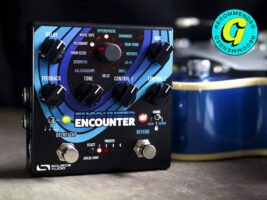
Source Audio Encounter review: “one of the most sonically adventurous pedals I’ve ever played”
$399/£369, sourceaudio.com
Let’s just get this out of the way up top: I’m typically not a fan of pedals that combine both delay and reverb. Sure, there are exceptions – the most famous being some of the many variants of the Roland RE-201 Space Echo – but the exception is not the rule.
READ MORE: Walrus Audio Qi Etherealizer review – chorus, delay, reverb and glitchy ambient soundscapes all in one pedal
Many companies have attempted this approach with varying degrees of success, and more often than not in my experience, the trade-offs outweigh the savings in cost and real estate.
That said, I am a huge fan of lush, ambient sounds and expansive textures. Pedals like the Walrus Audio Slö or the Chase Bliss MOOD have long been staples in my ambient arsenal. Despite my general reservations about the concept then, Source Audio’s latest hybrid offering – the Encounter – certainly piqued my interest.
Part of this is because Source’s previous attempt to fuse delay and reverb – the superlative Collider – was an ambient guitarist’s dream. Can it be two in a row?
Image: Press
Source Audio Encounter – what is it?
Ostensibly the Encounter is a very similar experience to the Collider – it has the same basic format of two footswitchable sides for reverb and delay, and a centralised rotary that selects which delay and reverb algorithm you’re currently using.
While the Collider was a fusion of the usual suspects of delay and reverb however, the Encounter is exclusively dealing in the most ambient and weird sounds you can find – there’s no room, spring, tape or the like here.
Instead you’ll find the likes of Hypersphere, Kaleidoscope, Trem Verb and Noise Tape – quite what those actually mean, well – you’ll need to take a look at the manual. The delay and reverb sections can be combined or run independently of the other, and the dry signal is routed around the signal processor for applications that demand unaffected tones via parallel routing. There’s also a 100 per cent wet/dry control for those effect-loop junkies.
Other highlights include onboard expression compatibility with depth and direction control, as well as complete MIDI functionality via 5-pin MIDI DIN input and thru jacks. The pedal offers eight onboard presets, with access to a total of 128 presets via MIDI.
If you want to unlock even more tweakability however, you can pair the pedal with Source Audio’s Neuro 3 smartphone app. This enables deep effect editing, MIDI control, interchangeable algorithms, preset sharing, and a wealth of other features – many of which are crucial for anyone looking to truly harness the full potential of this pedal.
Image: Press
Source Audio Encounter – usability and sounds
So, enough of the Star Trek technobabble – how does this thing actually sound? And is it too atmospheric for the normie who just wants a really good time-based pedal? To answer that hypothetical question, I grabbed a Jazzmaster and plugged it straight into a Vox AC15 to put it through its paces.
Before exploring the fusion food element of this particular meal, I decided to test each side on its own. I found the results to be both immediate and delightfully head-scratching.
For instance, one of my favorite delays – the Kaleidoscope – proved to be distinct from any kind of echo I’ve encountered before, but quite hard to describe. The best way I can think of is to imagine that your repeats have been chopped up and then sent down a giant helter skelter. It sounds strange, I know, but it’s immensely rewarding and enjoyable in practice.
Another standout delay is the expertly crafted Noise Tape, which is based on the tape delay section of the aforementioned Space Echo. I found this Space Echo emulation to be both dynamic and nearly identical to my actual 1984 RE-201. With a bit of modulation dialed in, I found myself channeling my inner Kid A almost by default – I would wager it’s the sound that the majority of us would use most frequently.
If the delays are fun and weird, the reverbs take things to a whole new level. The Hypersphere algorithm, for example, might be the closest we’ll ever get to hearing what the natural reverb of the universe sounds like. A wonderfully blooming effect that expands in all directions at once.
As you’d expect from an atmospheric pedal, there’s a fair helping of varied shimmer algorithms. These don’t necessarily reinvent the shimmer formula, but they’re tonally distinct enough to satisfy either the hardcore Sigur Rós enthusiast or those simply looking to add a slightly pitched, angelic voice to their Sunday service.
The Encounter’s greatest strength truly reveals itself when you combine delay and reverb to create richly atmospheric, creatively inspiring textures that ebb and flow between luscious sound pads and almost sequence-like lo-fi patterns.
One of my favorite pairings is the Drum Delay coupled with the Lo-Fi Reverb. This combination is perhaps the best starting point for ambient newcomers: you still get a touch of that ambient warble, but the drum delay remains straightforward enough to be usable in virtually any musical context.
When it comes to editing and saving presets, Source Audio has taken a refreshingly straightforward approach, offering both onboard editing and deep control via the Neuro 3 app. I found Neuro 3 to be especially intuitive in its design – the GUI is visually pleasing, easy to navigate, and thoughtfully laid out. In a world of overly-complicated app-based solutions, it’s nice to use something that doesn’t require a doctorate to get to grips with.
Image: Press
Source Audio Encounter – usability and sounds
So, did the Encounter change my mind about dual delay/reverb pedals? Certainly in this case, absolutely. It’s a pedal that builds upon the original concept of the Collider and takes it in a far more adventurous, sonically lush direction.
While there’s usually some sort of compromise in these sorts of pedals, by making it squarely focused on creating ambient textures does negate that impressively – as an all-in-one ambient unit, it might be the only one most of us ever need.
The flipside of this is that it’s certainly not cheap – at very nearly $400 you can definitely ask yourself whether that money would be better spent on two independent pedals, especially if your needs aren’t as esoteric as what’s on offer here.
But for its intended soundscape-y, textural audience, it’s one of the most sonically adventurous pedals you can get – and that’s well worth the price of entry.
While I initially had my apprehensions, Source Audio more than delivered, creating a pedal that could very well be the only ambient unit most players will ever need.
At $400, it’s certainly a significant ask for those simply looking for a straightforward delay/reverb combo. However, for the audience the Encounter is clearly aimed at, it stands as one of the most sonically adventurous pedals I’ve ever played – and that alone more than justifies the asking price.
Image: Press
Like this? Try these
Del-Verb Ambience Companion by Universal Audio
Qi Etherealizer by Walrus Audio
M309 Joshua Ambient Echo by MXR
The post Source Audio Encounter review: “one of the most sonically adventurous pedals I’ve ever played” appeared first on Guitar.com | All Things Guitar.
Source: www.guitar-bass.net