Strymon Olivera review – a notoriously lo-fi delay effect gets the hi-fi treatment
$259/£259, strymon.net
The beauty of modern digital effects is that you can recreate the sounds of arcane vintage devices without worrying about operating noise, reliability issues… or having to understand how those kooky old things actually work.
READ MORE: Strymon EC-1 review: “It does what it needs to do without any of the complexity of the big-box competition”
Take the Strymon Olivera: the online manual even includes an illustrated guide to the inner workings of a real oil-can echo, and I’ve studied it closely, but I still can’t fully get my head around what’s going on in there. What I do know is that, in the hands of Strymon’s engineers, a delay can be grubby and strange without being a pain to live with. Quite the opposite, in fact.
Image: Press
Strymon Olivera – what is it?
This much is clear enough: an oil-can echo is so called because it uses a spinning disc inside a metal can as its medium, lubricated by oil; the record/playback heads, meanwhile, are chunks of conductive rubber. Doesn’t sound like the last word in audio fidelity, does it? But, as with tape delay, it’s the imperfections that make it so appealing – and ripe for digital emulation.
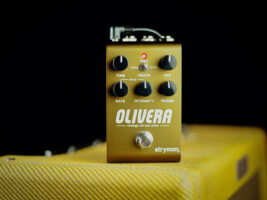
Strymon’s effort follows the compact format of its Brig and EC-1 delays, with the same five knobs and three-way mode switch. In this case the switch is for selecting either or both of the playback heads, and the knobs include modulation rate and intensity. The added modern features include stereo output, MIDI and expression pedal control, plus a range of secondary functions – notably adjustable tone on the repeats, true or buffered bypass, and analogue or digital dry-through.
Incidentally, ‘oil-can’ is being used as a compound modifier here so I’m hyphenating it, if you don’t mind. We don’t have to abandon the basics of grammar just because Strymon has, do we?
Image: Press
Strymon Olivera – what does it sound like?
It’s well made, it’s easy to use and it isn’t unduly hissy – in other words, it’s a Strymon. The effect itself, however, will make you swear you’ve plugged into something cobbled together out of old dishwasher parts in a strange-smelling garage.
The ‘lo-fi’ aspect of this delay is comprised of three separate elements: tonal filtering, overlapping echoes, and a nice bit of wobble. So first of all, while the dry signal stays crisp, the repeats are decidedly dark. You can brighten them up to an extent, but Strymon has elected to stay within the bounds of authenticity here rather than really opening things up.
Some overlapping occurs even with only one playback head engaged, the effect beginning to trip over itself a little after the first couple of repeats. It’s rather nice, and surely won’t clutter up your sound because the attack is so soft. Engaging both long and short playback heads together adds more rhythmic complexity, with the repeats still starting out fairly clean and spaced out but then gradually dissolving into a reverby mush.
The modulation is a gentle pitch vibrato, which sounds more like chorus once it’s blended with the dry signal. This adds a tasty bit of depth to the sound, especially if you’re running the Olivera in a stereo setup using a TRS cable. The stereo picture isn’t hugely expansive, though, and there’s no ping-pong option for splitting the two heads left and right.
There is, however, an option for controlling as many knobs as you want with an expression pedal. The manual includes detailed instructions for setting this up – but I just plugged my Moog EP-3 straight in, maxed out the ‘regen’ knob with my toe down and let the saturated self-oscillating chaos begin. It’s a riot… but, this being Strymon, a thoroughly disciplined riot.
Image: Press
Strymon Olivera – should I buy it?
Let’s take a step back: is this effect different enough from tape delay that you need to own both? I’d say probably not, but it’s certainly a viable alternative with a character of its own. Beyond that question, what you are getting with the Olivera – impeccable audio quality aside – is a bunch of potentially handy added features that cheaper oil-can emulators can’t offer. So if you like playing in stereo, or creating ferociously snowballing squawks and screeches with an expression pedal, it could be a canny purchase.
Image: Press
Strymon Olivera alternatives
More affordable options than the Olivera include the Catalinbread Adineko ($209.99/£199.99) and JHS 3 Series Oil Can Delay ($99/£99); a more expensive one, with some soundscapey skills thrown in, is the Old Blood Noise Endeavors Black Fountain Stereo ($329/£299).
The post Strymon Olivera review – a notoriously lo-fi delay effect gets the hi-fi treatment appeared first on Guitar.com | All Things Guitar.
Source: www.guitar-bass.net