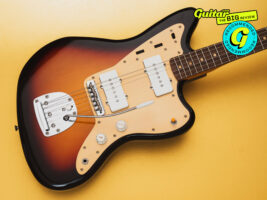
Fender Vintera II Road Worn 50s Jazzmaster review: “vastly improves the overall Vintera II package”
$1,699/£1,399, fender.com
Back in the good old days – aka the early-to-mid 2010s – I was working for another sadly now defunct guitar publication (RIP Total Guitar) when I came across a model that would change my perceptions of the Jazzmaster.
READ MORE: Fender Vintera II Road Worn 60s Stratocaster review – “this guitar is like spending time with an old friend”
Before then, I’d always been an outside observer of the offset. I’d always been enamoured with the shape ever since I saw Feeder’s Grant Nicholas strap one on back at the tail end of my teens, but as a dyed-in-the-wool Les Paul Guy I couldn’t mentally make the leap to a guitar with single-coil pickups and a weird floaty trem.
Then in the office one day landed the very first iteration of Fender’s Road Worn Jazzmaster. The very first Road Worn Strat and Tele – Mexico-made, nitro-finished and with factory-aged finishes – were the sort of guitars that looked great at a distance but up close you could really tell they were aged to a template and not by years of hard wear.
Sensibly then, when the Road Worn Jazzmaster arrived a year later, the wear and tear had been scaled back a bit to make it a bit less obvious, but that wasn’t the big deal for me. The looks still might not have fooled anyone, but the feel… man the feel.
The ‘old pair of jeans’ thing is cliché, but that’s the best way to describe it – here was a brand new electric guitar that felt in all the ways that mattered like it had been properly played in. It was a magical guitar that I still regret not buying on the spot (see also the very first MIM Cabronita Telecaster, IMYSM). One that fully turned my head to offsets, and now here we are a decade later and I can’t stop wanting the damn things.
All of which is to say that the 2020s redux – in the shape of the Vintera II Road Worn range – has a lot to live up to… let’s see how this goes…
Image: Adam Gasson
Fender Vintera II Road Worn 50s Jazzmaster – what is it?
You don’t need a Masters in cryptography to work out exactly what’s going on with the Vintera II Road Worn 50s Jazzmaster. It takes the original Vintera II 50s JM – the guitar that we called ‘the best Jazzmaster Fender has made in the last decade’, by the way – given it a coat of nitrocellulose lacquer and then gone all Time Team on the finish, the hardware and everything else.
Except, a decade or so on, and the factory-ageing landscape at Fender is a little different than it was back when the original Road Worns were a weird ol’ curio in a range of otherwise pristine shiny guitars.
Back then, the only way to get a Fender with a relic job was to spunk a small house deposit on something from Fender’s Custom Shop. Here in 2026, we have things like the American Professional Classic range – which adds very subtly aged lacquer finishes to Fender’s most expensive production guitars – and various one-offs from Fender Mexico (like the Mike McCready Strat) that set new benchmarks for what factory-aged guitars can do.
Which makes the vibe of this new Road Worn guitar rather interesting. In terms of the body, it’s a lot closer to those AmPro Classic guitars than the original Road Worns – there’s no faux-wear and tear to the finishes here at all aside from some very impressively done faux checking to the lacquer itself. You could argue whether the ‘Worn’ title really even applies anymore.
The rest is a bit more in keeping with the originals, however – the neck looks and feels very played-in, with some slightly artless grease and grime in the usual heavy traffic areas. The bridge, vintage-style tuners and trem also have a slightly grubby, dulled effect, which is again, on the artful side of ‘lost at the bottom of a lake for 50 years’.
It all has the vibe of a guitar that has been heavily used but still taken care of meticulously – potentially a bit of an anathema in the real world stakes, but the general vibe is very appealing in the flesh/alder.
Away from the cosmetics, this is every bit a Vintera II 50s Jazzmaster, complete with the love ’em or loathe ’em details therein. That means a 7.25″ radius, rosewood fretboard (with clay dots), vintage-style butt-adjust truss rod, and the vintage style Jazzmaster bridge with six threaded barrel-style saddles.
Image: Adam Gasson
Fender Vintera II Road Worn 50s Jazzmaster – build quality and playability
The thing that charmed me so much about that original Road Worn Jazzmaster was how comfortable it felt – and the new guitar captures that vibe once again. Removing it from its supplied hard case, it really does feel nicely played-in – something that’s further enhanced by the factory-rolled fingerboard edges and that nicely sanded C-shaped neck.
If I were being picky, I’d say that the fingerboard desperately needs a bit of lemon oil – the vintage tall frets are nicely installed and polished, but the ‘board itself feels a little dry, and while it’s not a playability-killer at this point, it would really would benefit from some refreshment.
The hardware might have some of the sheen taken off it, but it doesn’t impact its function – the tuners are smooth and stable, while the vintage-style floating trem has smooth and stable operation out of the box.
If you’ve spent enough time on the more offset-y corners of the internet, you’ll have heard knowledgeable and well-intentioned people explain that the stock Fender bridge with its threaded barrel saddles is perfectly usable and stable with a perfect setup and suitably heavy strings.
And maybe that’s true with vintage guitars, but I’m here to tell you that I’ve played a LOT of modern Fender Jazzmaster guitars with this hateful piece of hardware sat in the middle and not a single one has been fully immune from buzzing, rattling and strings constantly being pushed out of alignment.
Image: Adam Gasson
It’s absolutely bananas to me that Fender is persisting with this in the year of our lord 2026. I can just about forgive it in the obsessively vintage-accurate world of the American Vintage II line. But the Vintera range isn’t so slavishly tied to vintage specs, so you have to ask who is really asking for this bridge on a $1,500 guitar?
All it’s really doing is outsourcing the job of making your guitar usable in a real-world situation to you. Yes, replacing the bridge is an easy job – but why should we the consumer be on the hook for at least $50 for a Mustang-style bridge (or a lot more if you go down the Mastery/Staytrem route) just to not have the strings pop out of place whenever you strum a mildly robust E chord?
While I’m grumbling about this thing, a word or two about the aesthetics. Firstly, I don’t really understand why Fender seems convinced that everyone wants 50s-style Jazzmasters.
The company is surely aware that the definitive version of the Jazzmaster is the mid-60s version – they know it enough to make the AVII model a 1966 spec after all – so why can we not get a bit of that mojo in the Mexican range? We’ll even settle for ‘transitional’ guitars with Custom Colours and no block inlays or painted headstocks if it’s a cost thing, just save us from the underwhelming Fiesta Red/Sunburst Boomer dichotomy offered here.
Furthermore, as much as I appreciate a gold anodised guard on a Sunburst Jazzer, there’s no escaping that the scratchplate here feels shiny new to an illusion-breaking degree. Would a parchment or tortie guard not have worked better?
Okay, I’m really splitting hairs here, so let’s plug this thing in and have some fun.
Image: Adam Gasson
Fender Vintera II Road Worn 50s Jazzmaster – sounds
The sound of a Jazzmaster is one of life’s great pleasures, especially when plugged into a Fender amp with lashings of onboard reverb and tremolo – in this regard, the Vintera II lives up to the billing of its predecessor.
There’s warmth and clarity here courtesy of those big ol’ single-coil pickups, and with the brightness you’d expect from a good Fender guitar – but without the brittle nature that can plague some of its more popular siblings on the bridge pickup.
Take off the reins and add some fuzz or distortion to the party, however and that’s where things really get fun – it’s big, muscular and beefy, without ever veering into woolly territory (unless you accidentally hit the rhythm circuit, natch).
The much-maligned extra circuit on the Jazzmaster is often ripped out, but honestly, I think it does have a place – set the tone and volume controls correctly and it offers you an interesting fourth voice that can excel at well, rhythm, in the right context.
Image: Adam Gasson
Fender Vintera II Road Worn 50s Jazzmaster – should I buy one?
The big question with this Road Worn specimen is whether the cosmetic changes here justify the extra near-$400 outlay over the vanilla Vintera II. Personally, I think the overall improvement in both look and feel makes it worth the investment.
People will gripe and debate the merits of factory ageing until the heat death of the universe, but when it’s done as subtly and sensitively as this, the pros in terms of playing comfort vastly improve the overall Vintera II package.
What’s more annoying are the compromises you’re going to have to make along the way – the insta-swap bridge and the limited finish options being at the forefront of my mind in that regard. But these are minor issues in the grand scheme of things – this is an absolutely fantastic guitar, end of story.
[products ids=”UXwapbo8d1FF5n4EL48Tc”]
Fender Vintera II Road Worn 50s Jazzmaster – alternatives
If you can live without the nitro and the ageing, the regular Vintera II Jazzmaster ($1,309.99/£1,069) is a fantastic guitar for a lot less money, and has some serious discounts across the board at the moment – they’re regularly available for not much more than a grand right now. If you want something offset with more of a rock flavour, Epiphone’s new Futura Firebird looks a steal, while I’m very, very taken with Rivolda’s new stripped-down Mondata CC.
The post Fender Vintera II Road Worn 50s Jazzmaster review: “vastly improves the overall Vintera II package” appeared first on Guitar.com | All Things Guitar.
Source: www.guitar-bass.net