EHX Pico Atomic Cluster review – is this whacky and weird filter effect worth it?
$129, ehx.com
When you think of Electro-Harmonix, you may not think weird, at least, not weird effects. Magnetospheres and cigars aside, EHX’s sonic focus is for the most part gain and utility pedals. But every once in a while, the brand passes what we’ll call the “Chase Bliss Event Horizon” and makes something entirely dedicated to bleeps and bloops, the sort of pedal you’d see in an old Knobs review. The latest effort from EHX in this particular direction is the Atomic Cluster, a “spectral decomposer” – what does that mean? Let’s get into it.
READ MORE: Twilight Pulse Audioworks Konstante review – a dual dirt pedal that’s faster than the speed of light
What does the Atomic Cluster do?
The Atomic Cluster is, kind of, the filter equivalent of an arpeggiator. It isolates the component frequencies of your signal – the note’s fundamental and its overtones – and then rhythmically steps through them.
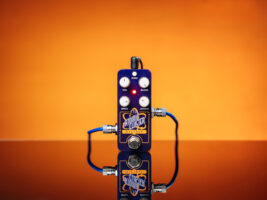
Controls include a volume and wet/dry blend, along with two knobs specific to this kind of effect: speed, which determines how quickly the effect steps through the discrete frequency bands, and atoms, which determines how many bands the pedal is chopped into. You also get a mode switch, which decides whether the transitions between the frequency bands are sharp and choppy or smoothed over.
These controls are packed into EHX’s pico form factor. There are undeniable benefits to the Pico platform, mostly in terms of saving pedalboard space – but you may find the controls fiddly to turn, and, as with all mini pedals, they can end up not saving quite as much space as you might hope, as ultimately you still need to leave room for patch cables, and to actually hit the footswitch.
Image: Press
Does the Atomic Cluster sound good?
My initial experiences with the effect are, sonically, pretty hard to square with anything anyone would want to use in any musical setting. In isolation, with an otherwise clean and dry sound, I find the Atomic Cluster fairly useless. The harsh filtering is just kind of unpleasant rather than interesting, and the steps between the atoms are pretty jarring, even on ‘smooth’ mode.
However, as the pedal works using overtones, it shouldn’t be too much of a surprise that putting a clean guitar sound into the front of the Atomic Cluster is going to be a tonal disaster. The signal that comes straight out of a guitar pickup has a strong fundamental compared to its harmonics – and so the resulting chopped-up sound, with the Atomic Cluster isolating these harmonics, is an unbalanced mess.
Hence, the next thing I do is get a distortion pedal placed ahead of it – this gives a more complex sound for the pedal to work with, a block of full-frequency sound to chop into slices. I then also turn on some reverb and delay – as well as helping evoke a more soundscapey vibe, these effects also help mask the crunchy artefacting from the digital filtering.
With these extra effects engaged, the sound is a lot more intriguing. It kind of sounds like my playing is being automatically accompanied by a weird, complex modular synth setup, pseudo-arpeggiating through the sounds of sustained chords. It does very little to augment the sounds of more traditional shreddy or bluesy playing, but you already knew that. Instead, I spend some time making loops and picking out some sparse, slow chord changes – the Atomic Cluster does indeed add a dimension of interest and depth in this musical mode.
As some people have pointed out in the comments of EHX’s official demo, the Atomic Cluster comes alive best on a synth, and indeed when I plug in a hardware synth I have a much easier time finding strange, crystalline worlds within its tonal universe. This isn’t too surprising, especially with more complex, multi-oscillator sounds, as these provide a fuller-frequency basis for the pedal to work with.
For guitar, though, it does feel like I at the very least need some compression, if not distortion, before the pedal to have it functioning properly – and indeed, this is actually recommended in the pedal’s manual. Which slightly begs the question as to why some compression or distortion weren’t included as part of the effect’s digital signal chain. Perhaps it would have brought the price up too much, or been too much of a lift given its miniscule form-factor and four knobs. However, we’re now in a world awash with all-in-one ambient-in-a-box pedals – which, even if they’re weird and unique effects, can function without too much help from a wider board.
And so the Atomic Cluster remains a difficult pedal to enthusiastically recommend to anyone other than EHX completionists, or those who are happy to compensate for its limitations. Sure, it’s a unique character effect, but it’s so unique and so characterful you may find yourself wrangling your playing – and your signal chain – to be in service of it. This can be cool for bedroom sound-scaping – but it’s a harder sell outside of that context. The good thing about it is its price – it is luckily not a lot of money for a pedal that needs a little signal-chain help.
Electro-Harmonix Atomic Cluster alternatives
The first thing it reminds me of is my dearly departed EQD Arpanoid, which is a more traditional arpeggiator that pitch-shifts your sound rather than slices it up. For a more in-depth and perhaps easier to use lo-fi filter thing, you’ve got a lot of options, of course, but the Old Blood Noise Endeavours Float comes to mind, being a controllable and weird set of filters.
The post EHX Pico Atomic Cluster review – is this whacky and weird filter effect worth it? appeared first on Guitar.com | All Things Guitar.
Source: www.guitar-bass.net