Blue FX Devices Fuzz Fields review – your new playground for modulated fuzzy adventures?
€349/£349 (€399/£399 with ‘It’), bluefxdevices.com
Fuzz pedals have been around for an awful long time – did you know there’s a MkII Tone Bender in the Bayeux Tapestry? – so it’s only right that modern makers should be playing around with the formula in search of something new.
READ MORE: DOD Badder Monkey review: much-memed pedal gets a bananas reissue
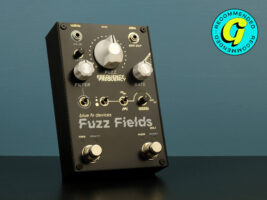
In the case of Blue FX Devices and the Fuzz Fields, that means combining JFET-based clipping with a synth-style filter section to create dramatically focused voicings, envelope-following swoops and – with a bit of external assistance – fuzzy tremolo, vibrato and phaser effects. You can see why it’s billed as ‘the ultimate modulated fuzz’.
Image: Press
Blue FX Devices Fuzz Fields – what is it?
This pedal is hardly a lip-smacker in aesthetic terms (and it isn’t even blue!), but it does present an appetising array of knobs and switches for those who like to get hands-on with their noisemongering. In fact, there’s so much going on here that I’m going to have to breeze through the highlights and let you check the online manual if you want the full picture.
Hit the bypass footswitch once and you’ve got a simple fuzz, controlled by the big knob in the middle. ‘Filter’ cuts treble to the left and bass to the right, with a toggle for mid-scooped mode, and ‘gate’ lets you get spluttery. Now hold down that footswitch for a second and you’ll engage the envelope follower, which sets the filter frequency to track the level of the signal coming into the pedal.
Image: Press
There’s more, including a bonkers self-oscillating feature that you can awaken with the left footswitch, but the only other thing you really need to know about is ‘It’ – an optional module that plugs into the CV input to give you the aforementioned tremolo, vibrato and phaser sounds with its depth and speed knobs.
Yes, the Fuzz Fields is a complex and potentially confusing piece of kit – and I really wish the status LEDs were further away from the switches, to stop them being obscured every time a foot comes near – but it takes less time than you might think to get the hang of basic navigation.
Blue FX Devices Fuzz Fields – what does it sound like?
If I had to cut this section down to a single word, that word would be ‘huge’. Two words would be the same preceded by an expletive. For Big Muff fans who like to bathe in oceanic fuzz, the scooped mode on this pedal is an instant triumph, but what’s really impressive is the way it stays just as smooth and pleasing with the mids pushed instead, and at virtually all filter settings. It’s a fluffy, cuddly monster of noise.
Image: Press
The envelope thing sounds great too – somewhat more complex and textural than the all-out swooshy arc of a typical filter fuzz – but let’s not overlook the gate, which can be used for subtle tone-tightening, full-on spitty squishing or classic on/off noise-killing. Gated fuzzes can be tricky to work with; this one somehow just does whatever you want it to do.
The left footswitch’s ‘gravity’ and ‘freq’ options are both interesting – the latter is the self-oscillating mode I mentioned earlier, and it can generate some truly wild octave-down glitching – but many players will prefer the more conventional modulation effects offered by the cute little module. These range from slow phasing to robotic ring-modulation, via some almost Hendrix-y Uni-Vibe pulses. If you can spare the extra pennies, you should definitely go for It.
Blue FX Devices Fuzz Fields – should I buy it?
There are clear reasons not to buy this pedal – mainly the price and the fact that it’s complicated, perhaps more so than it really should have been – but those reservations might just evaporate as soon as you hear what the Fuzz Fields can actually do.
The bottom line is, it sounds gorgeous. The added dynamic features are cool, but set those aside for a moment and what you’re left with is a big, sweet, grainy fuzz that’s up there with anything wielded by the venerated knights of ye olde rock’n’roll.
Blue FX Devices Fuzz Fields alternatives
This pedal’s two closest rivals might be the Collision Devices TARS (€332.50/£299) and Death By Audio Crossover Fuzz ($320/£329). The much cheaper Dreadbox Disorder (€123/£130) makes some wicked filter-sweep noises, while the Stone Deaf Rise & Shine (£218) offers a range of unique fuzz and tremolo tricks.
The post Blue FX Devices Fuzz Fields review – your new playground for modulated fuzzy adventures? appeared first on Guitar.com | All Things Guitar.
Source: www.guitar-bass.net