
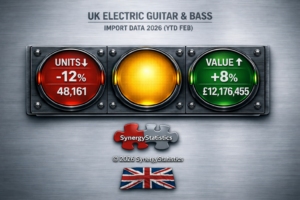
Knowing The Numbers – Electric Guitar & Bass Import Trends (YTD Feb 2026)
The electric guitar is undoubtably the foundation and the life support of our current MI market.
It has sustained the music retail sector over the last 20 years, whilst Keyboard numbers shrunk with the increased use of computers.
With all the demographic changes in music creation using AI and the demise of Bands in the mainstream of pop culture, it’s important to keep an in depth overview of what is happening to the market. Acoustic guitars will follow next week.
Imports of electric guitars and basses into the UK continue to show a structural shift rather than a short‑term fluctuation. Unit volumes have fallen 12 percent, extending the year to date pattern of contraction in the overall 92 cc market, where shipments were down 9%.
At the same time, total import value has risen 8 percent (the overall 92 category is up 6%) signalling that the category is increasingly important and is perhaps defined by higher‑priced and higher‑specification instruments rather than entry‑level stock. To support that proposition, the data shows that Chinese imports have been hardest hit.
This divergence between volume and value indicates that UK distributors are reducing exposure to low‑margin SKUs and prioritising instruments with stronger brand equity, and a more stable demand.
The shift also reflects broader supply‑chain rationalisation: fewer shipments, larger per‑unit value, and a more selective approach to replenishment.
- Volume contraction — possibly driven by reduced entry‑level demand and tighter retailer ordering. Perhaps the customer base is shrinking as it ages.
- Value growth — supported by premium brands, signature models, and boutique‑style imports. Perhaps the Older customer base has more disposable income.
- Market behaviour — retailers emphasise margin stability over broad SKU coverage.Increased retail overheads has increased the need for margin.
What This Means for the Market
The electric guitar and bass category is out of sync with the broader CC92 market in several ways:
- It is shrinking in volume while CC92 overall is stabilising.
- It is growing in value faster than the wider category.
- It is more dependent on experienced players, whereas CC92 benefits from a broader customer base.
- It is undergoing more aggressive SKU consolidation than the rest of the market.
In short, electric guitars and basses are becoming a leaner, more premium, more specialist‑driven segment, while the broader CC92 market remains more balanced and more volume‑sensitive.
Alan Greensall
Alan Greensall continues to be a prominent figure in the UK music industry, known for his long career in distribution, brand development, and market analysis.
He began his career in the music sector in the late 1970s, working as an Area Manager for Rose Morris (Marshall/Ovation/Takamine/Korg/MXR/Ludwig/Vox/Jupiter).
In the fall of 1984, he was poached by Roland UK, after achieving multiple top sales awards for RM.
He proved himself yet again in Roland, and was quickly promoted to UK Boss Sales Manager in 1987, and a few years later was appointed Roland UK Sales Manager. He also subsequently took over the role of UK MI Buyer. With Directorship roles on the cards, he was offered and decided to join Sound Technology, as the Managing Director, taking a team from the Roland Management team.
In the Sound Technology period, Alan played a key role in sustaining and developing several international brands in the British market, including Alesis, Taylor Guitars, Samson, EMAGIC, and G&L Guitars. The embryonic Line6 was a major breakthrough product that was nurtured directly by Alan. He later assisted in the setting up of the Line6 European operation.
This experience fuelled his passion for brand development in the UK.
In 2000, he founded Synergy Distribution, his own company, focused on distributing musical instruments and related products in the UK and Ireland.
Synergy was one of the first companies to develop a European strategy that enabled disadvantaged brands to expand into the UK.
Brands in that period included Engl, Gem/Lem, Lowden/Avalon, Red Sound, PJB, and Sandberg.
After a major medical incident, Alan reluctantly gave up distribution and shifted his primary focus to industry data and statistics. Alan had been uniquely successful whilst being the Chairman for Statistics & Trends, during his time as a Director of the MIA.
Alan now runs Synergy Statistics, providing detailed market insights, trends, and annual reports on the UK musical instruments (MI) industry—including all categories such as guitars, pianos, imports, and broader sector performance analysis.
His data is frequently cited in industry publications like Music Instrument News, and he shares analyses on platforms such as LinkedIn and Facebook.
He maintains an active online presence:
Alan has also contributed to industry oral histories, such as his interview with NAMM (National Association of Music Merchants), documenting his career and contributions to brand growth in the UK.
In summary, he is a veteran entrepreneur, former distributor, and current leading provider of statistical analysis for the British music gear market.
www.synergystatistics.co.uk
If you would like a more in depth historical report that will give full insight into the Guitar market, please get in touch.
Alan Greensall
The post Knowing The Numbers – Electric Guitar & Bass Import Trends (YTD Feb 2026) appeared first on Music Instrument News.
Source: musicinstrumentnews.co.uk