“It was just like my security blanket” Lamb Of God’s Mark Morton on his love affair with the Les Paul
The Les Paul may as well be in Mark Morton’s DNA at this point. The guitarist is 52 years old as of 2026, and he’s spent almost 30 of those years on the frontlines of heavy metal music, first in his university band Burn the Priest and then in its Platinum-selling, five-times Grammy-nominated successor Lamb of God. And, before those outfits even kicked off, he was lugging Gibson’s flagship model around.
READ MORE: “I play a lot harder than most” Kashus Culpepper’s guitar is a lightning rod for feeling, community and the sounds of the American South
“My first main guitar was a Les Paul Deluxe ’75,” Morton remembers, talking to Guitar over the phone from his home near Richmond, Virginia. “It was chopped up for PAFs and refinished – just a total beater! But I played it until the frets were flat. I was playing that guitar in punk bands all around town, just kind of dragging it around on the floorboard of my truck with no case. It was just like my security blanket.”
It was the simple things that made the model so appealing to him. It was comfortable to play, it was easy to access every part of the fretboard, and he was impressed with the sustain and reactivity. Beyond that, he didn’t overintellectualise it – and he still doesn’t.
“These are all very basic things that are still paramount for me, and I think for most players,” he says. “Some guitars are a little dull and flat. I think even then, despite having an unrefined understanding of instruments, I knew when something was jumping out, versus when something was dull and flat.”
Image: Gibson
Full Circle
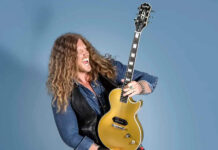
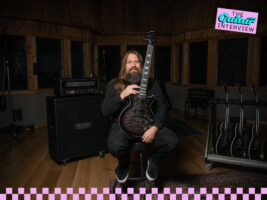
Even though he’s long since traded Virginia punk rock gigs for arena-size metal shows all over the world, Morton’s come full circle. He’s endorsed by Gibson after years with Jackson, and he has a new signature in the form of the Gibson Mark Morton Les Paul Modern Quilt. It’s true to his love for traditional Les Pauls: its slim taper neck helps with speed and comfort and evokes designs from the 1960s, and it uses passive pickups, as opposed to the active pickups that are a dime a dozen in the metal scene.
“I’m just a big proponent of passive pickups,” he says. “I said in an interview a while back that [Black Label Society singer/guitarist and longtime Ozzy Osbourne collaborator] Zakk Wylde is one of my favourite guitarists, and he uses active pickups, but I find passive pickups to be far more dynamic. I feel like it just allows for a more fluid voicing of the guitar than an active pickup does. When I play an active pickup, it sounds like the pickup, which is very consistent. But I always say, you could put that on a skateboard and it’s still gonna sound like that pickup.”
It’s not all old-school, though. Morton’s model is customised to the preferences and demands of a constantly on-the-road metal player. For starters, its mahogany body uses Gibson’s Ultra Modern Weight Relief.
“I’m in my 50s now and bouncing around onstage for as long as we do, it’s nice to have a guitar that’s a little bit lighter,” he explains. “But I can’t really moan when we’ve got [vocalist] Randy Blythe, who’s a year older than me, and he’s running around the stage like a lunatic and jumping off the drum riser and jumping off of amplifiers.”
Other standout features include the model’s namesake AAA quilted maple top, plus the Translucent Ebony Burst Satin finish, which makes it look sleek and suitably ‘heavy metal’ without seeming ostentatious. It has 22 medium jumbo frets to make bending easier, as well as a Modern Contoured Heel to help with upper-fretboard access.
“I find it to be pretty practical and convenient for soloing,” he explains. “It gives you easier access to the higher registers there. I can accomplish that without a heel contour, but it does make it nice and comfy. So that’s definitely one thing I do enjoy about this guitar.”
Lamb Of God. Image: Travis Shinn
Mashing Up
If it sounds as if this model is a mash-up of the traditional and the cutting-edge, then that’s good, because Mark’s playing is the same. Along with his Lamb of God cohort Willie Adler, he was one of 2000s metal’s freshest guitarists, laying down incredibly athletic leads that pushed mainstream heaviness forward. But, he’s said before that his greatest influences are actually in vintage blues.
“The cornerstone of my playing is classic rock and Southern rock and British blues and that kind of stuff,” he elaborates today. “When I’m playing for myself, that’s the kind of player I am, which is not a slight on heavy metal. I adore heavy metal, and I spend so much time playing it and writing it, and I just think it’s wonderfully expressive and dynamic and very technically challenging, but it’s not what I play when I’m in my living room. My first loves musically were the Allman Brothers and Jimi Hendrix and Jimmy Page.”
Morton was exposed to these artists – as well as Fleetwood Mac, Elton John, Aerosmith and 70s country – through his family, hearing his parents and his older brothers play them on the radio while he was growing up in James City County, Virginia. He remembers discovering heavy metal “probably around the advent of MTV, which would have been when I was 11 or 12”. By the time he was 14, he had friends who brought Metallica, Megadeth and Slayer tapes along when they hung out at his house.
“Even in our little town, there were [metalheads],” he recalls. “MTV had much of the same effect that you’d see the internet have later, whereby it was streaming this culture into areas that maybe otherwise wouldn’t have been exposed to it. It was right there on the TV! I found out about Motörhead in James City County, Virginia because of MTV.”
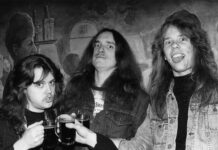
Then, Burn the Priest. Randy Blythe, who joined the band a few months after their ’94 founding and remained as they transformed into Lamb of God, has spoken before about how the band’s don’t-give-a-shit attitude is what inspired him to become their frontman. He tells a great story about seeing the police crash a house party they were playing, only for the members to refuse to put their instruments down. Was it as chaotic as it sounds like it was?
“It was more chaotic than it sounds like it was,” Morton answers. “We were, in every sense of the word, a punk band. Burn the Priest started in a mouldy basement. We really had no ambition to be some worldwide touring act. That would have been laughable to us, because it seemed impossible.”
Image: Gibson
Centre Stage
Nonetheless, they pulled it off. Lamb of God released some of the essential metal songs of the 2000s, with Laid to Rest and Redneck especially becoming MTV mainstays, and time has done nothing to dull the band’s jagged edges. Their new album – Into Oblivion, which features Mark’s signature guitar and its prototypes all over the place – is another stab to the jugular, laced with venomous lyrics and hellfire riffing.
“What we went to achieve with our records has largely stayed the same for us,” says Morton. “Lamb of God have established this long and in some cases very celebrated body of work over the decades we’ve been doing this. So to make a Lamb of God record, and call it a Lamb of God record and add it to that body of work, it has to feel to us like it’s worth doing, like we have something relevant to say. The process of making a record has to feel like it’s something we deem necessary to do for ourselves, for the five of us.”
He adds that whatever happens after an album’s release is out of the band’s hands, but one part of the process that Morton’s excited for is returning to the UK’s Bloodstock festival in Catton Park, Derbyshire in August. They’ll bring their new material, and Morton’s signature, for a headline set which will mark their third time at the top of the bill there. It seems like it’s become something of a home away from home for them.
“We’ve always enjoyed that audience,” Morton agrees. “It’s a very, very solid, through-and-through, metal-oriented festival. We haven’t really gotten into the production or the setlist or anything this far out, so we’ll have to see, but we will certainly give Bloodstock our best – and we expect the same from them!”
We finish by asking if Lamb of God have anything left to achieve, after the decades of dominance and now that Morton has his own version of the guitar he hauled during his underdog punk rock days. He doesn’t know. But, the band will continue for as long as it’s fun.
“We enjoy playing music together,” he says. “We’re all really close friends and we enjoy our time together. I feel like we don’t have a lot left to prove to ourselves or to anybody else, and at this point, we just do it because we enjoy it and because it’s fun, and because we feel like we’re good at it.”
Lamb Of God headline Bloodstock on 6-9 August. Find out more at bloodstock.uk.com
The post “It was just like my security blanket” Lamb Of God’s Mark Morton on his love affair with the Les Paul appeared first on Guitar.com | All Things Guitar.
Source: www.guitar-bass.net