Why do guitars have pickup covers and what do they actually do to your tone?
Walk into any guitar shop and you’ll see them everywhere: the chrome and nickel domes capping humbuckers on Les Pauls and 335s, the white plastic rectangles on Strats, the open zebra coils on countless modern superstrats. Pickup covers are one of the most visible parts of an electric guitar, and yet the question of what they actually do – beyond looking pretty under the stage lights – remains weirdly contentious. It’s one of those many tone myth rabbit holes that litter the guitar tech landscape.
READ MORE: Answered: what’s the point of a guitar’s string tree anyway?
Some folks insist a cover muffles your highs and robs your tone of any bite. Others swear they can’t hear a difference and have the blind tests to prove it. The truth, as it usually does, sits somewhere in the middle, and it depends a lot on what those covers are made of and the pickup that is underneath them.
A Bit of Pickup Cover History
The covered humbucker is essentially a Gibson invention. When Seth Lover designed the PAF in the mid-50s, the metal cover wasn’t a stylistic flourish – it was there to shield the coils from electromagnetic interference and to keep dust, sweat, and the occasional drop of beer out of the works. Nickel-plated covers came standard on Gibson humbuckers from the late ’50s onwards, and they’ve remained a defining visual cue of the format ever since.
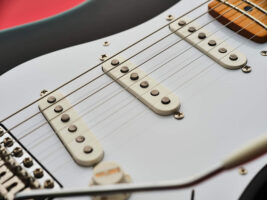
Single-coil covers, like those on a Stratocaster, by contrast, were mostly about practicality. Leo Fender’s plastic squares on the Telecaster and Stratocaster do almost nothing electrically – they’re protective shells over the coil, full stop. Anyone telling you a Strat cover meaningfully alters tone is most likely trying to sell you something. So the tone debate really lives with humbuckers, and specifically with what alloy is wrapped around them.
Material Matters More Than You Think
Most vintage-style humbucker covers are made from nickel silver, sometimes called German silver. Despite the name, there’s no actual silver in there. Nickel silver is actually an alloy of copper, nickel, and zinc with very low magnetic permeability.
Because nickel silver is barely magnetic, it doesn’t significantly disturb the magnetic field generated by the pickup’s magnets and pole pieces. Slap a nickel silver cover over a PAF-style humbucker and the tonal difference is very minimal – it’s measurable on a frequency analyzer if you’re patient, but usually invisible in a mix.
Brass, on the other hand, is highly conductive, and when you place a conductive sheet inside a fluctuating magnetic field, you induce eddy currents. Those eddy currents bleed off energy, and the energy they pull from the pickup’s signal disproportionately comes from the higher frequencies. The result is a noticeable softening of the top end. Chrome-plated brass covers, which became more common when nickel prices climbed, are part of the reason some players felt their guitars sounded duller after a re-cover job.
Gold-plated covers are usually plated over either nickel silver or brass, so the tonal character depends entirely on what’s underneath the plating. A common mistake is assuming a gold cover sounds different from a nickel one – it doesn’t, unless the base metal is different.
The “Covers Off” Question
Jimmy Page, Peter Green, Eric Clapton – the guys chasing more presence and aggression out of their PAFs claimed that taking the covers off and exposing the coils gave them a bit more clarity in the upper midrange.
If your humbucker has a nickel silver cover, removing it might give you a perceived bump in air and openness, but it’s subtle. If you’re peeling chrome-plated brass off a budget pickup, the difference can be more obvious. Either way, we’re talking about shifts of maybe a couple of dB in a fairly narrow upper-treble band – not a complete transformation. Anyone claiming their tone was completely overhauled by removing a nickel silver cover is either listening through a hi-fi rig in a dead-quiet room or hearing what they want to hear.
The Microphonic Problem
A humbucker cover that isn’t properly seated and wax-potted to the pickup beneath it can squeal like an angry kettle when you crank the gain. The cover becomes a microphonic resonator, picking up vibrations from the body and amplifying them through the coils. Original PAFs are notoriously prone to this because Gibson didn’t consistently pot the assemblies in the early days.
Modern manufacturers – Seymour Duncan, DiMarzio, Bare Knuckle, Lollar – almost universally wax-pot covers onto their pickups now, which is why you rarely hear about feedback issues from a stock guitar.
So Why Bother With Them At All?
Setting the aesthetics aside, covers protect the coils from the slow corrosive grind of gigging life. They provide a degree of electromagnetic shielding that helps in environments full of fluorescent lights and dodgy dimmer switches. They keep the pickup assembly physically stable, especially on older designs where the bobbins aren’t bonded to the baseplate. And, yes, a polished nickel cover on a flame-top Les Paul looks fantastic.
The reality, despite what you read in forums, is that pickup covers do alter tone, but the magnitude of that alteration is almost always overstated. A nickel silver cover on a quality humbucker is essentially transparent. Brass is where the real high-frequency loss lives, and that’s a story specific to certain pickups and eras rather than a universal rule. The cover-versus-no-cover debate is mostly a question of taste, looks, and tradition rather than a meaningful tonal decision. These days, if you’re opting for no covers, it’s probably an aesthetic choice, and there’s nothing wrong with that.
If you’re thinking about pulling the covers off your humbuckers in pursuit of a sound, do it because you like the look of open zebras or double-blacks, not because you’re expecting a revelation.
The post Why do guitars have pickup covers and what do they actually do to your tone? appeared first on Guitar.com | All Things Guitar.
Source: www.guitar-bass.net