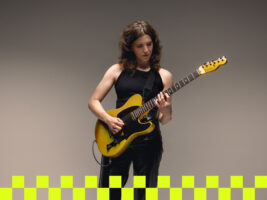
“As it’s associated with the beginnings of the development of the electric guitar, it’s iconic – and the players that use them are iconic” – Gina Gleason on 75 years of the Telecaster
Gina Gleason is one of heavy music’s great Telecaster advocates. Her unconventional outlook on tone fits well within the mutable approach Baroness takes to heaviness – with an origin story as the band’s lead guitarist that’s as unique as the band’s music. She joined Baroness in 2017, after a stint playing guitar for Cirque Du Soleil. She became fast friends with frontman John Dyer Baizley over their shared love of weird fuzz pedals – and it wasn’t long before she joined the band full time.
READ MORE: “It was just like my security blanket” Lamb Of God’s Mark Morton on his love affair with the Les Paul
When she joined, she was quick to adapt her gear approach from the shreddier side of things to suit the Baroness tonal palette – single-coils, weird fuzz tones, and pedal-friendly combos. And far from leading to a softer touch – this unique approach lets the band push the boundaries of heavy music into further and stranger places than ever before.
Image: Press
Why the Telecaster?
“I was always a fan of the Telecaster sound – just the pure brightness of it, and, from my early days of being interested in the guitar, the musicians that played Telecasters. Growing up my dad loved Elvis more than anything – so I was exposed to a lot of James Burton’s guitar playing from a really young age.
“I’ve also had the same guitar teacher since I was a teenager, and I still take lessons with him to this day. His name’s Yanni Papadopoulos, and he lives in Philadelphia. He’s got a great band called Stinking Lizaveta. He exposed me to some really great players when I took lessons from him – like Danny Gatton and Jimmy Bryant. I remember trying to learn a Jimmy Bryant piece as a teenager, and was just blown away by the effortlessness of his alternate picking.
“In my mind, I also drew this parallel between players like Jimmy Bryant, who had these insane alternate picking chops, and this ability to incorporate chromaticisms and reality fast licks, and these other guitarists I admired like Dimebag and like Randy Rhoads – these total shredders that sort of had this otherworldliness about their playing. Those folks that played Teles – they were reflective of the other players I loved in metal, from a chops perspective.”
Image: Press
What informed your own unique approach to ‘heavy’ tones?
“I think the breakthrough moment for me was, about 12 years ago, I was working as a musician for Cirque du Soleil, doing 484 shows a year – and it was Michael Jackson’s catalogue. So I had access to the isolated guitar tracks to learn the songs and emulate the sound with a Fractal.
“And something about listening to Eddie Van Halen’s isolated solo on Beat It – I was like, oh, it’s not that distorted – it’s pretty clean! I just started thinking about the perception of heaviness and distortion, and how more gain does not always equal heavier – almost the opposite.
“The more you can pull back the gain, it’s almost like your sound can kind of bloom in a way that takes up space, and gives a different perception of volume – that’s kind of what I feel brings a lot of heaviness to a sound. It’s the same with Baroness – it’s not just about what sound can be louder, it’s more about adding dynamics in a broader way, thinking more about frequencies, not just pure volume.”
Image: Press
How did your gear approach change when you joined Baroness?
“When I joined Baroness, John was playing a lot of G&L guitars – an ASAT Classic and a Bluesboy. And I was bringing this Jackson DK2M Dinky, this late ‘90s Jackson that I still play to this day – and a Kramer SM-1, which has a really similar body shape – pointy headstock, humbuckers, Floyd Rose, the whole thing. And I just felt it wasn’t suiting the vibe.
“At the time we were touring the Purple album that had just come out the year before. And to me, Baroness was a band that always had a lot of experimental tones and textures, with tons of layers. John was really interested in figuring out how we could explore that on a deeper level in the live settings. And I’m really into tone chasing – pedals are kinda the whole reason John and I met, through a mutual friend that made fuzzes.
“So, yeah, I think just that really early stage of sort of auditioning for the band. I was like, I want to have the right gear for this. Yeah. And I found a used – I think – ‘92 ASAT classic at a local Sam Ash, because again, I had always been fascinated by that style of guitar, and Baroness was my opportunity to get one.”
What’s your go-to Tele now?
“My go-to Telecaster is the American Pro I, from I think 2017 or 2018 – it’s just a really comfortable neck, and I like how the pickups are voices. It’s got a lot of brightness and presence, and I like how it sits in a mix with John’s rig, which is something I try to think about a lot. You want to have a cool sound that inspires you, but you also have to think about the whole picture, the full mix of your band.
“So I tend to try to think about that stuff – if we’re playing a harmonised lead and John’s on the neck pickup, I’ll try to make sure I’m on the bridge, and vice versa. It’s a way of complementing your bandmates’ sound, and making sure the live performance and presentation is as dynamic and as engaging for the listener as possible.”
The American Pro I Tele is a pretty traditional spec, rather than one built with more traditionally “modern metal” appointments.
“I like the three-saddle bridge because it makes me think of a more classic setup. It is slightly more tedious when you’re intonating it – but I like the feel of them. There can be a little bit of an imperfection sometimes when you’re really whaling on things, but I still just want that classic Tele setup.
“Fender is amazing at constantly innovating and coming up with new solutions and things to suit different players – like the 75th anniversary model, the American Ultra in Liquid Gold, it’s got a neck profile that’s almost like a Jackson’s, and those incredible pickups – I think all that stuff is awesome. But for me, I really like a more classic setup.”
With that more traditional guitar setup and an analogue pedalboard, how do you approach amps and headroom?
“I started with really low headroom when I first joined the band, and have kind of upped it through the years. Now I’m playing a Bassman reissue – and I also like having a Princeton in my rig. That’s not got a lot of headroom, but I like the way it breaks up – I never really have it past three, maybe four, so it just gets the slightest amount of breakup, as I’m not driving it super hard. Sometimes I’ll use a Fender Twin – not so much if we’re travelling, but for recording they’re great. John, when I first joined the band, he was using a Princeton and a Deluxe, and he’s since changed up so that he’s got a Roland JC-120, which is a great high-headroom amp for pedals.
“And actually, for some stuff I was recording at the Fender factory, I was using one of the 5150 EL34 heads – given I didn’t have my usual pedalboard, I thought that would be the most dynamic thing, to cover some more country licks to more chuggy playing. And I did end up picking one of those up for myself…
“The classic Tube Screamer-into-5150 – that is an incredible sound. But especially with John’s songwriting tendencies, and the way he voices chords – it’s arranged so there’s a lot of impact when we come together, because we’re playing different things a lot of the time. Gear wise, our more dynamic approach helps the power of that impact a lot of the time. You don’t want to be on a 10 the whole time.”
Image: Press
Is that related to how Baroness views the complex mix of metal genres that gets pinned on the band?
“Working with John is amazing for a lot of reasons, he’s one of the most inspiring people I’ve ever been around. And something that I perceive as being important to him is that he doesn’t want to be told what kind of music he’s making – I think his tendency is to just do the opposite of whatever somebody’s telling them that they think he is creating, or whatever space people think he’s creating in. So we definitely try to avoid some of those genre touchstones if we’re setting out to make something.”
You’re still taking lessons with Yanni – what are you working on at the moment?
“A few years ago I linked back up with him because I hadn’t lived in my home city of Philadelphia for a few years. So we started jamming together and going over licks and stuff like that, and then a couple of years ago, he was like – it’s time for you to start learning the real book. So we just’d go through these standards and look at transcribing, and how to solo over them or make accompaniments – and that has been the most helpful breakthrough as a guitar player that I’ve maybe ever had.
“I also teach lessons, so I try to express the importance of transcribing, you know – I’m not by any means a jazz guitar player, or really even in that world – but I do really like looking at it from that perspective of outlining chord progressions and finding things that complement them. So I’m really grateful to have a teacher to work through some of that stuff with – and we play out, too, he’s got a jazz trio, so I’ll sit in with those guys. That’s been invaluable.”
Why do you think people are still playing Telecasters after all of these years?
“It’s iconic, and because it’s associated with the beginnings of the electric guitar, the players that use them are iconic. For me, there’s just something that works about them. Particular when it comes to comfort – depending on the tour we’ll do a two-and-a-half or three-hour set! So it’s that, and my visual sensibilities. When I see certain crazy-looking guitars, it doesn’t do the same for me. Maybe if Chuck Schulinder is playing it, I want to hear that – but not for me!
Find out more about the 75th Anniversary of the Telecaster at fender.com
The post “As it’s associated with the beginnings of the development of the electric guitar, it’s iconic – and the players that use them are iconic” – Gina Gleason on 75 years of the Telecaster appeared first on Guitar.com | All Things Guitar.
Source: www.guitar-bass.net