Boss XS-1 Poly Shifter review – all the magic of the XS-100 in a smaller, smarter format
$209.99/£198, boss.info
Hey, have you ever considered that maybe you’ve got too many effects pedals? One answer might be to sell some of them – ha, imagine! – but another way to make more space is simply to get smaller ones. Boss knows this, and that’s why the XS-1 Poly Shifter exists.
READ MORE: Boss XS-100 Poly Shifter review – even better than the squeal thing?
Launched alongside the powerful but slightly enormous XS-100, this is the same kind of multi-function pitch-shifter, powered by the same all-new algorithms, but offered in the standard Boss form factor that’s been ruling stages since the 1980s. So… perhaps you’ve got room in your life for one more pedal after all?
Image: Press
Boss XS-1 – what is it?
By all means have another quick read through my review of the XS-100, because the basics are unchanged (plus I really like the line about the elephant). But here’s a mini-recap anyway: with these two pedals, Boss is making a play for the market currently dominated by DigiTech and its Whammy range of pitch-manipulators. You can shift up or down, from a single semitone to a multi-octave interval, you can blend that sound with your dry signal, and you can also select ‘detune’ mode for more subtle chorus effects.
Obviously the bigger unit has an expression treadle, plus a screen for navigation (including presets) and the option of stomping between two different intervals – none of which is present here. For the record, the maximum interval has also been cut from four octaves to three; but seeing as a three-octave leap is still more than any human could possibly find a genuine use for, that hardly qualifies as a compromise.
Image: Press
Boss XS-1 – is it easy to use?
This being a Boss pedal with two knobs and two switches, it couldn’t be any easier to use unless it had arms that stuck out of the sides and played the guitar for you. We’re talking real ‘don’t bother with the manual’ stuff here, and that’s quite a change from the logical but multi-layered operation of the XS-100.
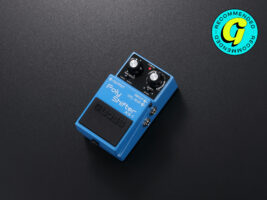
The first knob controls the balance of the output signal, from all dry to all pitch-shifted; the second controls the shifting interval, which can be anywhere between one and seven semitones (ie: a fifth), or one, two or three octaves. The little toggle switch below that selects up, down or the detune option, while the one on the left lets you set the footswitch to latching or momentary mode. And that really is everything.
Image: Press
Boss XS-1 – what does it sound like?
When it comes to the sounds, it’s all about the algorithms – and so this part of the review could almost be a direct copy of what I wrote about the XS-100. The crucial part is that the latency is impressively low and the processed tones are impressively pure, with barely a hint of the digital scratching and crackling that you might associate with pedals of this type.
The available effects can be divided into four broad categories: down-tuning for baritone-style metal riffing; up-tuning for a virtual capo and/or impossibly high widdling; blending in an up-octave for an approximation of a 12-string sound (you’ll want the balance at around 10 o’clock for this); and blending in any interval for tight-tracking harmonies. Oh, and that’s not counting the detune effect, which is much easier to access here than on the bigger unit thanks to that dedicated switch. It sounds really rather nice in an 80s kind of way, and can be adjusted using the two knobs.
The one thing you can’t do, of course, is Whammy-style soaring and swooping, which depends on foot control… but there is an input for an expression pedal, so even that isn’t completely off the table. Make sure you’ve got one that’s Boss-friendly, though: my Moog EP-3 normally gets on great with every stompbox it sees, but it sounded all sorts of wrong with this one.
Image: Press
Boss XS-1 – should I buy it?
By now the reasons to buy into Boss’s new XS range should be clear: put simply, it’s got the best algorithms. So if you’re after purity and realism above all, then this has to be the first name on your shopping list.
That just leaves the question of which model to get. The XS-100 is a chunk of fun for sure, but I like the XS-1 a lot more. It’s got all the features you need – compatible expression pedal permitting – plus it’s far cheaper, it’s easier to use and it takes up much less space. Just don’t blame me if you end up buying three more pedals to fill the gap.
Image: Press
Boss XS-1 alternatives
The DigiTech HammerOn ($299/£219) is one of three compact pedals in the Whammy family, and offers up/down shifting plus lots more besides. A simpler option is the Electro-Harmonix Pitch Fork ($198/£169), and a more complicated one is the full-size Boss XS-100 ($349.99/£299).
The post Boss XS-1 Poly Shifter review – all the magic of the XS-100 in a smaller, smarter format appeared first on Guitar.com | All Things Guitar.
Source: www.guitar-bass.net