DOD Badder Monkey review: much-memed pedal gets a bananas reissue
$149.99, digitech.com
It has now been a few years since JHS’ Josh Scott gave the invisible hand of the free pedal market a little push, and accidentally kickstarted a craze for the original DigiTech Bad Monkey. Reverb listings for the pedal soared to stratospherically silly prices, and the presence of true magic within it was hotly debated. There were those who claimed that the Bad Monkey was a better Klon than some Klons. There were also those who claimed that all of these comparisons were proof that most overdrive pedals can be set to sound pretty similar.
READ MORE: Neural DSP Quad Cortex Mini review: “this is the most universal Quad Cortex yet”
Regardless, talk of a reissue was inevitable, one that might fit into the lineup of a newly-reinvigorated DOD/DigiTech – and here we are. First things first, this is a DOD reissue of a DigiTech pedal, presumably because it’s an analogue stompbox, and Cor-Tek (parent company of both) now wants to keep things consistently and sensibly divided – DOD dedicated to the analogue, DigiTech the digital. It’s also, as we’ll explore, more than a straight ‘reissue’ – we could have gotten a simple four-control remake of the original circuit, updated to modern spec with a better buffer and a less dated enclosure. That’s all here, but there’s a lot more to unpeel, including a totally unique barrel control that can blend together three discrete variants of the circuit.
Image: Adam Gasson
Build and layout
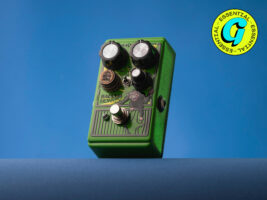
The Badder Monkey is packed into the standard DOD single-stompbox format, used for everything from the Overdrive 250 to the Carcosa. It’s a really sturdy platform, with a solid build and a cool little reversible backplate if you want pre-attached velcro. The only real negative for some might be the side-mounted jacks, but overall it’s still a well-executed version of the standard single-stomp.
The Badder Monkey does look uniquely great. The barrel draws the eye, of course, but the UV print on the enclosure is also brilliantly glossy and very three-dimensional – I have to give a nod to the design execution on the titular Monkey bending the bars of an otherwise abstract control outline, labels included.
Even discounting the barrel, the full control scheme is pretty whacky – for good or for ill. If you thought the Supermassive Black Fuzz’s control scheme was ‘theme over function’, it shows Boss-like restraint compared to the Badder Monkey. Here Bananas and Curiosity are gain and volume, while Mood is a concentric EQ control – Screech and Grunt for treble and bass, respectively.
I can see the logic on the EQ side, but Bananas and Curiosity do seem totally arbitrary – you’ve just got to remember that gain’s on the left and volume’s on the right. These knob names are unusually whimsical for DOD – even its other strongly-themed pedals such as the Carcosa or Chthonic still have knobs called things like “output” and “high cut” rather than “Eldritchness” or “Cyclopeanity”. But it’s only a slight knock against the pedal, really – it’s clearly having a lot of fun with the whole vibe, and so themed control names were perhaps inevitable.
Image: Adam Gasson
In Use
I first stay a little more conventional, and begin my testing with only the original Bad Monkey in the mix. This circuit is, as you may or may not already be aware, essentially a Tube Screamer-derived thing with the addition of a two-band active EQ. By itself, it is very easy to see why this gained status as a hidden gem from the early 2000s – that original slightly clunky enclosure was indeed hiding a fantastic overdrive sound.
Thanks to the two-band EQ it is as full or as sharp as you need it to be, and still allows the core sound to provide the all-important midrange presence. Like any good TS-inspired thing it can bring a clean amp to life as well as it can clear up gainy chugs. More extreme EQ settings behave as you’d expect – feel free to remove all the bass and pretend your guitar’s coming through an Amazon Basics walkie-talkie, or remove all of the treble and pretend you’re playing it underwater.
The real beauty, though, lies in the pedal’s versatility within the context of a full sound. You can target problem areas of both fizz and mud far more effectively than you could with a single tone control. These are all of the things that made the original so ripe for a modern revival, and so in terms of a straight-ahead reissue, DOD has absolutely done the job. But of course, like those well-meaning activists at the beginning of 28 Days Later, it is now time we open the cage and let the Badder Monkey run truly rampant.
Image: Adam Gasson
Barrel of fun
Did you know that the phrase “more fun than a barrel of monkeys” dates all the way back to the 1800s? The phrase, along with a few other interesting things, has led to a sort of vague general association between monkeys and barrels within the collective unconscious. Imagine, if you will, a whimsical pirate ship. There’s obviously a monkey there, who has likely poked his head out of a barrel, one full of either gunpowder, gold doubloons or bananas. And before you write in, Donkey Kong’s love of throwing barrels at plumbers doesn’t count as part of this association, as he’s an ape, not a monkey, and as such will not be mentioned again in this review.
The Barrel/Monkey continuum also brought us that children’s toy with loads of plastic monkeys in it, a copy of which is actually included as case candy with the Badder Monkey. It has also spawned the new 360-degree barrel control, a patent-pending continuously-rotational potentiometer that is employed to blend between three variants of the circuit: Behaved, Bad and Badder. Behaved is a smoother, more tonally subdued variant of the pedal, while Badder is a more chaotic and aggressive version – Bad is simply the original circuit.
With all the talk about how a lot of overdrive circuits can sound nearly identical, here the trio of circuits do all have a very distinct flavour. Behaved is indeed very subdued – there’s a noticeable roll-off to any barking high-end, and there’s a fair bit less gain. Badder, however, lives up to its name with a far more aggressive approach to both the distortion and the midrange hump.
The fact that the barrel is a three-way continuous blend control means you can choose your preferred blend of any two of the three circuits on offer – which is, for an analogue pedal, a completely wild thing to be able to do, and has to be commended from a pure engineering standpoint. But it does also offer real tonal flexibility: the three voices, while all ultimately being variants of a very green-flavoured overdrive, are all disparate enough to make the in-between positions worthwhile – for instance, blending both Behaved and Badder gives you a very smooth overdrive sound with a subtle undertow of snarl somewhere beneath the surface – it’s a very effective thing.
If you want to throw all subtle blending to the wind, however, just use the middle toggle switch to select ‘troop’ mode, which engages all three circuits in parallel – the resulting sound is extremely full-fat – it may not perform quite the same with the exacting tone-shaping precision as a single or a blended sound, but it is a hell of a lot of fun.
This switch can also set the blend to be out of phase, which leads to a rather weird but nonetheless engaging sound – it makes the effect far more of a character overdrive for adding an ear-catching texture to solos, more so than pure utility. It’s a strange experience, sweeping through the middle positions in the inverted mode, leading to a sort of infinitely variable clash of the different characteristics of the circuits.
Image: Adam Gasson
Should I buy the Badder Monkey?
It’s hard to overstate just how much joy the Badder Monkey brings me – DOD didn’t have to do any of this. It didn’t need to be a whacky, three-mode reissue with a totally unique blend control and the option for nasal out-of-phase sounds and an included copy of Monkeys In A Barrel. This could have been an easy win – but DOD took the stranger, far more creative path. The initial furor around the DigiTech pedal strayed a little close to the sun of discourse, and risked just being frustrating and draining as people bemoaned the hype and the hipsterishness of it all – this is the perfect inversion of any of the phenomenon’s negativity into something far more joyful.
All that has been discussed above is interesting enough, tonally and experientially, that you might assume it’s relegated to some exclusive boutique overdrive that’ll require a remortgage or two. And given the price silliness from the first spike in demand plus the barrel, DOD could have also probably gotten away with charging something like £200 for this thing. But the Badder Monkey is instead pretty damn reasonably priced at £129 – that’s not much over the going rate for a new official TS9, and about £100 less than the JHS Bonsai, another multi-circuit Tube Screamer-inspired pedal, albeit with a very different approach.
The Badder Monkey is also one of the few fun Tube Screamer-derived things out there – the circuit has such a reputation as a utilitarian tone-scalpel that it tends to evaporate any whimsy in its vicinity. The Badder Monkey, on the other hand, is more fun than a… well, you know the phrase.
Image: Adam Gasson
Badder Monkey alternatives
The world of Tube Screamer-derived things is fairly massive, with everything from ultra-affordable clones to more in-depth boutique variants out there. Listing them all here would balloon the wordcount of this review to that of the Silmarillion, and so I shall mention but two. If you fancy something a little more budget and prosaic, there is always the Ibanez Tube Screamer Mini ($79.99 / £49.99), a far cheaper single-mode version of the green overdrive sound. For another well-regarded refined boutique take on the thing that won’t break the bank, consider the EarthQuaker Devices Plumes ($119 / £124.99) – a straightforward take on the pedal with three clipping modes.
The post DOD Badder Monkey review: much-memed pedal gets a bananas reissue appeared first on Guitar.com | All Things Guitar.
Source: www.guitar-bass.net