
Galahcore FX Ploverdrive review: focused boutique overdrive can help a board take flight
After a short break in our series taking a look at some of the choice offerings from NotPedals.com, we’re returning to the shelves of that ever-so-cool small builder marketplace to take a look at the Galahcore FX Ploverdrive – an interesting overdrive pedal with some uniquely Australian aviary inspiration.
READ MORE: DOD Badder Monkey review: much-memed pedal gets a bananas reissue
The Ploverdrive is inspired by the masked lapwing, AKA the spur-winged plover. It’s an Aussie bird that’s known for defensively swooping at anything or anyone that threatens its nest – even, in some cases, airplanes. This aggressive territorial control is aided by its spurs – sharp outcrops of bone on its wings’ carpal joints that can make a curious cat’s day a lot worse.
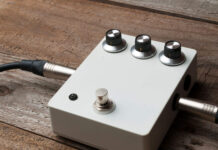
In all it’s a good basis for thematically mapping onto an overdrive pedal, as the heart of the unit is the Spur control – a highly interactive tone control that gives the Ploverdrive a lot of its character. I’ll get onto the specifics of its functioning in a moment. The Spur control is joined by the more standard and self-explanatory gain and volume controls, with no other switches, leading to a pretty straightforward three-knob drive format housed in a 1590bb-sized enclosure adorned with some gorgeous art by Conrad Keely of the band …And You Will Know Us By The Trail Of Dead.
Build quality, along with the quality of the art’s printing, is top-notch – component selection tends towards the sturdy and the high-end. Jacks connect with a satisfying and firm clunk, and the potentiometers offer the kind of resistance that indicates a quality part. Everything else is all pretty within the remit of a ‘standard’ pedal – mono, 9V pedal power, so it’s time to plug in and get going.
In use
When I first fire up the Ploverdrive, I happen to have the Spur control all the way ‘down’ and the gain all the way up. There are few better ways to wake up in the morning – the Spur control, a little like a RAT’s filter, is wired ‘backwards’, in that anticlockwise means a brighter, more focused and more resonant sound. Combined with the higher gain setting its a very punchy sound indeed, and per the manual is voiced more for brightening up a neck pickup.
On the bridge pickup that brightening effect is a little too effective, but on the neck humbucker of a Telecaster Deluxe the Ploverdrive does indeed add a lot of clarity – impressive given that this is a pickup that can quickly overwhelm a gainy amp.
Rolling the Spur all the way to the soft, fluffy, not-yet-flying-baby-bird side of the dial, and things get more interesting still. Here you’ll find the basis of a great sound for warm, wooly leads – the sound is very rounded, no matter the pickup, and does invite some more singing, Claptony style playing – here, higher gain settings accentuate its smooth, sustaining character, rather than the sonic stabs of the less friendly side of the Spur control.
And speaking of gain – there’s a lot of it! We’re still firmly in overdrive territory here, it’s no HM-2, but atop a relatively clean sound from a Marshall-style amplifier, the Ploverdrive can add a decent amount of thick saturation by itself. However, in backing off the gain control and setting the Spur to something less extreme, the sound remains very characterful and perhaps shines a more flattering spotlight on the operation of the Spur control. The amount of volume on tap can absolutely invite the front end of your amp to the party too – which is always a good combo with a mid-gain overdrive that manages to keep things dynamic. Set right the Ploverdrive will be extremely honest as to how hard you’ve hit your strings.
But enough restraint – doesn’t this bird attack airplanes? Setting the Ploverdrive back to its aggressive stance and feeding it into a more gainy amp, even more avenues for Ploverdriven goodness open up. The slightly resonant ring to the brighter side of the Spur control means that for “chugging” it may not be the most ideal pedal – through faster playing your ear does tend to latch onto the more static factor of that resonant beak. Er, peak.
However, if you put a more generic metal sound out of your head for a moment you get an excellent tone for clanking noise rock in the vein of The Jesus Lizard and Shellac. The sharpness of the more extreme settings becomes a feature not a bug if you play it right – and the fact that the pedal remains dynamic the whole way up the gain lets you still express yourself through it, but the fact that its EQ curve is very much not flat and transparent remains a boon for this kind of music.
Should I buy a Ploverdrive?
Overall the Ploverdrive is an affordable but creatively-designed pedal that is easy to learn, and hard to master, in a very good way. The spur and gain controls are quite interactive with each other, and so I was still finding new sounds within the thing days into my testing. And that’s not to mention that it very much won me over by coming with a nanoblocks model of a bird, which, you know, more pedals could stand to do. If you like an overdrive that’s ready to make its presence known with an aggressive caw and an ambitious swoop at a Cessna, you won’t be disappointed in the Ploverdrive.
Check the pedal out at notpedals.com.
The post Galahcore FX Ploverdrive review: focused boutique overdrive can help a board take flight appeared first on Guitar.com | All Things Guitar.
Source: www.guitar-bass.net