Gretsch CVT review: a cult classic reborn as a stripped down rock machine
$419/£499, gretschguitars.com
As this week’s cover story explained in more detail than I’ve got room to go into here, the Gretsch Corvette is something of a unique proposition in the world of electric guitars. Here we have a solidbody electric design that was created during the Golden Era of American electric guitar manufacturing, by one of the most beloved and famous brands of that time that hasn’t been done to death.
READ MORE: From vintage oddball to alternative classic: the Gretsch CVT’s remarkable journey
Let that sink in – despite the Corvette having found its way into the hands of literal icons like Jimi Hendrix and Rory Gallagher, this is a guitar that’s still under the radar. We live in a time guitarists are so desperate for the big brands to offer them something – anything – outside of the same half a dozen shapes that we’re seeing 70s landfill like the RD Artist and Starcaster get revived to huge fanfare.
Which is all to say it’s remarkable it’s taken Gretsch so long to get here. It’s been nearly 20 years since Gretsch first added an Electromatic Corvette into the line-up, and half a decade since it was discontinued. In that time, however, we’ve seen multiple signature models that speak to the design’s enduring appeal and outsider chic – for Fall Out Boy’s Patrick Stump, guitar-toting rapper G. Love and most importantly Bleachers frontman and Taylor Swift mega-producer Jack Antonoff.
That guitar – technically branded a Princess, the Corvette’s short-lived little sister – is perhaps the most important piece in that puzzle. When that guitar dropped last year, people promptly lost their collective shit – as did I, frankly – and I don’t doubt that the resounding reception that guitar was given has fed into the revival of the Corvette into the line proper, albeit with a new name: the CVT.
Image: Adam Gasson
Gretsch CVT – what is it?
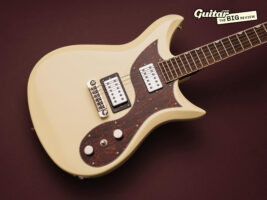
Pithily, it’s a Corvette without the vowels, innit? But on closer inspection there’s actually a fair bit here that explains why Gretsch felt the need to give it a new name altogether. For starters, when you put a classic Corvette next to the CVT, you’ll notice that the body has been subtly tweaked for reasons of both form and function.
Most notably the body is about a centimetre thicker than the original, while the carve on the sides has been lessened – you don’t get those SG-like edges here. The top horn has also been made a little stubbier than the original design, which makes the guitar look a little more stocky and aggressive – personally I think it’s a bit of a glow up, but your mileage may vary.
And there are more big changes outside of the cosmetic stuff. Most notably, the CVT is a bolt-on design rather than a set-neck – something that Gretsch says was done to take some of the low-end fuzziness out of the guitar’s all-mahogany build. The scale length is the same 24.6 inches as all the Gretsch Jets – so it’ll feel a little more compact than a Gibson but not really noticeably so. The headstock has also been tweaked – swapping the paddle-like original for a pointy ‘Falcon’-style option. The best compliment you can give it is that you’ll instantly assume it’s always been like that, as the shape compliments the body’s lines much more naturally.
Elsewhere you’ll find a pair of Gretsch’s Twin Six humbuckers and a no-fuss intonatable wrapover tune-o-matic-style bridge. As someone who absolutely loves Filter’Trons, I always think it’s a shame when Gretsch puts more generic humbucking pickups in its affordable guitars, but given the CVT’s hard-rocking target market, it probably makes sense. The humbuckers eschew any Gretsch switching eccentricity in favour of a simple three-way toggle with shared volume and tone controls.
Image: Adam Gasson
Gretsch CVT – build quality and playability
Even if you weren’t aware of the changes to the CVT’s body depth, you’d probably notice it when you heaved the guitar out of its box. This is no Les Paul in terms of its weight, but my example tipped the scales at very nearly 8lbs. Now, for most people, that’s perfectly acceptable, and you probably wouldn’t have a sore shoulder after gigging this all night. However, it was still heavier than I expected, and heavier than it looks like it should be – something that’s exacerbated somewhat by a lot of that weight seemingly focused on the bottom of the guitar. It’s not enough to make it feel unbalanced, but I still felt a pull to that end more than I’d like on the strap. It’s probably not helped by the baffling choice to stick the top strap button under the horn – just put it on the back!
That asides though, you really do have to remind yourself that this guitar barely costs $400. The build, fit and finish is absolutely flawless all over – I couldn’t find a single mark, rough edge, oversprayed finish or untidy assembly anywhere, and removing the scratchplate reveals a very tidy and unfussy wiring job too.
The neck profile is what Gretsch calls a ‘Performance C’ and it’s very comfortable if a tad generic. It won’t please the baseball bat aficionados, but it strikes a nice balance between giving you something to grip onto when you’re chugging away at the bottom end, without compromising the performance when you want to get a bit widdly up top. Speaking of which, the carve on the heel, while not removing the inherent chonk of a bolt-on arrangement, definitely makes those upper-fret excursions more comfortable than it would be otherwise. With very little to go wrong here, it’s perhaps no surprise that the tuning stability is rock solid, but you should never take it for granted – many a great guitar has been hampered fatally by an inability to stay in tune, and given this guitar’s rock-oriented persuasion, it needs to be able to take some heavy handed punishment and stay the course.
Image: Adam Gasson
Gretsch CVT – sounds
Unplugged resonance is always a great bellwether of an electric guitar’s overall performance, and again things are really encouraging here – it’s bright, snappy and lively. There is some minor string buzz on the D string when played open, but it’s probably a price worth paying for an action that is low and slinky.
In addition to its famous signature adherents, Gretsch is clearly aware of the brand’s growing popularity with artists at the heavier end of the spectrum and it’s hard not to see the CVT as a direct response to that.
That’s certainly the case when you plug in – these Twin Six humbuckers are pokey, to say the least. They will snarl with almost any encouragement and positively lap up gain – be that smooth overdrive, glitchy fuzz or indeed heavier slabs of crushing distortion. What’s really impressive is that they don’t ever get muddy or wooly with this – the extra midrange bump offered by that bolt-on is clearly doing its job here.
The bridge pickup is a riff monster, with power and clarity that makes short work of heavy chugs, arpeggiated chords and rapid powerchords. The neck pickup has that chewy, thick quality that a mahogany solidbody neck humbucker should have – adding some delay and reverb to a driven tone offers impressive sustain and clarity, again without ever getting too dark and messy.
You’ll notice I started talking about the gained-up sounds out of the gate and there’s a reason for that. When you’re dealing with a sub-$500 twin-humbucker solidbody, you know it’s likely to not be the most inspirational instrument for cleans, and so it is here. These aren’t bad sounds – there’s still that clarity and midrange punch to make them perfectly usable, especially if you’re running it into some good reverb and delay pedals – but there’s a definite lack of character to the unvarnished tonality.
Image: Adam Gasson
Gretsch CVT – should I buy one?
The most exciting thing about the budget end of the guitar market in recent years is how interesting and diverse it has become – gone are the days where if you wanted something with a pair of humbuckers in it for under $500, your choices were Les Paul, SG or maybe something pointy.
The CVT slides into this market with a confidence and focus that befits a design that has technically been around almost as long as some of the icons that its rubbing shoulders with here. It’s easy in the guitar world to naturally equate old with good, but there’s something authentic and classic about the Corvette shape, modified though it is here, that gives the CVT an extra bit of kudos and credibility.
It looks good, plays good and – provided you’re not buying it purely for the clean sounds – it sounds great, too. A new heavyweight contender in the budget rock guitar world has arrived.
Gretsch CVT – alternatives
If you want a Gretsch guitar that sounds a bit more, well, Gretsch-y then the G5220 Electromatic Jet ($579) sports more classic Broad’Tron pickups. If you want an affordable hard-rockin’ electric that’s a little more lightweight, Epiphone SG Standard ($599) is lot of guitar for the money – it’s not hard to imagine that the SG was on the mood board when Gretsch was designing the original Corvette too. Yamaha’s Revstar Element ($599) is another twin-bucker double-cut solidbody that stands out from the crowd – they’re killer guitars for the money too.
The post Gretsch CVT review: a cult classic reborn as a stripped down rock machine appeared first on Guitar.com | All Things Guitar.
Source: www.guitar-bass.net