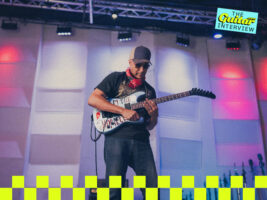
“It was the crappiest guitar I’d ever played!” how a disastrous guitar purchase became Tom Morello’s most important instrument
It’s late 1986 – possibly early 1987 – and a young Tom Morello is crestfallen. The young guitar player has just moved to LA having graduated from Harvard to pursue his dream of becoming a musician.
To aid him in his quest, he’s splurged on a proper professional musician’s tool – a custom guitar from LA’s own Performance Guitar USA. Luthier Kenny Sugai had made guitars for Frank Zappa, Joe Walsh and Steve Vai, and Morello envisioned his new instrument as the vehicle he could use to follow in the footsteps of his shred guitar heroes. But there was a problem with the finished article.
READ MORE: The story of Tom Morello’s ‘Arm the Homeless’ Guitar
“It was the crappiest guitar I’d ever played!” Morello exclaims today. “Everything about it was terrible. It was devastating, because it was not inexpensive, and I had a very, very limited budget.”
Morello was understandably crushed that he’d invested so much time and money and ended up with a dog, but on reflection the Rage Against The Machine icon can shoulder some of the blame for the situation.
“I custom ordered but I had no idea what I was doing!” he admits. “But I had sort of a lack of humility? I thought, ‘Well, I guess it’ll be an ebony neck or whatever.’ I didn’t know what I was talking about! ‘What sort of fret size do you want?’ I was making these random guesses. So, in some ways, it’s no surprise that it ended up being a poor guitar.”
At this point, Morello didn’t even have a band, let alone a record deal – he was working various low-paid jobs (and even as an exotic dancer) to keep his LA dream alive. He didn’t have the luxury of simply buying another guitar – he had to try and make this one work.
Image: Fender
“Over the course of the next couple of years, I changed everything except for the body wood,” he explains. “So it was multiple different pickups, different whammy bars, and so many different necks… Finally, the neck that I settled on is one that I found in a used neck bin in a store on Santa Monica Boulevard – it’s not any brand at all, it was just kind of an odd neck!”
But try as he might, Morello still couldn’t fully get the guitar to do what he wanted it to, and eventually he had to accept that no amount of tweaking and modding was going to change that.
“This was probably 1988 or so, and I was practising in my little rehearsal space in East LA,” Morello recalls. “I was so frustrated with my amp and with the guitar. It was really taking up a lot of my time swapping out necks, swapping out pickups and electronics and whatnot. Then one day I spent three or four hours trying to get the best out of it, and I could not get the sound I wanted. So, I just gave up and I said, ‘This is my guitar. I’m not going to think about it anymore. This is my sound. I’m just going to create with what I have. I’m going to stop whining and start making music.’”
The moment of acceptance would be transformative for both Morello and the guitar – instead of trying to force the guitar to be the shred-ready instrument he dreamed of, he evolved his approach to the instrument in a way that would change the course of guitar music.
“And that’s the sound that became my sound,” he reflects. “I stumbled into my signature sound in that way. And that guitar has ended up being a great ally for all these years. I’m confident that if I hadn’t made those mistakes, and then gone on that journey of Frankensteining this thing together, that I would have had a much more mundane 80s metal sound. Which is what I was looking for rather than this one.”
Image: Fender
Arms Around The World
That “awkward stepchild” of a guitar would go on to become one of the most iconic instruments in rock. Morello would scrawl the words “Arm The Homeless” across the front of it and use it as his primary guitar as Rage Against The Machine became one of the most important and influential bands of their generation, with Morello’s radical approach to guitar virtuosity reaching heights of creativity and individuality that few have reached since.
Now, Fender has teamed up with Morello to create a meticulous replica of the Arm The Homeless guitar – it’s the second collaboration between the two, following the release of his Soul Power Strat in 2020. The Soul Power guitar was at least originally a Fender guitar that Morello heavily modified for use with Audioslave… the Arm The Homeless guitar is a dramatically more esoteric instrument.
“And the question was, could we do it?” Morello explains. “Because while the Soul Power guitar was made of component parts that existed in the world, and the Arm The Homeless guitar is a guitar from the island of misfit toys, y’know? It is an amalgamation of a bunch of BS parts and pieces that I put together through the years!”
Despite this, Morello was adamant that there was no point in creating an instrument that had his name on it but wasn’t a precise reflection of what he used.
“I challenged them,” Morello says of the artisans at Fender’s Custom Shop. “I said, we’re not going to do this unless we can make it exactly like the Arm The Homeless guitar. And after a lot of work, and after many, many iterations of it, they got it right. And it’s awesome.”
Image: Fender
It ended up being such a process in no small part because of the endless tweaking, swapping and modding that a young Morello did to try and make it into something he could use – the parts bin graphite neck being perhaps the most unique and nebulous example.
“Because the feel of that neck is what led to a lot of the riffs,” he adds. “The Arm The Homeless guitar is the guitar. It’s the Bombtrack guitar. The Bullet In The Head guitar. Know Your Enemy, Fistful Of Steel, Bulls On Parade, People Of The Sun, Sleep Now In The Fire, Vietnam, Down Rodeo, Guerilla Radio… it’s the guitar that I’ve played at every show from 1987 to a couple of days ago. And so it was about getting every bit of it right.”
The guitar’s components were a different kind of challenge, in part because Morello exploited their eccentricities to make his unique sounds.
“The Gotoh whammy bar is the one that I finally settled on, in part because of its imperfections,” says Morello. “I liked how the bar loosened after a while. It’s not something you would normally look for, but it allowed me to create some of the helicopter effects. But the nut of the guitar doesn’t match the neck and the bridge in a way that it would on a guitar that was put together correctly!
“But the totality of the chemistry of all of those misbegotten pieces has led to the instrument that has been my companion in the studio and on stage for over 30 years. And I wanted to get it exactly right. And we did.”
Image: Fender
Settle For Nothing
While it was important to capture the physical dimensions and visuals of the original guitar of course, the stuff that’s under the hood was equally – if not more – important to nail down. Like the original, the new Arm The Homeless guitar sports a pair of active EMG pickups, but while most assume that we’re looking at a pair of humbuckers, the neck unit is actually a stealth weapon.
“That neck pickup is a single-coil pickup, disguised as a humbucker,” Morello explains. “And that springiness and the elasticity of that sound – and how it matched with the ferocious rhythm section of Rage Against the Machine – is really kind of like the secret sauce to making those songs as heavy and as funky as they are.”
Another vitally important component is the toggle switch that Morello used to unlock so many revolutionary sounds – given the punishment that toggle takes, it had to be an aircraft-grade component.
“The toggle switch is key!” he exclaims. “Because if I’d had a regular Gibson toggle switch or whatever, it would wear out right away! So, we put the toggle switch that I use in these, which is kind of an everlasting toggle switch. It took quite a while to find something that was going to be able to put up with the beating that it takes.”
As with Morello’s previous Fender signature guitar, there’s also a charitable aspect to the Arm The Homeless – and a fitting one. Proceeds from each instrument will go towards supporting the work of Midnight Mission in Los Angeles, and Covenant House, a charity that helps homeless teenagers across the US.
“It was important that in making a guitar that has spent so many decades on the front lines, fighting for the oppressed and fighting for justice, that there be a justice component to this as well,” he adds. “While this guitar is made up of scraps and shards, to get it just right is not necessarily an inexpensive process. And so I want to make sure that there’s a Robin Hood component, where when you purchase this guitar it does filter back into people who really need it.”
Image: Fender
Back In Black
It’s been a busy year for Morello on many fronts, but perhaps nothing was quite the logistical undertaking as Black Sabbath and Ozzy Osbourne’s poignant Back To The Beginning farewell show in July. Morello took on the role of musical director for the remarkable occasion, which brought together an unprecedented line-up of heavy metal talent.
“It was such an honour to be asked to curate that show and be the musical director,” Morello enthuses. “Firstly, because of how much Black Sabbath and Ozzy Osbourne have meant to me in creating the genre of heavy metal that made me love music. But secondly Ozzy introduced Randy Rhoads to the world. That was the poster that was on my wall when I was practising eight hours a day. I named my first born son Rhoads!
“So I owe a great debt, a great personal debt, not just a musical debt to Ozzy and Sabbath. The day was over a year in the making. And I really, I gave it my all. I was like, if I’m going to do this thing, we’re going to try to make it the greatest day in the history of heavy metal.”
Morello acknowledges that the sad and unexpected passing of Ozzy just weeks after the final show adds extra “resonance” to the experience, but reveals that the significance of the event was palpable even without its tragic post-script.
“It really felt like such a beautiful celebration of that band, that man, that music, those fans!” he reflects. “I don’t think that there’s any precedent for a band being able to be feted like that while they’re alive and be able to perform. They got to feel the love of all those bands who they created. They got to feel the love of all of the city where they were born. They got to feel the love of millions of fans around the globe who watched it. And then they got to give that love back and let people know how appreciative they were.
“Y’know, for a band whose origins were all this kind of evil doom and gloom. At the end of the day, the message of Black Sabbath was one of global love. So, it was really special and just was honoured to be a part of it and to be able to both play at it and to have a hand in creating it.”
Image: Fender
Twin Peak
Morello was performing that day with the OG Arm The Homeless guitar in hand, but it turns out that such is the success of his signature model, that might become something of a rare occurrence going forward.
“I feel very comfortable using this guitar, in place of the real Arm The Homeless guitar,” says Morello. “This is the guitar I take out now. I love it. I feel very, very comfortable. The last Canadian run, this is the guitar that I played with. I played a couple shows around town lately, and it’s interchangeable.
“The real Arm The Homeless guitar, let me tell you, it has certainly done its duty. But it’s in the studio. It’s always ready – it’s still going to come out for special occasions.”
Morello admits that even his own son struggled to tell the difference between the original and Fender’s replica, but there is one very subtle telltale difference…
“If you look closely, you can tell,” he notes. “Because a dog chewed the headstock of the Arm The Homeless guitar at some point in the past. And we did not recreate because I did not think that was important to the sound! But you will always be able to tell the real one because it’s been chewed!”
Image: Fender
With two Fender guitars under his belt then, the question turns to the potential of doing a third, with the guitarist’s famous “Sendero Luminoso” Telecaster an obvious choice. “There’s a Fender Telecaster that I played on a few songs that we might be looking at…” he says coyly – watch this space, then.
The evasiveness is perhaps not entirely about whetting appetites for future releases – more than most, Morello seems to take the responsibility of signature guitars very seriously.
“This is a real big deal for me,” he agrees. “For the entirety of my career, I never did any instrument or product endorsement. Because it always felt to me a little weird when I was a young guitar player, that with each new album cycle, some of my favourite artists would be hawking some new guitar that had nothing to do with the songs I liked! And so I was always a little shy of that process.”
With signature guitars, pedals and even plugins under his belt, that has obviously changed in recent years – but with a clear condition: “I want to be able to stand behind stuff and say, ‘This is exactly my sound’,” he insists. “This is exactly the thing. I care about it so much that it’s really real!”
The Arm The Homeless guitar is clearly a labour of love for all involved then, and while it’s by no means an affordable instrument, you sense that it had to be this way in order to capture the magic that still captivates Morello to this day.
“It is the guitar that, for me, opened brand new avenues of ways of looking at music, of creating sounds that I had never heard before,” he elaborates. “There’s a special magical power in that crazy combination of parts that should not have gone together, that I’m hoping people will be able to use to write their own new songs, their own new musical chapters.”
Find out more about the Tom Morello Arm The Homeless guitar at fender.com
The post “It was the crappiest guitar I’d ever played!” how a disastrous guitar purchase became Tom Morello’s most important instrument appeared first on Guitar.com | All Things Guitar.
Source: www.guitar-bass.net