
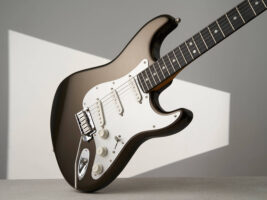
“Leo Fender was a technician who admired function and ease of manufacturing; he was not an artist”: LSL Instruments and Fender trade barbs in legal letters
Last week, shockwaves were sent through the guitar industry when it was claimed that a German law firm working on behalf of Fender had sent cease and desist letters to other builders demanding they stop making Stratocaster-style guitars.
At the forefront of the discussion has been US boutique maker LsL Instruments, the only brand to have currently gone public to confirm it has allegedly received the letter from Fender’s lawyers.
LsL publicly pledged to resist Fender’s alleged attempt to make them stop producing Strat-bodied guitars, and now Guitar.com has seen what is claimed to be the brand’s formal response to Fender’s lawyers, and also a letter that appears to be a response from them.
The letters – which have been widely reported online – appear to firmly lay out both sides of this alleged argument, and offer some wider context for what might happen next.
What kicked all this off?
(Photo: Adam Gasson/Guitar.com)
If the original Fender cease and desist letter is legitimate, this chain of events was started when Fender won a default ruling against Chinese-based company Yiwu Philharmonic Musical Instruments Co in the Düsseldorf Regional Court in Germany.
The win was significant because it defined under EU law that the Stratocaster body shape was not simply a trademark, but a “copyrighted work of applied art”, that could be policed like any other copyright.
The default judgement – which came after Yiwu failed to turn up to court – only covers guitars made or sold in the EU, but given that LsL is a US-based brand, the alleged C&D would imply that Fender is attempting to enforce the ruling on any maker that sells instruments inside the European Union.
The letter, which Guitar.com has been unable to independently verify as legitimate, demanded that LsL stopped producing Strat-bodied guitars, to hand over sales data regarding these instruments, to recall and destroy any infringing instruments, and pay damages. The letter also offered concessions on some of these points if the recipient agreed to stop making the guitars.
What’s happened now?
Image: Adam Gasson for Guitar.com
LsL was the only company to publicly claim they’d received the letter, and in a statement to Guitar.com as well as posts on a blog, they vowed to fight back against Fender’s alleged attempt to enforce this ruling, and set up a GoFundMe to help with legal costs.
On Tuesday, (26 May) LsL Instruments issued a scathing and in-depth riposte to Fender’s alleged letter – refuting both the substance of Fender’s claims, as well as the legitimacy of their actions.
Notably, the letter was authored by Ron Bienstock – the US lawyer who has been involved in numerous guitar industry trademark cases over the years, most notably representing the consortium of brands that successfully lobbied against Fender’s attempt to trademark the Strat, Tele and P-Bass body shapes in 2009.
Furthermore, Guitar.com has now also seen a copy of a letter allegedly from Fender’s lawyers – now reported extensively online – that pushes back on much of what Bienstock wrote in his 16-page response.
What does LsL’s letter claim?
Bienstock’s response on behalf of LsL is as detailed as you’d expect from someone who has huge experience litigating trademark cases in the music industry – and especially his experience of successfully arguing for the generic nature of the Strat, Tele and P-Bass body shapes 17 years ago.
A core plank of Bienstock’s argument is that the default ruling against Yiwu Philharmonic in the Düsseldorf Regional Court does not bind LsL, which is based in California and as such is not directly subject to German law.
The letter also claims that in order to secure the default judgement, Fender “misrepresented” the history of the Stratocaster’s design to the court, and the role that Leo Fender played in the creation of the instrument.
The letter alleges that Fender “invented” the story that Leo Fender was the “sole author” of the Stratocaster design, and that “there were at least four additional collaborators in the design”. Furthermore, the letter alleges that Leo Fender’s famously utilitarian and practical approach to functional design means that the guitar can’t be considered a work of applied art.
“This collaboration is well-documented, as is Leo Fender’s infamous attention to function, manufacturability, and repairability, but not aesthetic design,” the letter goes on. “FMIC’s own Justin Norvell, President, Americas, has even acknowledged Leo Fender’s now infamous quote, ‘If I have $100 to make a product, I’ll spend $99 making it work and $1 making it pretty.’”
As such, LsL asserts that Leo Fender was “a technician who admired function and ease of manufacturing; he was not an artist.” Because of this, plus the fact the Stratocaster had meaningful design contributions from “Fred Tavares, Bill Carson, Rex Gallion and George Fullerton, among others”, LsL says “the facts do not fit the necessary narrative to achieve [Fender’s] goal of obtaining a copyright for a portion of a guitar in any jurisdiction”.
Bienstock also alleges that Fender was negligent in policing its own trademarks for decades, leading to many other brands to utilise and evolve the design.
“Regardless of whether [Fender] ever gained intellectual property rights to the Strat body shape,” Bienstock asserts. “It certainly cannot now claim after the reproduction, distribution and communication to the public by hundreds of guitar companies by their use of that same body shape for over 70 years that any exclusivity can be had as to the alleged “applied art” of the Strat body shape,” it says.
“[Fender] has forfeited its claims of ownership of any intellectual property rights via express abandonment, acquiescence, and passivity.”
He also claims that other brands have played a big part in making the Strat an iconic design – noting the use of the shape on non-Fender guitars being used by legendary artists. It also notes that after he sold Fender and its designs to CBS, Leo Fender himself continued to make instruments using the Strat body at Music Man and G&L.
“Competitive guitars were ubiquitously displayed on television, in movies, on the internet and were being played by some of the most influential musicians of all time, such as Eddie Van Halen, who played a Charvel Strat-style guitar and later a Kramer Strat-style guitar. Thus, the Strat shape grew in popularity among the general buying public,” Bienstock claims.
What has Fender said in response?
Image: Adam Gasson
For the first time since this story broke a week ago, Fender has publicly acknowledged the situation. In a statement to Guitar World, the brand’s position and ultimate goal in this case has been clarified.
“Fender fully supports innovation and competition across the guitar industry, including such guitars with two horns and/or double cutaways,” the statement reads.
“Fender’s goal is simply to protect one of the company’s most iconic and recognisable designs while continuing to support a vibrant and innovative guitar industry.”
Separately, Guitar.com has also obtained a response letter that appears to be from Fender’s lawyers to LsL’s most recent communication.
Unsurprisingly perhaps, the letter disagrees that Fender misled the Düsseldorf court regarding the history of the Strat, noting that they, “took great care in making sure that all our factual representations in our action were accurate”.
“The Court of Düsseldorf then formed its view on whether the Stratocaster qualifies as a ‘work of applied art’ under the circumstances put forward by us in our action. The panel which handed down this judgement is probably the most experienced panel in questions of ‘works of applied art’ in Germany at the moment, and arguably also in all of Europe.”
While defending the legitimacy and robustness of the ruling and their right to seek to enforce this on LsL and other brands, the letter appears to also lay out the detail of what Fender allegedly wants these builders to do in order to stave off further legal action.
“All that is required and expected from third-party manufacturers of Stratocaster clones is that they change the design of their electric guitars sufficiently so that they do not look like more or less exact copies of the Stratocaster anymore,” it reads.
“We think that this should be acceptable for everyone, as it should not impair the quality of their instruments, but would only require relatively minor design changes.”
Perhaps the most interesting and potentially impactful part of the alleged letter is a claim that while LsL have obviously taken the route of loudly and publicly pushing back against the apparent cease and desist letter, other brands have taken another route.
“Many of the addressees of that initial communication have reached out to us in the meantime, often via their German lawyers, and have entered into reasonable settlement discussions on the premise that they will discontinue making and/or selling the “Stratocaster” clones,” it reads. “This proves that there is not a unanimous refusal from all third parties, but indeed also a great deal of understanding for our client, which however of course is not covered in the media, on social media and in the discussions between the various makers.”
So what happens next?
In the alleged response from Fender’s lawyers, it is claimed that the company has extended the deadline for brands to agree to its terms to 8 June 2026.
Judging by the content of their initial response, it doesn’t seem like LsL is inclined to settle any time soon:
“We hereby demand that you withdraw the entirety of your claims as stated in Your Letter,” Bienstock writes. “Our client has every right to continue to sell its guitars with Strat-style guitar bodies, whenever and wherever it so chooses, as does the entire MI industry on a worldwide basis.
“Efforts by Your Client to bully competitors based on misrepresentations and overstatements are anti-competitive. If Your Client continues to pursue these matters, Our Client will, of course, seek all available remedies, including all attorneys’ fees and costs.”
Fender declined to comment further on this case when Guitar.com reached out.
The post “Leo Fender was a technician who admired function and ease of manufacturing; he was not an artist”: LSL Instruments and Fender trade barbs in legal letters appeared first on Guitar.com | All Things Guitar.
Source: www.guitar-bass.net