Poly Effects Trails review – probably the world’s most inspiring multi-effects pedal
$399/£399, polyeffects.com
The Poly Effects Trails is for people who want something different – like, really different. Well, why put up with the plinky-plunk of a silly old electric guitar when you can have swirling bells, unearthly voices, or something that sounds like a terrible accident in a sewage tunnel?
READ MORE: Buyer’s guide to the best compact multi-effects: sound-shifting units from Neural DSP, BOSS & Line 6
This peculiar little box is the latest pedal from the Australian company behind the fabulous Ample digital amp simulator. It can be beautiful, scary, and often both at the same time. But it can’t be ordinary.
Image: Richard Purvis
Poly Effects Trails – what is it?
Oof, can’t we start with an easier question? Because I still don’t really know what the Trails is – maybe nobody does. But I can say it’s not a modulation pedal, or a lo-fi delay, or a glitchy microlooper… though its skill set does include, in one form or another, all of those things.
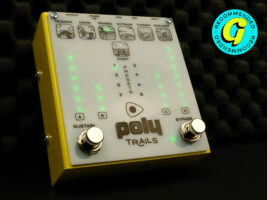
At its heart is a set of seven effect categories, selected by the touch buttons with cute pictures along the top. They’re all very different, and each one comes with eight editable factory presets. So that’s your starting point… now all you need to know is how to actually work this thing.
Image: Richard Purvis
Poly Effects Trails – is it easy to use?
It’s quite understandable to be sent into a panic by the fact that the Trails doesn’t even look like an effects pedal. But honestly, it’s fine. Take some deep breaths, stroke your imaginary cat three times, then focus on the four columns of LEDs across the middle (A to D) and pretend they’re knobs – because, effectively, they are. This is Poly’s signature touch interface, where dragging a finger up and down is the equivalent of knob-twiddling, and the LEDs – colour-coded for different effect types – indicate the current position.
Yes, it’s odd and takes some getting used to – particularly as it can be hard to see the LED that’s underneath your fingertip – but it’s a smart system, and there’s a colourful manual in the box that makes everything clear, including what those four ‘knobs’ do in each mode.
Beyond that, there’s a second footswitch for infinite sustain, the option of true stereo output using a Y-cable, and MIDI for changing presets remotely.
Poly Effects Trails – what does it sound like?
I think the best way to tackle this – describing the indescribable – is to go through the seven modes and try to give a flavour of what each one is doing.
Meadows is up first: a sitar-like effect that creates blooming sympathetic resonances with an element of randomised movement. You can change the structure and density of the virtual sympathetic strings, as well as the wet/dry blend and resonant pitch. It’s supremely musical, it can sound stupendous in stereo, and it’s a hell of a start.
Haven has similar qualities in terms of resonance but goes in a more bell-like direction – making it even prettier if anything – and then we take a sharp left turn into Prairie, an interesting mix of delay and vinyl-style filtering, complete with (optional) pops and crackles. After that comes Outback, and this mode is surely inspired by the didgeridoo, creating vocal-like filter shifts that can sound like a talk box at high speeds or a uniquely grainy phaser when slowed down.
Tundra is a pitch-shifting delay that gets gloriously glitchy if you freeze it with the sustain switch then start messing with the time and pitch controls; Badlands is described as “a very brutal distortion” but is really something much more strange and vicious than that suggests; and we finish with Coast, arguably the most conventional effect on offer here – a granular texture generator with control over the blend, grain size, wave shape and density. This is another one that demands to be heard in stereo.
A couple of minor issues need mentioning – I found the sustain switching to be noisy in some modes (but not in others), and the touch buttons sometimes needed tapping more than once to respond – but of course it’s the sounds that matter most, and they are consistently awesome.
Image: Richard Purvis
Poly Effects Trails – should I buy it?
Each one of these effects is a playground for unorthodox soundscaping; the fact that you’re getting seven of them in the same compact box makes the Trails a hell of a secret weapon. The only question – given that it’s not a cheap pedal – is whether you’re intrepid enough to take on this gnarly sonic wilderness.
Poly Effects Trails alternatives
There aren’t really any alternatives – that’s the point. But other pedals that mess with the ambient soundscape formula include the Hologram Chroma Console ($399/£486), Death By Audio + EarthQuaker Devices Time Shadows II ($199/£199) and Red Panda Raster 2 ($329/£275).
The post Poly Effects Trails review – probably the world’s most inspiring multi-effects pedal appeared first on Guitar.com | All Things Guitar.
Source: www.guitar-bass.net