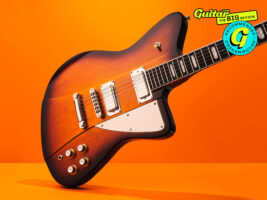
Rivolta Mondata CC review: sets a new standard for what a mass-produced offshore guitar can be
$1,399, rivoltaguitars.com
If you’re reading this, you probably already know about Dennis Fano: the man who created two of the most respected and revered boutique electric guitar brands of the last few decades – first with his own name and more recently under the Novo marque.
READ MORE: Eastman Fullertone Offset ’62 review – “it has a unique sonic voice and retro feel all of its own”
There’s a compelling argument to make that in terms of electric guitars, nobody on earth knows how to make a better playing, better sounding instrument than him – as the monster waiting lists and remarkably consistent resale values of Novo and Fano guitars will attest. The problem is that even on the used market, you’re veering into ‘half-decent used car’ territory – and very few of us are whispering “Treat Yo Self…” at the prospect of dropping five grand on a guitar, no matter how good we’ve been.
Mercifully for those of us not burdened with an overabundance of paper, there’s Rivolta – the brand partnership between Fano and purveyors of affordable, quirky guitars Eastwood, which celebrates its 10-year anniversary this year.
In the beginning, Rivolta was a place where Fano could get weird and explore some of his most esoteric ideas – full-length block inlays! Weirdo top carves! Baritones! – but over the years the brand has evolved.
Rivolta is still a place where Fano can take big risks design-wise – last year’s gloriously unique Forma series being a perfect example – but here in 2026, some of the more polarising edges have gradually been shaved off to create something that’s a lot more universal.
This has never been more overt than in the brand new Mondata CC – and in terms of the overall package of aesthetics and functionality, it might be the most compelling Rivolta yet.
Image: Adam Gasson
Rivolta Mondata CC – what is it?
The magic of Rivolta was always found as much in who designed them as who made them. Despite being made alongside Eastwood’s other guitars in Korea, Rivolta guitars added a level of refinement and quality borrowed from Fano’s US-made instruments.
The rub was that there were always some eccentric elements to the design and functionality that meant that these guitars didn’t become as popular as they deserved to be – the Mondata CC might well be the guitar to change that.
Because, for starters, just fucking look at it. Dennis Fano has built a career doing marvellous and unique things with offset shapes, but the Mondata in its CC form is something special. Stripped of the extraneous switches, elaborately over the top pickguards and polarising headstock combos that have been a fixture of the model (and the Rivolta line) since it debuted in baritone form half a decade ago, now replaced with an understated elegance across the board.
Most notably, instead of the usual three-a-side angular headstock, we get the beautifully proportioned stepped six-in-a-line number seen on the original Fano-branded instruments, and the first Rivolta Regata semi-hollow model.
I cannot overstate what an improvement this makes to the guitar’s overall look – combined with the majestic body shape, it feels complete and considered in a way that no other Rivolta guitar has before it.
Speaking of the Simarouba body, the Mondata’s raised central block has always nodded to the guitar’s Firebird inspiration. But here, with a simple understated pickguard, Gibson-style four-controls and a three-way switch wiring, tune-o-matic bridge and tailpiece, and of course those mini-humbuckers, that spirit is in full effect. The finest compliment I can give this guitar from a visual perspective is that it looks more like a lost classic from the Kalamazoo drawing board than what Gibson actually found in Ted McCarty’s filing cabinets.
Image: Adam Gasson
Unlike a Firebird, however, the Mondata CC is a more traditionally set-necked instrument, with a scale length that’s bang on 25 inches – splitting the difference between Gibson and Fender is a theme we will come back to, I suspect.
That neck is of the one-piece roasted maple variety – a recipe Fano has used almost exclusively for Novo guitars over the last decade or so – though you wouldn’t be able to tell as it’s sprayed with a caramel satin finish that fits nicely with the rest of the guitar’s gloss tobacco burst.
You get an ebony fretboard that’s bound with white plastic, and a generous complement of 24 medium jumbo frets. The ‘board’s edges are factory rolled, while the 12-inch radius will make any Gibson fan feel right at home. The inlays are Rivolta’s own pearloid ‘MOTO’ style – that’s rounded off blocks to you and me. I’ll admit I don’t love these as much as I’d love dots or regular blocks, but they’re about as inoffensive as quirky inlays can be.
Equally inoffensive is the set of quality Wilkinson tuners keeping things in check on the peghead. Those vintage Fender-style buttons further add to the hybrid vibe of the whole thing.
The pair of mini-humbuckers are Rivolta’s own design, and the output measured 6.5k at the bridge and 7.5k in the neck. There’s no case as standard, but you can add a custom-fit premium gigbag for an extra $100 or a wooden hard case for $200.
Image: Adam Gasson
Rivolta Mondata CC – build quality and playability
The first thing to note about the Mondata CC is that this is a pretty big guitar for a solidbody: as evidenced by the fact that it pretty much obscures every trace of my trusty Jazzmaster when I rest the Mondata on top of it for comparison’s sake. This is worth remembering because it’s also impressively lightweight for such a chonky boi – barely tipping 7lbs on my trusty luggage scale.
This is no doubt down to the use of Simarouba for the guitar’s body. This South American wood is quite an uncommon tonewood, but it’s notably less dense than most traditional timbers used in guitar building, giving it a lower overall weight. The more classic and familiar pickup, electronics and hardware arrangement no doubt contributes to this too – there are no extraneous pots, switches or a vibrato here to add mass. It’s a well-balanced guitar both on the strap and on the lap too, with no noticeable dip at either end. The rear body contour on the top also makes it a more ergonomic and enjoyable instrument when played seated.
When I reviewed the Forma series, I enthused at length about Rivolta’s wonderfully characterful necks – and the Mondata gives me another excuse to rabbit on about it. Novo guitars might have the most wonderfully playable necks in the business, and Fano has clearly brought that knowledge to bear here.
I’m so used to mass-produced guitars having necks that simply exist in the middle ground of generic inoffensive usability, it feels almost subversive to make a guitar at this price point with a neck that reminds you that actually, a guitar’s neck is designed to enable a meaningful and organic connection between player and instrument.
Quite how the Rivolta Chunky C+ neck carve does this is quite hard to quantify – it’s not slim, it’s not a baseball bat… it’s just… right? At every point up the neck it feels like the connection is meaty enough to feel secure, without ever feeling like you’re having to wrestle with it. It’s really quite some feat of craftsmanship to do this at scale.
The general playability is helped by that new super smooth satin-finished neck (a real improvement over the gloss on the Formas), some nicely rounded ‘board edges, immaculately installed and polished frets, and a body shape that allows excellent upper fret access, should you be that way inclined.
It’s a similar story all over really – the finish and build quality is first class, internal wiring is neat and tidy, and everything feels solid, dependable and ready to take on the road. There’s nothing here that would instantly hint that this was a guitar made in Korea and not the USA, bar that price tag – and that’s a very good thing indeed.
Image: Adam Gasson
Rivolta Mondata CC – build quality and playability
It’s worth noting out of the gate that, despite appearances and the lack of adjustable poles, the pickups here are listed as mini-humbuckers and are not the same as Firebird pickups. You might wonder why I’m splitting hairs here, but traditional ’Bird pickups do have quite a different kind of construction to a mini-humbucker – with alnico bars set in the bobbins themselves, and steel reflector plates on the top and bottom.
This is what gives Firebird pickups their distinctive single-coil-esque quality – albeit without the hum, of course. Mini-humbuckers are constructed much more like traditional buckers, just smaller, and so have more in common with their big brothers – albeit with some sonic differences.
Plugging in the Mondata CC, you can readily tell this out of the gate – but that doesn’t detract from it being a rather glorious experience. Mini-buckers tend to offer the grunt and power of a full-sized bucker but with increased clarity and high-end response, and flicking the three-way toggle switch to the bridge position and running it through a dirty Marshall Plexi, you’ll find the sort of unrestrained fun that respectable people would no doubt disapprove of.
Interestingly, given the snarl and grunt at play here, I find the bridge pickup uncommonly usable when cleaning things up too – it’s strident, sure, but without the piercing nature that a lot of bridge buckers can offer.
Switching to the neck and there’s an enjoyable woodiness to proceedings, but without the darkness that you’d normally find from a neck humbucker. It’s more like swimming in maple syrup than molasses if that makes any sense? It’s thick, it’s warm, but you don’t feel like you’re losing too much of the inherent character of your sound.
The middle splits the difference between the two nicely, offering a punchy, insistent sound with a soupçon of fluteyness – it’s again very usable. While this isn’t a guitar that’s going to offer you glassy, Fender-style cleans, there’s a quality spectrum of Gibson-adjacent tones to be found in here.
Image: Adam Gasson
Rivolta Mondata CC – should I buy one?
It’s increasingly rare in this job when a guitar comes across my desk that has me looking at my guitar rack and having some genuine hard internal conversations about which one of my treasured instruments is going to have to have a new home under the bed in the immediate future.
But the Mondata CC has been making me do those equations virtually since the moment I pulled it out of its box. I’ve played some really impressive mid-priced guitars over the last few years, and while there’s no doubt that the Mondata CC is not the most inexpensive Korean-made instrument you can buy, it might very well be the best.
The only hair I can really split is the fact that at the moment it’s only available in a single finish – imagine this guitar in Pelham Blue, Shoreline Gold or some of the other legendary DuPont metallic shades? The lack of an included gigbag or case also feels a little on the mean side. It’s certainly not the cheapest guitar you’ll find coming out of Korea either, but if you want a fantastic-sounding, elite-playing, rock-ready guitar that stands out from the crowd, you need to check this out.
Image: Adam Gasson
Rivolta Mondata CC – alternatives
An even more affordable Asian-made guitar that’s seeking to offer a killer blend of unique looks and high-quality characterful build is Eastman Fullertone Offset ’62 ($999 / £899) – it’s a killer guitar for the price. If you want real Firebird mojo then Gibson’s new Firebird Platypus ($2,499 / £2,199) is a very cool, USA-made option. Another USA-made offset guitar that’s more in the ballpark of the Mondata is the PRS S2 Vela ($2,049 / £1,699) – it’s a stripped-down, no frills thing, but personally that’s part of the charm.
The post Rivolta Mondata CC review: sets a new standard for what a mass-produced offshore guitar can be appeared first on Guitar.com | All Things Guitar.
Source: www.guitar-bass.net