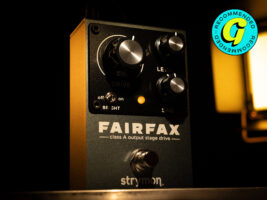
Strymon Fairfax review – an old-school drive pedal with plenty of rough edges
$199/£199, strymon.net
Strymon, renowned purveyor of hi-tech reverb and delay pedals using advanced digital signal processing, apparently has a team known as “our analog guys”. Presumably they spend most of their time making coffee for everyone else, but every now and then they are allowed to design something. That’s the origin of the Fairfax overdrive… and on this evidence, it’s time for the digital nerds to start making their own coffee.
READ MORE: Twilight Pulse Audioworks Konstante review – a dual dirt pedal that’s faster than the speed of light
In fact, the best way to appreciate this fully analog dirt machine might be to cover up the name at the bottom and pretend it’s made by some ultra-hip indie brand. Because the sounds it makes are about as far from Strymon’s usual fare as you can get.
Image: Press
Strymon Fairfax – what is it?
There’s a sort of reverse arms race going on in the stompbox world, with makers rifling through the archives in search of ever more old and obscure kit to recreate. In this case, the inspiration comes from the Canadian-made Garnet Amplifiers Herzog – a tube-driven preamp built in the 60s for Randy Bachman of the Guess Who. He used it on the band’s biggest hit, American Woman, and throughout his subsequent career with Bachman-Turner Overdrive.
The Herzog is, in a word, large – it’s designed to be stacked on top of an amp, not stomped on. The challenge for Strymon, then, was to capture all of its rich valve tones – without using DSP, remember – in a compact pedal. So the Fairfax has a preamp, a power amp and “an ingenious custom circuit that emulates the saturation characteristics of the output transformer”.
There’s also a real transformer – in the power supply, converting your standard adapter’s 9v into 40v – and you get controls for drive, output level and ‘sag’. This dials in extra compression and spluttery gating as the biasing of the JFETs is pushed out of whack. There’s no tone control, just a toggle switch for bright mode.
Image: Press
Strymon Fairfax – sounds
The sound of the Fairfax is sweet and chunky, with a gently crumbly texture. Basically it’s vanilla fudge in stompbox form. And while it’s not the first overdrive pedal to produce that kind of tone, it’s among the best of its type.
With drive at halfway and sag at minimum, you get a medium-gain crunch tone that’s pretty much uncoloured in pure EQ terms but with a ‘sticky’ feel that sets it well apart from the average transparent overdrive. There’s an element of gurgly scuzz involved, but it’s addictively pretty and responds nicely to variations in pick attack.
As you crank the drive, all the good stuff just gets bigger. It doesn’t go quite as fuzzy as, say, a Land Devices HP-2 or Hudson Broadcast (two pedals with which it has some tonal similarities), but it will do a fine impression of a small tweed combo at full volume – and adding some sag just makes it feel even more amp-like. There’s some wonderfully squishy compression available before things turn properly splatty, and it’s only towards the top of the dial that the gating effect starts to properly pinch.
The bright switch has been well judged, letting you decide whether or not to let all the high frequencies through unchecked, and I never found myself wishing for more control over the voicing of the Fairfax. You might feel differently if you’re using extra-sizzly single-coils, though.
Strymon Fairfax – should I buy it?
For me, there are two reasons to buy this pedal. The first, and most obvious, is that it’s awesome – smartly designed, unexpectedly versatile and bubbling over with musical character.
The second is that, the better the Fairfax sells, the more likely it is that Strymon’s bigwigs will let those analog specialists loose on a load of other Series A projects. The second entry, the recently announced Canoga, looks like a fairly unremarkable vintage-style fuzz; but after a debut like this, who knows what else they’re capable of?
Strymon Fairfax – alternatives
Other compact overdrive pedals with the emphasis on chunky warmth include the Supro Drive ($219/£189) and Beetronics Fatbee ($189/£199). But then again, why mess about with silly little stompboxes when Garnet Amplifiers is still going and you can order a reissue Herzog for CA$695?
The post Strymon Fairfax review – an old-school drive pedal with plenty of rough edges appeared first on Guitar.com | All Things Guitar.
Source: www.guitar-bass.net