The Close Up: Muse guitarist Matt Bellamy’s most iconic and beloved guitar, the Manson 007
“When I pick up this guitar, it makes me play the way I play and come up with the ideas I come up with that are different to when I play any other type of guitar.”
Muse’s Matt Bellamy is one of the most influential guitarists of the last two decades, but the way he approaches the construction of the instrument is as vital and interesting as the actual notes he plays. This is because for the majority of Muse’s career Bellamy has used custom instruments created by UK luthier Manson Guitar Works – but the 007, also known as “Black Ed”, is perhaps his most iconic and famous. It’s the guitar that can be seen in the video for Time Is Running Out, it’s the guitar one you hear on New Born, Stockholm Syndrome, Uprising and Starlight. It’s no exaggeration to say that it’s the most often-heard guitar in the entire Muse canon.
“I would say that on every album Muse has made since this guitar was built it has been featured on about 50 per cent of every song we’ve ever recorded,” Bellamy explained to Manson MD Adrian Ashton. “It’s the number one, most go-to recording guitar for me. I did use it on stage a lot as well, and it took a bit of a beating! And I won’t say it was the only one, but it was pretty much the only one that was always getting recorded consistently on Muse albums.”
Plug In, Baby
Back in the early 2000s, Bellamy came to Manson founder Hugh Manson with a plan. He’d already been getting Hugh Manson to install various pedal circuits into the T-style guitars Bellamy had been using, enabling him to tweak his sound on the fly without having to mess with a pedalboard. But now he wanted to squeeze the much more involved gubbins of a DigiTech Whammy pedal into one of the customised T-type guitars Bellamy had been using in Muse.
Rather than load the guitar with a bunch of heavy electronics and batteries, Manson suggested that a more elegant solution would be to: install a touch-sensitive strip that could control the pedal via MIDI, and achieve the same results. The idea spurred Matt Bellamy to take the idea further – just how much could you squeeze into one conventionally-proportioned instrument? A lot, it transpires.
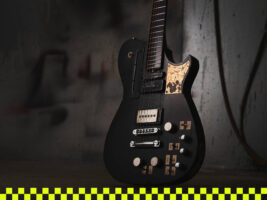
The finished guitar ended up with a Fernandez Sustainer pickup to offer crazy infinitely sustaining notes, a killswitch for stuttering effects, a Z.Vex Fuzz Factory for distortion and perhaps most uniquely of all, a Z.Vex Wah Probe. The Wah Probe is a bizarre, unique creation that uses a theremin-like copper plate to alter the sound of the effect depending on where your finger sits. Naturally, Manson built the plate into the guitar’s pickguard with a specific purpose.
“Whenever we went to Japan, we used to always go and buy weird pedals, basically,” Bellamy recalls. “That was just a thing that we did. A lot of [bassist Chris Wolstenholme]’s synth pedals come from Japan. There were certain shops we used to know in Tokyo, and they had all the best collections and stuff. And I remember seeing a Z-Vex Wah Probe over there for the first time. I bought one and played it and said, ‘Let’s do this!’
“The idea behind it was to try to get this theremin vibe going – with a sustainer holding the note, but just trying to get the note to have some movement.”
And as if that wasn’t enough, the fretboard also lights up with LEDs, kicking off Muse’s longstanding practice of making their instruments just as part of the visual spectacle of a show as everything else.
Back In Black
Fitting it wasn’t a problem, said Hugh, but the resulting guitar would weigh a huge amount purely because of the number of batteries you’d have to squeeze in there to run the tech.
A better solution, Hugh suggested, would be to install a MIDI controller in the guitar. MIDI is the standardised means of digital communication for music technology, and Hugh reasoned that Matt could use it to control an outboard Whammy just as effectively.
The resulting guitar sported a touch-sensitive MIDI control strip above the pickups to control said Whammy, but Matt wasn’t done there. Manson had already been building various other pedals into Matt’s guitars, and with 007 he kicked it into high gear. The guitar features internal circuitry and controls for a Z.Vex Wah Probe (the theremin-like control plate takes the place of a scratchplate on the bottom horn), a Z.Vex Fuzz Factory, and an MXR Phase 90, as well as the addition of a Fernandes Sustainer pickup above the Seymour Duncan hot P-90 neck pickup. Oh, and the fretboard also lights up with LEDs, kicking off Muse’s longstanding practice of making their instruments just as part of the visual spectacle of a show as everything else.
Bellamy first began using this unique and remarkable instrument Black Ed in 2001, and it quickly became his go-to guitar. As you can see from Guitar.com’s photos, the guitar had taken some serious punishment over its time as a stage instrument, and around 2011 Matt decided to retire it from the stage for practical reasons. “It has a very specific tone, but it was a bit heavy for me on stage,” he reveals. “Some of my latest guitars, I’ve had them made deliberately from lighter woods, sometimes with hollowed-out bodies to be extra light. And that’s one of the reasons why I stopped touring with it so much: because it was heavy. But it had the best tone of all the guitars.”
You might start to spot it again soon, however… sort of. Last year Manson (which Bellamy took ownership of in 2020) released the Matthew Bellamy Signature Black Edition – an identical replica of the 007 guitar down to every scratch, chip and repair, while exactly replicating the guitar’s truly unique internals. “If I could only have one guitar in the world, the Black Edition would be it,” Bellamy explains. That’s how important this guitar is to him, and why Manson spared no expense to ensure he can continue using a version of it for years to come.
The post The Close Up: Muse guitarist Matt Bellamy’s most iconic and beloved guitar, the Manson 007 appeared first on Guitar.com | All Things Guitar.
Source: www.guitar-bass.net