Gretsch Synchromatic Falcon review – “this guitar is going to make Falcons a much more common sight on everyday stages”
$1,469.99/£1,299, gretschguitar.com
If we accept that the most recognisable and iconic electric guitars of all time are exclusively made by Fender and Gibson, the Gretsch Falcon might be the exception to that rule. Whether in the hands of Neil Young, Joe Strummer, John Frusciante or The Edge, the Falcon has established itself as a big, bold and blingy holy grail guitar for many musicians – though the eye-watering price tag has usually disqualified most people who aren’t rock stars from indulging their raptor reverie.
READ MORE: Warm Audio WA-TS Tube Squealer review: “it offers a great deal in a small enclosure”
But now the velvet rope behind which the Falcon has existed for the last 70-odd years has been dropped, and now Gretsch are for the first time producing a Falcon that won’t cost as much as a small family car.
The catch? It’s made in China like many of Gretsch’s more affordable instruments, but interestingly this isn’t part of the popular Electromatic range – instead these new instruments form the bedrock of a new class that sits between Electromatic and the Japan-made Professional Series – the Synchromatic collection.
Image: Adam Gasson
Gretsch Synchromatic Falcon – what is it?
For years now, Gretsch has been one of the worst offenders for giving products overly long and unnecessary names. So it’s quite nice to see a guitar that is just called “Synchromatic Falcon” without the jumble of numbers and letters that no human being outside of Gretsch shipping and handling can understand spaffed in there somewhere.
They can’t quit cold turkey however, and so this guitar is technically called the “Gretsch Synchromatic Falcon Hollow-body Single-cut with Bigsby”. That certainly goes a long way to explaining the basic makeup of this guitar without having to consult a spec sheet, but beyond that is an absolutely insane thing to call a product.
Imagine if the new iPhone was called the “iPhone 17 Pro Max with 6.9″ Super Retina XDR display, A19 Pro chip and a USB-C port”? That’s what Gretsch is doing every time and someone needs to stage an intervention.
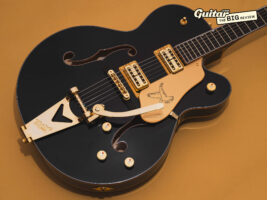
Anyway, this is a classic Falcon in all the ways that are fundamental to the concept: a big, deep hollowbody guitar with a honkin’ great Bigsby and a bunch of flashy gold hardware.
How big? Well, it’s actually a teeny bit smaller than a Professional Series Falcon. The classic is 2.5” deep and 17” wide, while my example is more like 2.45” deep and 16.9” wide.
That is basically nothing, but does correspond to bang on 6cm deep and 44cm across, so I would guess this is probably to make the measurements more straightforward in a metric-using Chinese factory than anything else. Still, the more you know!
Image: Adam Gasson
The Synchromatic range is designed to offer “upgraded materials and components, enhanced bracing, and authentic aesthetic features”, says Gretsch, and that’s clear to see when you look closer.
Perhaps the most notable change here in terms of construction is the new Semi-Arc bracing. This is a variation on Gretsch’s classic trestle bracing – which has two straight braces running down the top of the guitar, anchored with two sets of ‘feet’ to the guitar’s back – designed in the 50s to improve sustain and reduce unruly vibrations and thus feedback, at the cost of a little resonance.
Semi-Arc bracing effectively does away with one of these sets of feet, meaning that the bracing is now connected to the back only beneath the bridge. The thinking is that this still retains the advantages of trestle bracing while allowing more liveliness and resonance.
Elsewhere it’s all very Falcon – the body and neck are maple, you get a nice “Classic C” neck profile and 25.5-inch scale length, plus a bone nut and thumbprint pearly inlays on the ebony fingerboard. You even get a set of Grover Super Rotomatic tuners to keep things as stable as a Bigsby-toting laminate hollowbody can hope to be.
Finishes are a choice between classic white or black for the finish, and there’s an abundance of gold sparkly binding throughout – though the headstock is a disappointingly demure affair compared to the regular Falcon.
While there’s precedent for Falcons having the simple Gretsch logo on the peghead, it does feel rather underwhelming compared to the glorious bewinged ostentatiousness of the classic design – but I suppose costs have to be factored in somewhere.
That’s also something you’ll have to make peace with for two of the most important components. The Bigsby is a B60 with V cutout, but it’s a licensed version as opposed to the proper USA-made model, while the pickups are Gretsch’s own Hi-Fidelity Filter’Tron units – no TV Jones for those in the cheap(er) seats.
In happier news, the guitar ships with a deluxe Gretsch hard case – something that has been a glaring omission from the top end of the Electromatic line.
Image: Adam Gasson
Gretsch Synchromatic Falcon – build quality and playability
Whenever an iconic guitar gets reimagined at a significantly reduced price point, the first thing you’re looking to ensure is that the inevitable corners that have been cut to get there don’t compromise the essence of what the guitar should be.
But for the Synchromatic Falcon, the initial impression is very positive indeed. Pulling it out of the case, it looks every bit the Falcon – the drab headstock ornamentation aside.
I happen to have a Japan-made Professional Falcon to hand and visually it really does stand up to muster on initial inspection. The binding and hardware are equally as vibrant and sparkly on both guitars, and you even get the same red jewel-encrusted control knobs for an extra bit of opulence.
White is obviously the classic Falcon colour, but I tend to think the black version here is actually the connoisseur’s choice – black and gold is a timeless guitar pairing, and it feels more gig-ready than the white’s ‘looks nice in a music video’ aesthetic.
On closer inspection, however, there are a few finishing issues that you would not expect on a near-$1,500 guitar. The binding is generally well applied, but there are a few areas where the binding has some tool marks and roughness, mainly in the f-holes, and there’s also an excess of glue around the heel which really should have been tidied up.
The fingerboard also has some unsightly residue above the 12th fret – something easily removed with a bit of wire wool but again, this is a $1,500 guitar and I’d expect a bit better on the QC/finishing side of things at this price point.
Image: Adam Gasson
Most problematically, however, there’s a white blemish to the finish on the top of the neck just before the neck joint. It’s a tiny dot, but one that’s pretty visible against the black finish, and is also right in your eyeline as you look down at the guitar – it’s the sort of thing that you might not notice at first but you’d never stop noticing once you did.
I’d be surprised if this wasn’t an isolated issue – another Synchromatic guitar I have in for review has no such oversights – but it’s also the sort of thing that really should have been spotted and rectified before it left the factory.
Strapping it on, and while a hollowbody is never going to be a boat anchor, I was still surprised at its weight – a hair off 9lbs isn’t a deal-breaker by any stretch of the imagination, but if you’re buying this expecting to feel like you’ve got a cloud wrapped around your neck, take heed.
The neck is described by Gretsch as a ‘soft C’ and it certainly makes for a smooth and enjoyable playing experience. It might not have the personality of a bigger and more heavily-shouldered neck, but it feels comfortable in the palm and doesn’t discourage meandering up to the dustier regions.
Be warned, however, that this does ship with 11s out of the box – a suitably robust thickness of string to ensure better tuning stability, but one that might come as something of a shock to those used to 10s or 9s.
The Bigsby’s travel is smooth and responsive, and while there’s always going to be a degree of compromise in terms of stability with one in situ, the Grover tuners and a nicely cut and lubricated nut certainly make the experience as in-tune as you could hope for.
A nice touch that deviates from tradition is the presence of an oval jack plate. There are too many sad stories about plate-less hollowbodies getting a new and entirely unwanted hole in the side courtesy of a free-mounted jack socket, so this is a definite upgrade.
Image: Adam Gasson
Gretsch Synchromatic Falcon – sounds
With more freedom for the top to vibrate, you’d expect the new bracing used on the Synchromatic would make this a more strident acoustic instrument, and an unplugged strum certainly presents a little more volume and vibration than I’d expect, even from a big ol’ hollowbody like this one.
Confession time before we plug in – I absolutely love Filter’Trons. If you’ve never played a guitar with a set in before, do yourself a favour and rectify that because they split the difference so well between single-coil and humbucker, while still maintaining the punch and power that makes them so well suited to rocking out.
Plugging in, and it’s immediately apparent that these High Fidelity units capture a lot of the best bits about Filter’Trons – with plenty of growl, punch and articulation. However, they’re definitely not overburdened with the airiness that characterises a ‘classic’ Filter’Tron.
In fact, the bass frequencies can get a little overwhelming at times – part of that is just what you’d expect from a big-bodied guitar of course, but I wonder if this new bracing pattern makes those low-end frequencies resonate more forcefully.
It makes for a guitar you have to keep a watchful eye on when played clean and at volume then – it doesn’t take much for that punchy bass to tip things into feedback. The Falcon has the classic Gretsch four-control wiring, however, including the master volume with treble bleed, and this is an effective way to tame some of those thuddier frequencies on the fly.
Add a bit of gain to proceedings and it all starts to come together in a way that’s tremendously rewarding. Rhythm tones are thick and muscular while retaining the note separation that you’d expect from a Gretsch, while adding fuzz to proceedings is an absolute riot.
The liveliness of that more freely vibrating top makes the Synchromatic a perfect companion to my Bigfoot King Fuzz, and emphasises the inherent sonic character of the guitar. It feels like something of a hybrid between a traditional humbucker and a Filter’Tron.
That might mean it’s not going to nail the Brian Setzer rockabilly sound necessarily, but if your White Falcon heroes are more at the Neil Young end of the spectrum, turn it up and have fun.
Image: Adam Gasson
Gretsch Synchromatic Falcon – should I buy one?
For an awful lot of potential buyers, the proposition of cutting the price of entry for a Gretsch Falcon in half is compelling enough on its own, regardless of how good the guitar is. And you can certainly make the argument that for $1,500 you can easily drop a few hundred bucks on a pair of TV Jones pickups and get a lot closer to a Professional Series instrument for a fraction of the cost.
And that’s because, QC issues aside, this is a fundamentally very good guitar that captures much of the essence of what a Falcon should be without cutting too many obvious corners. Even the decision to use pickups that are voiced a little bit more to the middle ground probably makes sense in the grand scheme of things – they still sound great and will rock in the free world with the best of them.
Some Falcon owners will be dismayed at what they perceive as a dilution of the exclusivity of the model. For decades it has been a Rolex of a guitar that was as much a status symbol as it was a musical tool.
There’s no doubt that this guitar is going to make Falcons a much more common sight on everyday stages, but the Tudor Black Bay hasn’t stopped people wanting to buy Rolex Submariners, has it? Falcons for the masses – it’s a beautiful thing.
Image: Adam Gasson
Gretsch Synchromatic Falcon – alternatives
If you want the big-bodied Gretsch hollowbody vibe without the Falcon appointments, the Gretsch G5420T Electromatic Classic Hollowbody ($839 / £769) is a great value alternative. At the other end of the scale, the Professional Collection Falcon ($3,789 / £3,549) offers Japanese build and quality of life improvements like a string-thru Bigsby. Another affordable hollowbody with prestige and heritage is the Guild M-75 Aristocrat ($1,199).
The post Gretsch Synchromatic Falcon review – “this guitar is going to make Falcons a much more common sight on everyday stages” appeared first on Guitar.com | All Things Guitar.
Source: www.guitar-bass.net