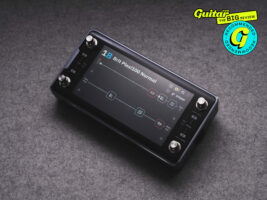
Neural DSP Quad Cortex Mini review: “this is the most universal Quad Cortex yet”
$1,399/£1,129, neuraldsp.com
Finland might have spent the best part of the last decade at the top of the World Happiness Report table, but Helsinki-based Neural DSP seems to have a rare talent for inciting the opposite emotion in large swathes of the guitar internet.
READ MORE: Sterling By Music Man Rabea Artist Series Sabre – a solid rock and metal workhorse
It’s easy to forget that it’s been less than five years since Guitar.com brought you the world-exclusive review of the Quad Cortex – a truly game-changing hybrid of profiling and modelling that has since replaced traditional amps for arena bands, touring artists and even pub giggers. The fidelity and usability of Neural’s hardware has made Doug Castro’s company one of the biggest new players in the guitar world, but it’s also had a trickier side effect.
When you reshape the entire gear landscape with your first hardware product, expectations are raised to unreasonable levels – and it’s something the company has been battling against for the last few years.
Image: Adam Gasson
The launch of the Nano Cortex in 2024 was the first sign that people on the internet were going to get weird when it came to new Neural products. While a bizarre pre-launch video didn’t do them many favours, the sheer vitriol that greeted what was an unquestionably excellent product was bizarre. It was taking pelters, primarily it seemed, for not being the fantasy product people on forums had dreamed up in their head – a Quad Cortex that was roughly a third of the size, but featured all the same functionality and features for a third of the price.
Neural admitted it was somewhat taken aback by the response in the aftermath, and it’s perhaps not surprising that they’ve simplified the pre-release hype somewhat with recent releases. But with the release of a brand new Cortex product – and one that seemingly gives people the vast majority of things they complained was missing from the Nano – the grumblers are back: certainly they were in full voice in our Instagram comments.
But does any of this actually matter? Well, no… the awkward truth is that as loud as the boo-boys are online, it makes not one jot of difference to whether the Quad Cortex Mini is actually any good in the real world. So let’s ruminate on that, shall we?
Image: Adam Gasson
Neural DSP Quad Cortex Mini – what is it?
In the grand old tradition of saying what you see, the Quad Cortex Mini is… well, a Mini Quad Cortex. Unlike the Nano, which stripped down a fair bit of the functionality to turn a $1,500 pedal into a $500 one, the Mini keeps the QC’s mojo intact, but in a form factor that’s roughly a third of the size – just 8 inches long and a hair over 4.5 inches wide.
That ambitious goal is what gives the Mini its rather polarising look – in order to squeeze the QC’s impressive and essential 7” capacitive touchscreen into a box this size, concessions have had to be made. That means we lose seven of the QC’s 11 footswitches, as well as the rotary volume knob (replaced by a subtle up/down switch on the pedal’s top), as well as a few elements of the I/O side of things.
There’s one fewer combi-jack input here – though you do still get a standard jack input for stereo rigs – and the dual effects loops are now condensed into a combined input/output pair that you’ll need a TRS insert cable to utilise both loops. Another sacrifice to space is the second expression pedal output – if you want to run two expression pedals you’ll need to connect one via MIDI.
Far be it for me to dismiss the I/O needs of the wider guitar community, but certainly from my point of view, these feel like the sort of niche-use luxuries that I’d be happy to sacrifice to get a Quad that fits on my Pedaltrain Nano and costs $400 less… your mileage may vary, of course.
Other than that, Neural is at pains to stress that it is 100 per cent a Quad Cortex – with the same underlying hardware, UX and processing power as the big boi, just in a box that looks like someone’s put an iPhone on a punishing protein supplement regimen.
Ah yes, the screen – the thing that has provoked the most chin-stroking amongst guitar people in the weeks since the Mini’s launch. Neural has been at pains to stress that making the top surface of an effects pedal that is designed to be stepped on in a variety of dimly lit environments is fine. They say they’ve tested it to extremes and that you don’t have to worry about that glass cracking under normal use. I would counter that by saying that Apple has been boasting about how hardcore the glass in their iPhone screens is for the last decade and yet every town in the land has at least two shops that do screen repairs…
Image: Adam Gasson
Neural DSP Quad Cortex Mini – build quality
Right then, let’s get this out of the way up top: the screen. I’ll admit to firmly being in the eyebrow-raised camp when I saw the QC Mini at NAMM this year, but having spent some time with it at home, I can’t deny that this feels like an incredibly well-made piece of kit.
It’s reassuringly heavy, precision engineered, and that glass feels thick and has coped with plenty of stomping over my few weeks of testing without so much as a scratch.
As I’m a clumsy oaf, I’ve also knocked a few things onto it, dropped it onto my desk (oops), and generally not been particularly careful with it and it still looks as pristine as it did when I pulled it out of the box.
I did contemplate dropping a Les Paul strap button-first onto it from a height, but I was genuinely worried my guitar would come off worse than the pedal. In lieu of that, I’d say don’t drop anything very heavy onto it, or drop it from a great height onto a hard floor. To be fair, this is generally just good (and you would hope unnecessary) advice when talking about any pedal that doesn’t have Boss written on its rubber-capped footswitch.
The pedal’s unconventional design doesn’t exactly help on the reassurance side of things. The proximity of the switches to that screen – and the way you have to step across them due to the way they’re laid out – does invite an accidental step on the screen in a way that it wouldn’t were the switches all situated on one side or in a line across the bottom. It’s for this reason that I can still see DeckSaver doing a fairly good trade if they were to make a perspex cover to slot over the top of this thing – belt and braces and all that.
A big tick however, for the new locking power cable – a great way to ensure that your entire rig won’t be plunged into silence because someone trips or yanks the power cable during set-up or mid-gig – especially given that the QC Mini takes about a minute to reboot after a reset or power loss.
Image: Adam Gasson
Neural DSP Quad Cortex Mini – usability
It’s perhaps inevitable that a pedal offering significantly fewer actual physical controls would have a bit more of a learning curve than its bigger brother, and so it is with the Mini.
This is most apparent when you boot the QC Mini up for the first time – unlike the original Quad, it doesn’t have that instant intuitive setup, especially if you’re not overly familiar with the QC’s existing UX. Each of the three modes – preset, stomp and scenes (effectively presets within a preset) – requires you to learn a series of tap-dancing switch shortcuts to switch between sounds and the like.
There’s an element of this with any multi-effects of course, but it’s definitely accentuated here because of how many functions are tied to these four switches. The tuner, for example, is selected by a quick tap on the A and C footswitches together… but closing it requires you to hit the B footswitch instead of simply tapping the same one again. Equally, holding down those two switches simultaneously instead of a taping on them scrolls up between the preset banks in preset mode.
It sounds more confusing than it is in practice, but it does require you to wire your brain to the specific set of button presses to get stuff done in a way that you didn’t necessarily have to with the bigger unit.
One thing that I certainly do appreciate is the clever addition of rotary footswitches. Each of the four switches also doubles as a rotary control that is smart-bound to select and then edit certain parameters. It’s a dramatically more precise and useful way of tweaking your sound both in a live setting or in the studio – and offsets a fair bit of the tedium of endless touchscreen fiddling.
The QC Mini having wifi for wireless updates and downloading new presets and captures is a fantastic holdover from the original QC, but I was disappointed that unlike the Nano, it doesn’t have Bluetooth, thus meaning that you can’t pair it with the Cortex Cloud app.
The Cortex Cloud app is essential for creating presets on your phone that you could then load onto the screen-less Nano wirelessly, but it’s a shame that the Mini doesn’t offer similarly smooth off-pedal editing.
You can connect it to your laptop via USB-C and use the Cortex Control app of course, but given that this pedal is designed more than its bigger brother to live on a pedalboard, it’s a shame you have to either take it off your board or get down on your hands and knees to do the deep stuff. Is it a big hassle? No, but Neural is usually so good at streamlining the creation process, it’s a rare oversight.
Image: Adam Gasson
Neural DSP Quad Cortex Mini – sounds
The greatest compliment I can give Neural about the entire Cortex ecosystem is that no matter what piece of hardware I’m talking about, the sounds section could be copy and pasted without much in the way of deviation. There’s a reason that all your favourite bands have pivoted to the Quad Cortex in some way shape or form – the quality and consistency of the sounds on tap is truly remarkable.
While the out of the box presets do tend to skew more towards the heavier side of the market (a perception that Neural has been starting to change recently), the quality and fidelity of these sounds – not to mention the instant usability of them – is quite a thing to behold.
A lot of multi-effects presets are about showing off – showcasing all the myriad different sounds you can get out of a thing without thinking too much about whether these sounds would actually work in a mix, but Neural doesn’t get too caught up in this. The basic presets showcase a Mount Rushmore of iconic amps presented without too much embellishment – meaning you could boot it up and roll right into a Marshall Plexi or a Deluxe Reverb and use it without ever needing to get into the deep editing side of things.
And it bears repeating how impressive not just the sound but the feel of Neural’s captures are – more so than anything else I’ve tried. Is it indiscernible from a real valve amp? Well, yes – but only slightly. It’s also probably not quite as good sonically as Universal Audio’s amp pedals – but they cost $400 each, and feel as good in terms of response.
I always think the high gain and ethereal clean amp models are the easiest things for digital to replicate – it’s the stuff in between where you really earn your coin. And it’s here that I find myself dwelling more often than not. Cranked vintage Marshalls, cooking Tweed combos, these are the things that digital has always struggled with, but the QC Mini makes them compelling and organic.
The built-in suite of effects is impressive too – especially compared to the pared-down offering that the Nano provides – and it’s also very nice to be able to try out a bunch of captured dirt pedals in the chain, too.
While the QC Mini plays nicely with pedals both in and out of the loop, and does so in a way that feels organic and authentic, the quality and variety of the effects on tap will likely cause many players to consider whether they even need them. There’s serious horsepower under the hood here, and it’s being put to very good use.
Image: Adam Gasson
Neural DSP Quad Cortex Mini – should I buy one?
It would seem that Castro and his mates can’t win at this stage. They’ve been Mark Hamill-ed; doomed to have their stratospheric early success hung round their necks like a millstone, no matter what they do next.
It felt harsh when Neural started getting so much grief about the Nano Cortex, and the grumbling feels even more out of place here. The Quad Cortex Mini is everything that fans have been asking for in terms of size and functionality – it’s a truly pedalboard-ready QC that makes very few compromises (and those it does are broadly quite acceptable).
I’ve seen a lot of grumbling about the price, but this is still $400 cheaper than the original – what exactly were people expecting here? Players may compare the Quad Cortex Mini to the HX Stomp, conveniently forgetting that they are quite different bits of kit in both form and function. Line 6’s new Helix Stadium is a more fair competitor, and that costs about the same as the original Quad, and hasn’t even launched its Proxy profiling technology yet.
Unquestionably, $1,400 is a hell of a lot of money to spend on any damn thing – but in the context of the high-end, capture-enabled modeller world, it’s about par? It intentionally sits nebulously between the full-fat QC and the Nano, but offers a much more complete package than its screenless stablemate.
There are so many options for so many use cases in the modern world of modellers and multi-effects – but the Mini might be the most universal one of the lot. They know how to make people happy in Finland, and when you plug in the Quad Cortex Mini, it’s impossible not to smile.
[products ids=”19PQzuW8mz3waD0guXZFLS”]
Neural DSP Quad Cortex Mini – alternatives
There are, bluntly, shitloads of options at all manner of price points in the multi-effects and amp modelling game, but not many of them have both the profiling ability of the Quad Cortex, nor its huge library of user captures that is Cortex Cloud. If your budget doesn’t stretch to the QC Mini, then the Nano Cortex ($569 / £449) is an impressive gateway to the ecosystem. The Line 6 Helix Stadium XL ($1,699 / £1,549) is a big, unapologetic high-end modelling station, but with its own Proxy capture technology dropping imminently, it’s got the potential to offer much more than previous Helix units. If you want profiling on an absolute budget, the Tonex Pedal ($329 / £329) is limited in functionality but has some impressive sounds and features. Finally, the OG is of course Kemper, and the brand’s Profiler Stage Mk II ($1,649 / £1,499) can compete with the best of them sonically – in terms of ease of use and modern convenience however, the German brand is lagging far behind.
The post Neural DSP Quad Cortex Mini review: “this is the most universal Quad Cortex yet” appeared first on Guitar.com | All Things Guitar.
Source: www.guitar-bass.net