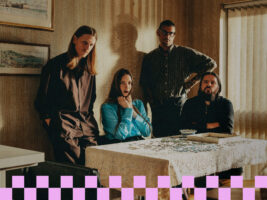
From playing Botch to Cate Le Bon to finally understanding the Stones, the oddball guitar story of Dry Cleaning’s new album, Secret Love
Often, the only way to help another person understand what you’re getting at is to show them something. And that’s how Dry Cleaning’s Tom Dowse ended up playing Botch’s classic mathcore face-melter We Are The Romans to Wales’ leading psych-pop auteur Cate Le Bon, who was producing the band’s new record Secret Love at the bucolic Black Box studio in the Loire Valley. Her immediate response? “Nah, absolutely not,” Dowse recalls with a laugh.
READ MORE: How Wheatus distorted an acoustic guitar to make Teenage Dirtbag an early 2000s classic
But the guitarist soon found that Le Bon has earned her rep as someone who isn’t out to put limits on things. Soon, she was reconfiguring the spirit of Dave Knudson’s gear madness into something that would make sense in Dry Cleaning’s world of oddball melody and guitar skronk. “There’s one track on We Are The Romans where he used four DL-4s playing into each other,” Dowse says. “But I tried to do it with a Boss DD-3, using the hold function. I was making separate loops and then we went back into the control room and chopped them up really brutally.”
You can hear the fruits of this particular labour in a guitar breakdown following the second chorus of Rocks, a song that neatly encapsulates Secret Love’s abrasive spirit by being both furiously hooky and ferociously weird. “Each bar is completely isolated from the last one,” Dowse elaborates. “It’s a hard cut. Cate put a lot of effort into making it work, and it did work. She could have shut that down, but she let me have a go.”
Having broken out with the sardonic post-punk of 2021’s New Long Leg, Dry Cleaning have continually reframed their ambitions. On Secret Love we see more of what makes them tick than ever before, with Florence Shaw’s peerlessly droll spoken-word running alongside Todd Rundgren-esque piano stabs, Richard Dawson-adjacent fingerpicking, brittle no wave leads and the dangerously danceable interplay between drummer Nick Buxton and bassist Lewis Maynard.
Image: Max Miechowski
They have arrived at this point by allowing even more of themselves to bubble to the surface in hours-long writing sessions that sound from the outside like egalitarian jams. “We’re all equal songwriters,” Dowse observes. “You don’t have a dominant person, you explore what you’re interested in.”
As reliant as they are on the chemistry that exists between the band’s four members, though, they’re not insular. Secret Love is as much about finding other voices that might create a new harmony, leading them to ditch their Peckham rehearsal space for a spell demoing ideas at Jeff Tweedy’s Chicago studio the Loft, where they crossed paths with Le Bon during her stint producing Wilco’s Cousin record.
“One of the things we tried to do there was play a bit more casually,” Dowse says. “The way Tom Schick, the engineer, works is that everything is always mic’d up. Jeff goes there every day to write. I was thinking, ‘While we’re working this out, I’ll sketch it.’ Tom had captured all of it, even incidental things, and he pieced it together really quickly. By the time you’d put the guitar down, he’d mixed it, and you’re like, ‘Fuck, that sounds really good.’ Usually, you’d bug out on mistakes – I’m not a very technical guitarist, I’m quite sloppy – but this is the first time I realised those are the good bits. I really thought about that when we were working with Cate.”
Once they’d left Chicago, there were different itches to scratch. “You’re working with the engineer’s taste, and I wanted to go much more extreme,” is how Dowse puts it. That’s how Dry Cleaning ended up in Dublin, throwing things at Sonic Studios’ walls with the help of Gilla Band’s Alan Duggan and Daniel Fox. “We had a song called Blood,” he recalls. “It starts with a jangly guitar – Johnny Marr is a huge influence – but we couldn’t get it to go anywhere.
“Gilla Band pushed to get an industrial edge on the drums. I thought they’d probably shred all the guitars and start again, but they didn’t. They focused on the drums and made a palette that’s really different to what the guitars are doing. Once they did, things started to open up. Cate heard that and really liked it, and it seeped into a lot of other songs.”
Image: Max Miechowski
Alongside taking that spirit over to France with them, Dowse sought out a guitar that he’d first encountered in Chicago to make the trip. “Between Jeff and the rest of the band there are about 600 electric guitars and hundreds of acoustic guitars, and they’re all accessible,” Dowse says of his time at the Loft.
“Racks and racks of pedals, all these amps. I sat in Nels Cline’s chair playing one of Jeff’s custom SGs or his olive green ES-335s. The one that really caught me, though, was a Danelectro 1449. He had two lipstick pickups in it. I played that so much. It was a bit of a lightning bolt moment – these crap sounds sat really well with everything else.”
In particular, they took up room where Dowse might have immediately turned to his SG in the past. “A lot of the heavier riffs were done through a ‘70s Hi-Watt with an Expandora I bought in Japan,” Dowse says. “This is the third version of it, which is the best one. When you put that through a Hi-Watt with those shitty lipsticks and a guitar that is basically plastic, it sounded so good.
“For a lot of the harsher sounds, Cate was very keen for me not to use my SG. Usually, we went to the Danelectro so it kept a bit of crapness, it wasn’t too macho or something. I think she was really keen for it not to be really hench. It had to be more unhinged.”
Throughout the course of our chat, Dowse reels off influences with the speed and zeal of someone who really, truly loves this stuff. On the unhinged end of the spectrum there’s the dystopian punk of Helios Creed’s work in Chrome, on the noisy front there’s a deep love of Kevin Shields and My Bloody Valentine. But there are a few that stick out when he thinks of Secret Love – read on to discover the five formative guitar sounds that drove the record.
The trashy brilliance of Moses Brown and Peace De Résistance
“A big influence was Berlin-period Bowie, Lou Reed, all those characters. That bit of glam distortion with a chimey guitar over the top, even an acoustic, that’s really bummed out. There’s an album Lullaby for the Debris by a guy called Moses Brown, who has a project called Peace De Résistance. We listened to that a lot, just for how loose and trashy it was. I used my Laney AOR 50 quite a lot for that kind of thing. He seems like a good amalgam, he was in a post-punk band from Texas called Institute that was inspiring, and then he’s gone down this Lou Reed route. That was a big touchstone.”
Jimi Hendrix’s take on The Star-Spangled Banner
“I wanted a really fucked sound. I was thinking a lot about Jimi Hendrix playing The Star-Spangled Banner, and how fucking crazy it was. I put that performance of guitar up there with any 20th century artistic gesture. I immediately think of those Jasper Johns paintings of the American flag, covered in this thick, gloopy paint. It’s not a patriotic thing he was doing. He was criticising Vietnam. He was a vet, you know? He’s criticising America by doing that solo. I just love how expressive that was. That made me up my game on Hit My Head All Day. I wanted something that had more space in it.”
The weirdo listenability of Guided By Voices
“When we wrote Joy, I was thinking a lot about Guided By Voices. There’s a guitar-pop sound that they did, like an approximation of the British Invasion bands. It was so immediate. If you think about their songs, they’re like a minute long — they get straight to the point. I can hear the Kinks in it, and I absolutely love the Kinks. There’s an album called Half Smiles of the Decomposed, it’s got Girls of Wild Strawberries on it. I wanted Joy to be like that. I wanted this refreshing-sounding chord sequence, even those little licks in the chorus. Actually, for once, I wanted to write something that sounded fun, something that’ll work at a festival.”
Tuning into the Rolling Stones
“The one [big] thing for me as a guitarist over the past five years is finally understanding the Stones. Nick said that he thought I sounded the most Keith on My Soul Half Pint and Cruise Ship Designer. I’m trying to think, ‘What would Keith do?’ Other than the drugs, obviously. What I noticed was that he’s like a party started on the guitar but once he gets going it’s very even-sounding. There are no peaks and troughs, and that’s why he works so well with Mick Taylor. Even when Mick does a ripping solo, it doesn’t jump out of the mix. The song starts, they get a vibe going, and you don’t want it to stop. I was listening to Sticky Fingers — I think that’s their best record — and on Can’t You Hear Me Knocking it’s got those toasted valves. I had my Champ with me. It’s not as good as those ones but that’s definitely something I was going for.”
Anarcho-punk’s unusual chords
“The thing I like about anarcho-punk is they use much weirder chords, they’re not doing the straightforward punk of the time. Icons of Filth have a song called Mentally Murdered and it’s drier, you know? I think what’s happened to hardcore and punk as production has gone on is that it’s lost a little bit of that. Early ‘80s hardcore, like Bad Brains and SS Decontrol, it’s like Keith Richards joined those bands, just how dry it sounds. You have to play hard. There’s no studio trickery in it. I like modern hardcore, but it doesn’t have quite the same character.”
Dry Cleaning’s Secret Love is out on January 9 through 4AD.
The post From playing Botch to Cate Le Bon to finally understanding the Stones, the oddball guitar story of Dry Cleaning’s new album, Secret Love appeared first on Guitar.com | All Things Guitar.
Source: www.guitar-bass.net