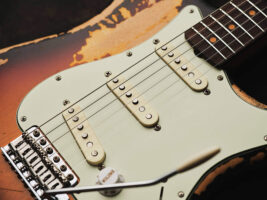
What’s the point of a guitar’s pickguard anyway? This is what it’s actually there for…
In all my years of writing guitar-centric articles, I’ve covered a lot of ground, and still, sometimes there are things I realize I’ve never considered when it comes to guitar construction. For example, have you ever wondered why guitars have pickguards? Especially since a lot of players like their guitars to have that worn-in kind of look.
READ MORE: Stop wasting your money on professionals – here’s how to install a new guitar pickup yourself
The pickguard – or scratchplate, as it’s sometimes called – seems like an obvious feature at first glance. It’s there to protect your guitar’s finish from pick scratches, right? Well, after some research, we find the answer can sometimes be a bit more complex than that, and depending on the guitar, the pickguard might be doing a lot more work than you think.
Image: Adam Gasson
The Original Purpose: Protection
Let’s start with the basics. The pickguard was originally designed to protect a guitar’s finish from damage caused by the picking hand – specifically from fingernails, not picks. If you want a good example of that sort of wear, check out Willie Nelson’s “Trigger”, which was a Martin N-20 that didn’t have a pickguard. As a result, the wood on the guitar’s top has been completely worn through down to the bracing.
According to historical documentation, the pickguard became important on acoustic guitars where aggressive strumming or fingerpicking could easily scratch and wear down the polished wood surface near the soundhole. Gibson introduced the “floating” pickguard design in 1909 for archtop acoustic models like the Gibson L-1, where the guard was elevated on adjustable metal support brackets. This allowed players to adjust the height based on their playing position while keeping the guitar’s top protected.
On acoustic guitars, pickguards are typically thin sheets of plastic adhered below the soundhole. The material needs to be lightweight – usually around 2mm thick – because anything heavier could dampen the soundboard’s vibration and affect the instrument’s tone and volume. It’s a delicate balance between protection and performance.
Image: Adam Gasson
The Electric Guitar Revolution: Function Meets Manufacturing
When Leo Fender designed the Telecaster and Stratocaster in the early 1950s, he transformed the pickguard into something far more clever. Leo Fender was a brilliant man, but his contributions to guitar design extend into the means of mass production – that was equally important as the design of the solidbody guitar. He didn’t just design the solidbody electric guitar as we know it, he revolutionized the industry at the manufacturing level as well.
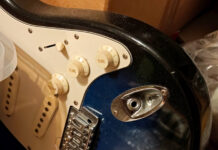
As we know, the Stratocaster’s electronics are mounted directly to the pickguard rather than to the body. This design feature meant the entire assembly – pickups, controls, and wiring – could be dropped into place and screwed down with just eight screws, requiring only a connection to the output jack.
This was revolutionary for mass production. As noted in Fender’s historical documentation, the original Telecaster featured a simple black pickguard made from fiber or Bakelite held on with five screws. The pickguard changed from black to white in 1954, and materials evolved from brittle early plastics to more durable options by 1955. By 1959, Stratocasters received multi-ply celluloid pickguards with 11 screw holes instead of the original eight.
Image: Adam Gasson
How The Pickguard Can Improve Tone: Shielding
Modern pickguards serve a third purpose that many players don’t realize: electromagnetic shielding. According to guitar electronics experts, guitars with single-coil pickups are particularly susceptible to electromagnetic interference from fluorescent lights, dimmer switches, and other electrical devices. This interference creates unwanted hum and buzz in your signal.
Many manufacturers now apply conductive shielding – either copper foil or conductive paint – to the underside of pickguards. When properly grounded, this creates what’s known as a Faraday cage around the guitar’s electronics. Shielding the pickguard back and connecting it to the grounded body cavities helps reduce radio frequency interference and electromagnetic interference that would otherwise be picked up by your wiring.
Some companies even manufacture metal pickguards from aluminum or copper specifically for their shielding properties, though these come with their own aesthetic considerations.
Image: Adam Gasson
Another Hidden Purpose
Back in the late 1960s, Fender was making their guitars out of lightweight ash, but it became difficult to find, so after a shipment of heavy ash wood, they started exploring other means of weight relief in the bodies of their Telecaster guitars. One of the first attempts at this weight relief resulted in what many know as “The Smuggler’s Telecaster”. Basically, Fender routed out a large cavity in the guitar’s body just beneath the pickguard.
From the exterior, it looks like any other Telecaster at the time, but the pickguard was hiding one of the first attempts at weight relief in solid body electric guitars. The routed-out cavity seemed to be perfect for people what might want to smuggle items in their guitar undetected, hence the moniker “Smuggler’s Tele”. This was somewhat a precursor to what would become the Thinline Telecaster which would come out in 1968. Most Smuggler Telecaster examples are from 1967. About ten years or so ago, Fender did a limited run of 100 Custom Shop “Smuggler’s Telecasters” which came with two pickguards – one white and one clear, so you could see into the cavity. The Smuggler’s Tele teaches us that the pickguard was the key to a major innovation regarding weight relief in solid body guitars.
Image: Adam Gasson
So What’s the Point?
The pickguard serves several distinct purposes depending on the guitar. On acoustics, it’s purely about protecting the finish – this is the most obvious purpose. On electric guitars, particularly Fender-style instruments, it’s a mounting platform that makes assembly and repairs significantly easier. And increasingly, it’s also part of the guitar’s noise-reduction system, helping to keep your signal clean in electrically noisy environments.
The next time someone tells you the pickguard is just there to look cool, you can let them know it’s actually one of the hardest-working components on your guitar – even if most of that work happens completely out of sight.
The post What’s the point of a guitar’s pickguard anyway? This is what it’s actually there for… appeared first on Guitar.com | All Things Guitar.
Source: www.guitar-bass.net