Fender Strobo-Sonic Pro Tuner review: fast and accurate strobe tuning for a great price
$129.99 / £99, fender.com
Here’s a fun challenge – make a few hundred words about a new tuner pedal anything other than excruciatingly dull. I’ll give it my best shot! Perhaps with liberal use of exclamation marks! OK, maybe not. Anyway, despite being a pretty essential part of your setup (surely the most essential pedal you’ll ever buy), tuners risk being pretty bland, especially when your job is normally to find new adjectives for how scrunkly a new fuzz pedal sounds.
READ MORE: Line 6 Helix Stadium XL review – “bewilderingly ambitious… but it feels like the future”
Pretty much only one tuner recently – the Walrus Canvas Tuner – has managed to create any sort of buzz, because you can put memes on the LCD screen when it’s bypassed. However, while there has not been as much of a furore of excitement about the new Fender Strobo-Sonic Pro, it is still worth talking about.
Image: Press
Fender Strobo-Sonic Pro Tuner: Functionality
Despite Fender making a version of basically everything guitar-related under the sun, the Strobo-Sonic is actually its first dedicated tuner in quite some time, following the PT-100. Unlike the quite basic PT-100, here we’ve got fast and accurate strobe tuning, and quite a sizeable display.
First things first, no, it’s not a screen like that of the Walrus Canvas tuner, and so you cannot upload pictures of your beloved family members or hilarious cat gifs to be shown when the tuner is bypassed. You can’t rotate this screen angle either to position the Strobo-Sonic Pro pedal sideways on your pedalboard if required. A bit of a shame, but lest we forget, some of the Walrus Canvas’ fun-factor came at a relatively higher price – just under $150. What you lose in putting memes on your board, you gain in still having an extra $50 compared to the Strobo-Sonic.
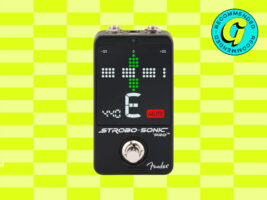
There are two modes you can have the display work in – needle or strobe. Needle is your standard tuner mode found on pedals like the Boss TU series – whereas strobe has a scrolling set of blocks, the speed and direction of which indicate your distance from the target pitch.
The screen itself is bright and readable, and its discrete LED nature means that it’s pretty unambiguous, even at a distance. There’s an auto-dim mode for bright environments, which is fine, although the light sensor for this function does look weirdly like a camera, giving the thing at first glance the look of a blocky, early smartphone.
And speaking of blocky – its otherwise sleek, minimal design is slightly undermined by a stonking great logo, written in a vaguely futuristic italic that seems to have been taken directly from a PlayStation 2 racing game. It’s not the most tasteful thing in the world, sure, but this is why the gods gave us black electrical tape.
Image: Press
There are a few other utility features on board – you can adjust the tuning reference frequency, if you like, and you can turn off the auto-dim feature. You can also change the bypass mode – true-bypass, buffered, or ‘mute’, which is a buffered mode that keeps the pedal always listening, with the footswitch muting your signal. The mute state of the pedal in this and the other modes is shown by a big red “MUTE” indicator on the screen, which is good to see – clear, unambiguous stuff like this does matter in the heat of the moment on stage.
And one final note of practicality before we get to the exciting stuff – the jacks here are top-mounted – all of them, not like the Canvas Tuner’s slightly weird and impractical audio-on-the-top/power-on-the-side approach. So that’s a big plus if space is at a premium on your ‘board, and fortunately, the pedal is wide enough that using pancake jacks is fine too.
So, the actual tuning! In use, the Strobo-Sonic Pro is remarkably fast – I’ve been using the same V1 EHX 2020 Tuner for years, and I was actually blown away by how much quicker the Strobo-Sonic tracked a note’s pitch – it was a much smoother and more responsive experience, and I never overshot the mark because of this. It quickly responded no matter what signal I threw at it – bass and baritone guitar included.
Additionally, due to how the strobe mode works, it is extremely accurate – ±0.01 cent compared to the needle’s (and most other tuners’) ±1 cent – on stage and in most settings this gets you to such fine detail it won’t make too much of a practical difference, however it’s a really handy thing if you want to set intonation, or want things to sound dead-on in the studio.
Image: Press
Fender Strobo-Sonic Pro Tuner: Should I buy one?
Let’s be honest – a £45 second-hand TU-2 from 2004 with half the paint scraped off will do 90% of the job of any other tuner. However, I find the Strobo-Sonic Pro to be a very effective and efficient piece of kit, and for speedy and accurate strobe tuning, it’s a relatively affordable thing that definitely feels worth the extra money over a cheaper unit. Yes, it could look sexier, but ultimately, it’s a tuner pedal, it’s not here to be sexy – it’s here to tune, and it tunes really damn well.
Fender Strobo-Sonic Pro Tuner alternatives
For a more premium experience, you can always check out Peterson’s Strobostomp HD and Mini line, pretty much the de facto high-end tuner pedals. If you’re desperate for something a bit more ‘aesthetic,’ then, yes, the Walrus Canvas Tuner ($/£148.99) will do you well, and you can put memes on it. If you’re not fussed about the last 10% of performance or the memes, and want to save a little cash, you can’t really go wrong with Boss’ TU-3 ($109.99/£99) – pretty much the industry standard, and good enough for countless professional pedalboards. Try the Waza version if true-bypass is a must. The TU-3 can also be used to power some other low current draw other effects by daisy-chaining, as can the TC Electronics PolyTune 3 ($63.90/£59.99), which represents great value. It has switchable true bypass or analog buffer as standard too.
The post Fender Strobo-Sonic Pro Tuner review: fast and accurate strobe tuning for a great price appeared first on Guitar.com | All Things Guitar.
Source: www.guitar-bass.net