
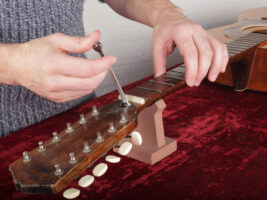
This is how your guitar’s truss rod actually works – and here’s what you’re doing wrong with it
The truss rod might be one of the most misunderstood components on a guitar when it comes to DIY setups. A lot of players think it’s some delicate mechanism that’ll explode if you look at it wrong, while others treat it like a universal fix for every setup issue. The reality sits somewhere in between, and getting it right makes a massive difference in how your guitar plays. So let’s take a look at what a truss rod is and what it actually does.
READ MORE: What’s the point of a guitar’s pickguard anyway? This is what it’s actually there for…
What a Truss Rod Actually Does
A truss rod is a metal rod running through the length of your guitar neck, and it has one very specific job: counteracting the pull of your strings and contributing to neck stability. That’s really all it does. Your strings create somewhere between 100 and 180 pounds of combined tension pulling on the neck, trying to bow it forward. The truss rod provides resistance against that force.
Picture your neck like a diving board with weight on the end. The strings are that weight, making it curve. The truss rod is what lets you control how much it flexes. When you tighten the rod, you’re pulling the neck backward, reducing the bow. When you loosen it, you’re allowing more forward bow.
As an aside, there are dual-action truss rods, which can bend the neck in either direction, but the vast majority of guitars use standard single-way truss rods. Some guitars and basses use two truss rods to do the same thing, but for the sake of simplicity here we’ll just talk about single-action ones.
This is where the confusion starts. The truss rod doesn’t directly raise or lower your action. It doesn’t fix fret buzz on its own. It won’t help your intonation. It controls one thing: the amount of curve in your neck, which is called “relief.” That relief is the intentional bow you want in the neck to give strings room to vibrate without smacking into frets.
Understanding Relief
Most guitars play best with between 0.005” and 0.012” of relief measured at the center of the neck. You check this by fretting the low E string at both the first fret and where the neck meets the body (typically around the 17th fret), then looking at the gap between the string and the fret around the 7th or 8th fret. That small gap is your relief.
Too much relief makes the middle of the neck feel like it has high action. Playing in that 5th-to-9th fret range becomes harder than it should be. Too little relief – or a back-bow where the center of the neck is actually higher than the ends – causes fret buzz, especially on the lower frets when you’re playing with any real attack.
The right amount depends on your playing style. Light players who mostly strum chords can run less relief. Aggressive pickers and lead players who really dig in need more space for the strings to move around without buzzing out.
Common Mistakes
The most frequent error is using the truss rod to adjust action height when the real problem lies elsewhere. Action is primarily set at the nut and bridge. The truss rod only matters if your neck relief is off.
Another common issue is being overly cautious. Yes, you can damage a truss rod, but it’s not nearly as fragile as people think. These components are designed to be adjusted regularly. The key is making small changes, giving the neck time to settle, and checking your work. A quarter turn, waiting several hours or overnight, then reassessing – that’s the process.
Then there’s adjusting without actually measuring. Some of you out there might have laser eyes, but all it takes is a capo and a feeler gauge to be precise, so why not just measure? In my experience (gained from millions of mistakes), guessing leads to problems.
Finally, people adjust too quickly after changes. Brand new strings, different string gauges, major temperature swings – necks need time to adapt to these changes before you start making adjustments. Give it a few hours at least.
The Correct Approach
Start with your guitar tuned to pitch. Relief changes with string tension, so you need accurate tension to get an accurate measurement.
Check your current relief using the method described earlier – fret at both ends, observe the gap at the middle. Need more bow? Turn the truss rod nut counter-clockwise to loosen it. Need less bow? Turn it clockwise to tighten. Standard threading rules apply here and the truss rod adjustment will normally be at the headstock of the guitar (sometimes beneath a truss rod cover) – but on some models, they are at the base of the neck, where it attached to the neck pocket.
Begin with a quarter turn. That’s 90 degrees of rotation. Retune your guitar since changing neck shape affects string tension slightly. Then wait. Check it the following day. Make another small adjustment if necessary.
If you keep tightening without seeing changes, or if the nut becomes genuinely difficult to turn, stop immediately. You’ve either reached the rod’s adjustment limit or there’s a structural problem that needs professional attention. Truss rods can strip out or seize up depending on their construction, and if that’s the case, it will require an experienced tech to do some surgery, which can require removing the fretboard to access the truss rod.
When the Problem Isn’t Relief
High action uniformly across the entire fretboard points to bridge or saddle height, not relief issues. Buzzing only on the first few frets suggests nut slot problems before relief problems. Buzzing everywhere might mean you need fret leveling work.
The truss rod is one component in a complete setup, not a magic solution. A proper setup involves nut height, truss rod relief, bridge height, intonation adjustment, and sometimes fret work. These elements work together as a system.
Knowing what the truss rod actually controls – and equally important, what it doesn’t control – prevents you from chasing solutions in the wrong direction. Once you understand its actual function, setting up your guitar becomes much more straightforward, and you’ll stop making adjustments that create more problems than they solve.
The post This is how your guitar’s truss rod actually works – and here’s what you’re doing wrong with it appeared first on Guitar.com | All Things Guitar.
Source: www.guitar-bass.net