Teaching Machines FuzzBillion review: is this the most ambitious and unique dirt pedal ever made?
£435, teachingmachines.co.uk
It’s easy to look at the world of guitar effects these days and wonder if we’ve reached a point where all the innovation has started to dry up. It feels like not that long ago every month seemingly saw a new and wildly inventive new pedal arrive, often out of nowhere, that instantly inspired people to make new music and approach their instrument differently.
READ MORE: Line 6 Helix Stadium XL review – “bewilderingly ambitious… but it feels like the future”
Those ‘wow’ moments seem to come along less frequently nowadays, and that’s only natural. Like iPhones or the mechanical wristwatch, guitar pedals have reached a “mature technology” stage where most of the big breakthroughs have happened. We’re probably past ‘peak pedal’ now – as this very website opined a few years back – and while that doesn’t preclude people making interesting new pedals, they’re going to be mainly iterating on what already exists.
It does, however, make it all the more exciting and interesting when something comes along that does surprise you, and that does approach things in a way that you haven’t seen before. Allow me to introduce the Teaching Machines FuzzBillion.
Image: Adam Gasson
Teaching Machines FuzzBillion: what is it?
Teaching Machines is the brainchild of Frank Naughton and Mat Wigley, two friends and musicians who decided to work together to craft unique musical devices from their home city of Cardiff, Wales. The brand’s first product, the Wellspring – a rackmount analogue stereo spring reverb with a huge amount of unconventional tweakability and functionality – showed that this two-man operation was not short of ambition or inventiveness.
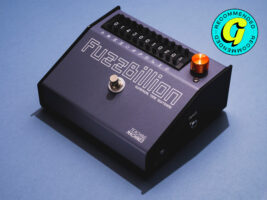
The FuzzBillion is their first foray into floor-based guitar pedals, and while it looks like the sort of thing you’d use to input the nuclear codes or do some Cold War code-breaking (or in guitar terms, a Lovetone pedal from the 90s), it is in fact a totally unique and totally analogue dirt pedal.
On the top of the pedal you’ll find 11 rotary switches that are numbered from 0-9. Each of these rotaries controls various types of diodes and amplification devices from Germanium to Silicon and light-emitting diodes.
The numbers determine the intensity or type of the effect on offer, and each of these different stages then feeds into the next one using analogue technical wizardry. Effectively, it’s as if someone took apart a whole bucket load of fuzz pedals and reattached their components to a code generator wheel.
The result is, the brand claims, quite literally billions of possible permutations and combinations. I’ve not done the maths on this myself, but safe to say, there’s a lot going on here than your standard three-knob fuzz pedal…
Image: Adam Gasson
Teaching Machines FuzzBillion: build quality and usability
I said that this thing looks like something you’d use to input the nuclear codes into, and that’s reflected in the overall build quality. With its rugged steel chassis, old-school plastic switches to control the rotaries, plus a big metal knob and footswitch, this certainly feels like something that’ll come through armageddon unscathed alongside Keith Richards and the cockroaches.
In case you were wondering, by the way, the ‘Wedi gwneud yng Nghymru’ you can see stamped on the case in our photographs isn’t more code that needs cracking, it’s simply Welsh for ‘Made in Wales’.
In terms of size, it’s not exactly pedalboard-friendly, and it’s not lightweight either. But given the way this pedal operates, you imagine it’s envisioned more as a studio tool anyway, so maybe that doesn’t matter.
Image: Adam Gasson
The operation is both incredibly simple and deathly complicated. To make a sound, simply pick an 11-digit number, plug it into the rotary controls on the FuzzBillion and see what happens.
Now, if you’re feeling a little scared by all that open pasture ahead of you, don’t fret – Teaching Machines isn’t sending you into this blind. There’s a cheat sheet included in the box that explains exactly what each rotary control does, and the manual itself features a really in-depth but accessible guide to each one that features loads of example settings to try out – both for guitar, but also bass and synth too.
There’s also a good portion of the manual given over to providing space to log your favourite combinations – a handy little table that has space to put in 112 different presets with room for both the number and a brief description.
And you’ll need to get your pen and paper out, because this is an all-analogue thing, and that means no onboard presets, no MIDI and no way to save or recall anything other than the old-school method.
I do appreciate this commitment to the all-analogue form on some level, but it does definitely limit the FuzzBillion’s potential as a live tool to not have any way to quickly store and recall presets. I can’t imagine your bandmates having much sympathy for you stopping the gig between songs so you can input a credit card-length number into what is effectively an 11-barrel combination lock.
The act of putting those numbers in, however, is a big part of the FuzzBillion’s appeal – the tactile nature of it, the way the numbers thunk so satisfyingly as you input your chosen number… it’s a pedal that’s clearly designed to make you take a beat and enjoy the experience of tone exploration.
One slight drawback to this was the incongruous way the + and – controls are laid out – so that you have to press the switches on the bottom to increase the number, and the ones on top to go down.
No matter how long I spent with this pedal, I never once managed to adjust my brain to this upside-down configuration, and I hope future units turn them the other way. That doesn’t take away from the fact that using it is a hugely fun, unique experience that is unlike any other pedal.
Image: Adam Gasson
Teaching Machines FuzzBillion: build quality and usability
A billion sounds then, but are they any good? Well, I decide the best thing to do is plug the FuzzBillion into a P-90 loaded Goldtop and clean Princeton Reverb, and have at it.
As you might well expect, all the main fuzzy food groups are covered here, and then some. From thick and sustaining Gilmour-esque leads, to Faces, Muffs, and Benders, and Velcro-ripping zonky splutters – I struggled to find a single fuzz sound it couldn’t do with absolute conviction.
But despite the name, this isn’t all about fuzz, and by delving deeper into the permutations and what they mean, you can quickly summon every other strand of the dirty dimension.
Awesome boosts and overdrive sounds? check! Distortion, yep tons of it. Hendrixian Octavia? Yes indeed! The best bass fuzz we’ve ever heard? Yep. Even when adding texture to synths or drum machines in the studio, the FuzzBillion, excels with gorgeous sonic authenticity and an innate ability to encourage further tweaking in search of new sonic horizons.
Personal sonic highlights include some simple op-amp boosts that offered gorgeous interactivity with the guitar’s volume control, a mismatched transistor fuzz, and hours of fun making spaceship noises with the theremin-ish Phase-locked Loop rotary (nope, I don’t know what that is either), desperately trying to follow the pitch of my notes. The sounds here are truly inspiring.
Image: Adam Gasson
Teaching Machines FuzzBillion: should I buy one?
In a world of instant patch recall, deep-dive sub menus, amp capture and IR rig modelling, it’s refreshing and enlightening to realise your time investment experimenting with the FuzzBillion will not only be some of the most fun you’ve had with your instrument, but you’ll also develop a deeper understanding of how your dirt sounds are created and how components work together to shape that tone.
There’s no doubt that a lack of presets and MIDI control is going to limit its live utility, but studio musicians will rejoice at the transformer-isolated switchable line-level ins and outs, allowing the FuzzBillion to add its dirt to everything from synths to samples.
Teaching Machines describes the FuzzBillions as the “last distortion pedal you ever need” and while all us pedal obsessives know that’s a fanciful idea no matter how good something is, it’s rare to find one pedal that covers so many bases in such a comprehensive way – while also adding some new points on the map that you’ve never heard before. It’s not cheap, but the unique things rarely are.
Image: Adam Gasson
Teaching Machines FuzzBillion: alternatives
It won’t surprise you to learn that there are not many all-analogue dirt pedals that promise a billion sonic combinations on the market – in that regard, and in the way you use it, it’s certainly unique. However, if gain experimentation and versatility is what you’re after, then Chase Bliss’s Preamp MKII covers a huge array of Boost, Drive and Fuzz textures – you’ll have to find one on the used market though as it’s out of production. At the fuzzy end of the spectrum, the Clusterfuzz ($219) by FunctionFX has a number of different clipping options and filters in a compact package.
The post Teaching Machines FuzzBillion review: is this the most ambitious and unique dirt pedal ever made? appeared first on Guitar.com | All Things Guitar.
Source: www.guitar-bass.net