
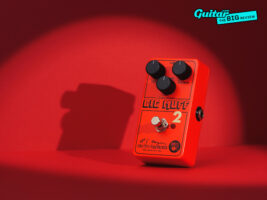
Electro-Harmonix Big Muff 2 review – a forgotten fuzz masterpiece, or just a marketing exercise?
$122/£125, ehx.com
It doesn’t take much to get me excited about a new pedal – especially one with the words ‘Big Muff’ on the front. And when it’s a long-forgotten variant that never went into production, found by chance in a pile of old papers and now brought into existence after almost half a century… well, by the time the announcement video finished I was sitting in a pool of my own saliva.
READ MORE: Strymon Fairfax review – an old-school drive pedal with plenty of rough edges
But then, after I changed my trousers, my inner cynic began to stir. Do we really need yet another Muff? If this circuit is so good, why did Electro-Harmonix choose not to build it in the late 70s? And doesn’t the involvement of JHS Pedals supremo Josh Scott – undisputed world champion of stompbox salesmanship – suggest the whole thing might be more about clever marketing than genuinely new tones?
Image: Adam Gasson
Electro-Harmonix Big Muff 2 – what is it?
The story goes that Josh and archivist Daniel Danger were researching their book on the history of Electro-Harmonix when, during a visit to the old workshop of original Big Muff designer Bob Myer, they found the hand-drawn schematic of the fuzz that never was. And so, with Bob’s blessing, they made it real – first as an ‘EHX by JHS’ pedal in a large folded metal enclosure, and now also as a nano-sized version produced by EHX.
The technical angle is that it’s powered by dual op-amps rather than transistors. That’s also true of the model favoured by Billy Corgan and recently reissued as the Op Amp Big Muff Pi, but we’re told to expect a different sound here – something “slightly more dynamic, slightly more fuzzy”. It’s controlled by the classic three-knob array of volume, tone and sustain.
Image: Adam Gasson
Electro-Harmonix Big Muff 2 – what does it sound like?
It sounds big and it sounds muffy, but that doesn’t mean it sounds Big Muffy… at least, not completely. This is a fuzz with no shortage of thickness, and when you hit strident power chords you can certainly hear the rich, gurgly roar that defines the type – while single notes sing out with that familiar boop-boopy smoothness.
It’s only when you crank the tone knob to open up the top end that… well, it doesn’t happen. You can sharpen up the treble for sure, but it never fizzles and sizzles with the freshness of its many siblings. What you get instead is a solid midrange – which is not exactly vintage, and can sound congested at times, but could be welcome if you’re not a fan of the old Big Muff mids-scoop.
Max out the sustain and it gets fuzzier, of course, but you might also notice a jittery gating effect when you stop playing, which is not pleasant. Luckily, there are two ways to avoid this: either keep the sustain down at around halfway, which is quite filthy enough for most use cases, or just carry on playing forever.
Electro-Harmonix Big Muff 2 – should I buy it?
Remember, this circuit wasn’t lost – it was rejected – and there’s nothing in the performance of the Big Muff 2 to suggest that was some sort of calamitous mistake. If you’re looking to buy your first Muff, this is not the one to go for – EHX has several other options that cover the basics better.
Having said that, once you strip away the backstory and judge the pedal on its own merits, it is really rather nice. This is a straightforward fuzz with a powerfully throaty sound that might even hit the spot more satisfactorily than a traditional Muff for some players.
Electro-Harmonix Big Muff 2 alternatives
For something tonally similar but a little more ‘correct’, your first port of call is probably the Electro-Harmonix Green Russian Big Muff Pi ($109/£85). But there are hundreds of refinements to the formula from other makers, including the EarthQuaker Devices Hoof ($179/£195) and ThorpyFX Fallout Cloud (£199.99/$299).
The post Electro-Harmonix Big Muff 2 review – a forgotten fuzz masterpiece, or just a marketing exercise? appeared first on Guitar.com | All Things Guitar.
Source: www.guitar-bass.net