How do you play guitar with a hologram? The live guitarists behind ABBA Voyage reveal all
The ABBA Voyage concert experience brings to life again the timeless music of one of the 70s’ biggest pop groups, ABBA. The Swedish foursome called it a day back in 1982, though in 2021 they did reunite on record for one last hurrah which culminated in the album Voyage.
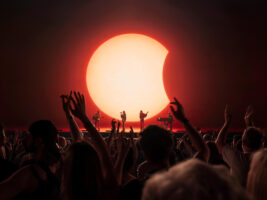
Then the following year, the group was back on the concert stage albeit in digital form or as they’ve now become known as, ABBA-tars. And to describe the ABBA-tars as holograms is inaccurate; they are digital versions of ABBA created through cutting edge motion capture performance techniques by video effects company, Industrial Light & Magic – the company behind some of the most incredible Hollywood special effects of the last five decades.
READ MORE: Yard Act’s Sam Shipstone on clichés, concision and how guitars returned to their core: “Great bands really find their style, and that’s the thing they sit on”
The Voyage concert is held in the purposely built ABBA Arena in London and features a 10-piece live band, with the twin guitar team of Fernando Sanchez and Christian Mendoza tasked with replicating live all the intricacies of the guitar parts on the original ABBA recordings.
But ABBA Voyage is no ordinary show. It’s a concert where the technicalities involved are multi-levelled, especially when it comes to the live band who, each night, face the challenge of bringing ABBA’s memorable music to life for 21st century audiences.
“We try to stick as much as we can to the original part and to the arrangements that we’ve been told to play,” explains Sanchez who first auditioned for the gig in June 2025 and made his live debut with the Voyage band in December, 2025. “However, because we’re playing every night and doing a lot of shows, you are in this little bubble and so, you start adding a little note here, and adding on something there. But when I do that personally, the next day I try to go back to the original so I don’t lose track of what I’m supposed to be playing. We know as musicians we can do other things and maybe embellish it or do something, but I always try to go back to the original the next day.”
“I would say that this is not a job for me to put much of a stamp on what I want or what I would think would be needed,” adds Mendoza, who is now in his third season with the Voyage troupe after having first auditioned back in December 2023, and made his live debut in April, 2024. “These are timeless classics and to go and change like a lead part because I want to do something, is not on. I think the purpose of us is to recreate this music and have people hear these lines and be excited that they’re hearing the stuff that they were excited about when they were young or first heard it.”
Image: Johan Persson
Reconstruction Workers
From day one the modus operandi for all the musicians involved with the concert was to reconstruct the sonic aspects to the original recordings in minute detail. In order to help the musicians along in the process of learning the material, charts were also offered up.
“It’s not necessarily a gig where you have to read music, but it is obviously a massive plus if you do,” explains Sanchez. “I do read music. So, in my case, I got sent the charts and I had to learn the songs before we went into rehearsals. And then in rehearsals we have our MD who is guiding us through it, so if we’re playing a part that is not being played correctly, he will come and let you know what we’re supposed to be basically doing.”
And early on in the process, the musicians received some guidance from ABBA’s piano playing maestro Benny Andersson.
“When I joined, Benny was at some of the rehearsals and there were a few things like if he heard something that he maybe wanted more closer to on the record, he would mention it,” recalls Mendoza.
“Like with the lead line in Knowing Me, Knowing You. It was funny because he said, ‘I don’t know what’s on the paper as it doesn’t matter, because what’s on the record is this’. And he then sang the line to us. So, he knows that sometimes liberties maybe get taken in the way that stuff gets written, but that was an example of something where he felt strongly, ‘Let’s do it like the way it was’.
“But he was very gracious. I believe that at that point had we been playing something very differently, I feel like that wouldn’t have happened because they would’ve made sure that before Benny came to the rehearsals, we were playing the music the way it is intended.”
Fernando Sanchez. Image: Press
In The Pocket
One of the difficulties both guitarists and the band face each night are the occasional alternating tempos of the original recordings which were recorded in the pre-digital age where click tracks weren’t a common practice in the studio as they are today.
“Some of the tracks are not exactly to the grid,” says Sanchez. “People record to a click track today, but some of the avatar’s instruments are not to a click so, we have to pay attention. For example, in Chiquitta, there’s a part where Christian and I are playing the exact same thing and we need to listen to the track intently because it kind of moves around the click. And if we are not playing accurately to that part, it’ll just sound a bit messy.”
“There’s a click in our tracks, but they [ABBA] didn’t put the music to a grid, so it’s going to move,” adds Mendoza. “In Chiquitta, because everything goes quiet at one point, the click obviously is louder in our ears than normally, but because the piano part is slower, we kind of have to ignore the click in that part at the beginning and just play to the piano, even though the click is still there.
“We have to play together to this piano part and ignore the click to kind of know when to come in. It’s only for a couple of bars, but those are little challenges we face. Sometimes intros too like on Thank You for the Music the click is only given to us in the intro and then we don’t have a click. So, the drummer has to play to the vocals and we have to match his beats to the vocals. But that’s a lot easier to feel, as you’re playing in time following the drums.”
Christian Mendoza. Image: Press
Knowing Me, Knowing Tubes
Perhaps surprisingly given the technological nature of the show, both guitarists are running real tube amps for the show. Both employ Mesa/Boogie California Tweed amps, with Mendoza primarily using a Fender Telecaster for the majority of the concert, and a Fender Strat for a few select numbers, while Sanchez uses a Fender Stratocaster for the entire performance. Just as important is the selection of tones for the guitars, which too, has to be matched to the tones on the recordings.
“I built my pedalboard to what I knew and also after hearing the music, certain overdrives because the gig doesn’t really necessarily need much distortion,” explains Mendoza. “I try to get close to it with just an overdrive tone, not so much 80s distortion or whatever. I got a Phase 90 too because of the funky parts and all that kind of stuff. I remember when I auditioned, there was somebody who came in with a sort of more of a heavy metal tone and they were playing right, but I remember they were asked, ‘You think you could put less drive on your sound as it’s not quite in context with the style.’
“I got given the pedalboard that the previous guitarist had chosen for the gig,” interjects Sanchez. “So, for me, the challenge was to rearrange the way I wanted to use the pedal board, because obviously the other guitarist was using it in a different way. So that might have affected the tone. I had to try to change a few things, but it was a conversation that we had to have with the guys, so that I didn’t change the tone much because it’s a very specific thing for the show.”
Image: Johan Persson
With multiple performances per week, sometimes with two in a day, how do the pair cope with the pressure to deliver the goods night after night.
“Because it’s a live band and we’re on stage all the time, for me that gets me buzzing with the audience,” affirms Sanchez. “It’s not like other stage shows where you are sat in a pit and it’s very small. I get excited if I’m going on stage to play to 3,000 people every night and even though we’re playing the same thing, there are fantastic arrangements, and the band that we’re playing with is amazing. And we have certain freedom to interact with each other on stage, too, which makes it more interesting.”
“I’m what they call a road dog,” concurs Mendoza. “So, I’m more than happy for me as a musician personally. A day played, is better than a day you have not played. And I started out with my first paid gig, when I was 15 years old playing weddings with my parents. My parents are musicians and I played clubs five days a week and three one-hour sets back in my home country of Mexico. So, I’m used to very late nights and playing and that’s just what I live for.”
The post How do you play guitar with a hologram? The live guitarists behind ABBA Voyage reveal all appeared first on Guitar.com | All Things Guitar.
Source: www.guitar-bass.net