Martin 00L-16E review: “this is not your grandaddy’s Martin”
$2,499/£2,499, martinguitar.com
When you think about a Martin guitar, you probably have a pretty set image in your head. Very likely, you’re imagining a classic square-shouldered dreadnought guitar with a natural top and dark-stained back and sides. And that’s fair enough: Martin invented the dreadnought after all, and as such they are more than entitled to lay claim to this most iconic and imitated guitar configurations.
READ MORE: Martin 00-10E Retro Joe Bonamassa review: “Forget the name on the label, this is a great guitar”
The thing about being iconic however, is that it’s not exactly something that stands out from the crowd. I could happily fill the rest of the word count of this review listing the names of legendary artists of literally every genre imaginable who have at one time or another sat down with a natural-finished Martin on their laps and made brilliant music.
For a lot of us, that’s part of the appeal – but clearly not everyone feels that way. If you’ve been paying attention to festival stages over the last few years, you’ll have noticed that artists – especially younger ones – seem to want their acoustic guitars to deviate from the norm. Where once practically anyone who was anyone would stride out with a natural-topped acoustic, increasingly we’re seeing painted tops and Gibson-adjacent body shapes favoured over the old faithfuls.
Martin has clearly noticed too, as its recently revamped 16 Series attests. This new range has brought a bunch of rather unconventional-for-Martin shapes to the party – including a slope-shouldered dread, a jumbo and the 00 you see here. Even more striking, however, are the tops – which in what must be a first for the brand, aren’t even available in natural finishes. Bright reds, blues, blacks and whites abound here – this is not your grandaddy’s Martin.
Image: Adam Gasson
What is it?
The 16 Series has been around since the 1980s, and in that time the range has existed to offer something a little different – the focus was always on providing instruments that catered to evolving player needs and tried something a bit different. The old D-16E for example, had a shallower body depth than standard, to make it a more comfortable player, while the 16 series was also the place where Martin’s controversial Streetmaster factory-worn shade top first arrived – it has long been a place where the brand has felt comfortable taking big swings.
The new 00L-16E certainly feels like a bigger swing than most however. Fundamentally, it’s a 14-fret sloped shoulder guitar, and it’s quite impossible to continue in this review without mentioning the Gibson-shaped elephant in the room. In contrast to say, the Joe Bonamassa 00 that we featured recently, the slope-shouldered design is very, very familiar to fans of Gibson’s 1930s small-bodied classic.
Of course, Gibson doesn’t own the exclusive rights to this shape any more than Martin does the dreadnought or auditorium. And, like the slope-shouldered DSS-16E, this is far from the first time that Martin has made guitars with this body shape in its long history. All that being said, it does make you do a double-take when you pair that headstock with that body – it’s a bit like seeing Lebron in a Phillies jersey… it doesn’t look bad per se, but it is a little jarring.
On closer inspection however, there’s plenty to differentiate it from an L-00. For starters, the neck has a 14th fret join and a 24.9” scale length – slightly longer than the 24.75” of a Gibson – which should make for an intimate but not cramped playing experience.
Image: Adam Gasson
It also sports Martin’s High Performance Taper neck, which means a roomy 1.75” at the nut, while my calipers register a roomier 2.13” at the 12th fret. The neck profile is Martin’s modified low-oval type, which means it has a little more shoulder than a vintage V-shape, with a little more general thickness all round.
In terms of build, we’re getting a spruce top with mahogany back and sides (another contrast to an L-00), with an ebony bridge and fingerboard. The neck itself is our old friend “select hardwood” – Martin uses this catch-all term to cover its bases around wood supply chain issues, and in practice that means it’s usually either tropical mahogany or Spanish cedar. The grain on this one looks like mahogany to me, but you will get whatever was available on the day the guitar was made!
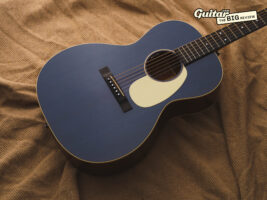
The most striking thing about these new 16 Series guitars are the finishes. For the 00L-16E, you can choose between the shade topped 1935 Burst, or one of two solid colours – Black Smoke and this Blue Denim. This isn’t the first blue Martin guitar – Eric Clapton had a limited-run ‘Jersey Blues’ model a while back – but it is still quite an unusual colour to see on an acoustic. Interestingly, both of the solid colours are not really solid at all – they’re semi-transparent, allowing you to see the full grain pattern beneath the stain, at least up close. This does also head off the oft-repeated accusation that a painted top was just a convenient way to hide inferior quality wood – there’s no hiding place here.
The tops are all gloss-finished, which makes the decision to make the neck and sides (which are stained dark) in matt slightly confusing. I could understand doing the neck in satin from a playability perspective, but it does make the guitar look a little cheap from behind.
Elsewhere it’s all pretty restrained and stripped back – the binding is simple white plastic with a multi-stripe rosette, bridge pins are black plastic, while at the other end you’ll find a TUSQ nut and simple abalone dots.
Plugged in sounds are courtesy of a trusty Baggs Element system, and you also get Martin’s softshell case into the bargain – a reassuringly padded, semi-rigid affair that will protect your guitar from everyday bumps and thumps, but isn’t the sort of thing you’d want to check at an airport or toss into the back of a van with a load of other gear.
Image: Adam Gasson
Build Quality and Playability
Talking about ‘value’ when you’re dealing with a $2,499 guitar seems slightly churlish in this economy, but there’s no escaping the reality that these are the cheapest spruce-topped guitars that Martin currently makes in Nazareth, Pa. The only cheaper USA-made Martins are the all-mahogany 15 and 17 series, and you’ll need to stump up another 100 bucks to get an all-satin Standard Series D-18, for example.
All of which is to say that efficiencies have had to be made to get a guitar with this level of spec and materials made in the USA for this price, but pleasingly very few of them appear to be reflected in the build. On the outside, that Blue Denim finish had better be done well given how eye-catching it is, and it has a nicely even stain across the top, one that nicely showcases the spruce grain underneath. The satin-finished neck and headstock are equally nicely applied, and feel smooth and comfortable to the touch – there’s no stickiness here.
The neck has a nice middle-ground feel – it’s not so chunky that you’re going to struggle to grip it with smaller hands, but it doesn’t disappear in the way that some vintage Martin V-neck does either. It’s supportive in the right areas.
The body is compact without feeling too toy-like, even for someone as big as me, but it still feels very accessible. The slope-shouldered dimensions definitely help in this regard, with the svelte upper section and narrow waist giving way to a more substantive lower bout.
Peeking inside, and it’s all very neat and tidy – the spruce scalloped X-bracing and purfling is expertly cut and installed with no excess glue or any rough bits.
Image: Adam Gasson
Sounds
I’m always pleasantly surprised by the grunt and projection that a small-bodied Martin can present in the right circumstances. I will forever remember the speed at which my jaw hit the floor when I strummed Joan Baez’s 1880 Martin 0-40 in the Nazareth museum a few years ago – it was an absolute canon of a guitar.
Maybe this guitar will sound similarly life-changing when it has had 140-plus years to age, but there’s still plenty to be impressed about this little guy even in its earliest knockings out of the Martin factory.
Played with pick or fingers, it reveals a surprisingly versatile sonic character – more so than most small-bodied Martins I’ve experienced. It’s warm, with a focused mid-ranged and clear top-end, a fact that is no doubt helped by the mahogany back and sides – making it a rather charming and intimate strummer, but one that can really snarl if you dig in and give it some bluesy lines to work with.
Given my previous comments above, I wouldn’t say that I’m surprised by the projection on offer here, but it is still notable. While it’s not going to shout above a band without plugging in, it’s pokey and muscular in a way that is extremely enjoyable.
If you do need to shout over a band, however, the Baggs Element unit is a well-travelled performer. It’s simple and sounds good – avoiding any unpleasant piezo quack while giving a perfectly cromulent impersonation of the unplugged sound. It’s not going to change your life, but anyone expecting that from a plugged-in acoustic sound at this point is probably kidding themselves.
Image: Adam Gasson
Should I buy one?
Trying to work out the sort of person that might buy this guitar is an interesting conundrum. Because by and large, my impression of the average Martin customer is someone who is drawn in by the classic looks and unimpeachable heritage of the brand and its instruments. That’s not to say that Martin hasn’t been actively trying to innovate and try new things over the last 100-odd years, often with rather impressive results, but the perception is there.
The question for many of these new 16 Series guitars is, ‘Why would you buy this over a Gibson?’ – a brand for whom the slope-shouldered thing is much more familiar in the eyes of most musicians – and it’s one I’ve been wrestling with myself.
Visually, these guitars stand out in ways that may or may not pique your interest. If you want a Martin that stands out from the rank and file, there’s no better option than this – but that limited finish palette is unquestionably going to alienate a lot of players who don’t want their guitars to present in primary colours.
In terms of sonics and playability, the 00L-16E is a much easier sell. Its interesting blend of Martin and Gibson features makes it an interesting greatest hits package of smaller-bodied American acoustics, with projection, articulation and versatility that could make it a perfect songwriter’s guitar. It’s this, much more than the garish finish, that makes the 00L-16E a worthy and interesting new addition to the Martin canon, whatever colour it happens to be in.
Alternatives
Gibson’s L-00 Century ($2,299) – this is a fine alternative to the 00L-16E. It’s a tried and true Gibson classic for a reason, though the 12-fret configuration does make it a more compact playing experience.
Taylor Ben Harper Gold Label 512e ($2,999) – Taylor has always known a thing or two about making great small-bodied guitars, but the new signature model is a lovely vintage-vibed bit of kit that has pretty unique looks itself.
Martin 0-17 Standard ($2,399) – all-mahogany Martins are a bit of a cheat code to getting wonderfully expressive Nazareth-made guitars for a bit less money than the spruce-topped versions, and this 0-style instrument is a nice compact but not too compact option.
Image: Adam Gasson
Specs
Model name: Martin 00L-16E
Price: $2,499/£2,499
Type: 14-fret slope-shouldered 00
Top: Spruce
Back & Sides: Mahogany
Neck: Select hardwood
Fingerboard: Ebony w/ abalone dots
Scale length: 24.9″ (632mm)
Nut width (1st fret): 1.75” (45.45mm)
Neck depth (1st fret): 19mm (0.75″)
Neck profile: Modified Low Oval
Body depth: 100mm (3.94″)
Bridge: Ebony w/ black plastic pins
Nut: TUSQ
Tuners: Martin nickel open-gear
Electronics: Baggs Element
Weight: 1.7kg (3.7lb)
Finish: Blue Denim gloss top, satin mahogany-stain back, sides & neck
Alternative finishes: Black Smoke, 1935 Burst
Extras: Martin soft shell gigbag
The post Martin 00L-16E review: “this is not your grandaddy’s Martin” appeared first on Guitar.com | All Things Guitar.
Source: www.guitar-bass.net