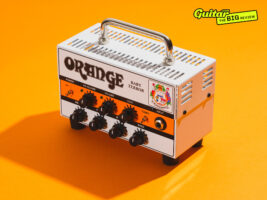
Orange Baby Terror review: a minuscule lunchbox head that packs classic Orange punch
$249/£199, orangeamps.com
Despite the name, the Orange Baby Terror is not a horrifying infantile reincarnation of the current US president, born through mysterious science in order to circumvent term limits and rule over the blasted nuclear wastelands of 2028. It is, in fact, a new amplifier from Orange, one that combines the versatility of the Baby range with the small format of a Micro Terror. Orange has previous for making excellent little lunchbox heads that punch well above their weight classes – will this be any different?
READ MORE: Boss EX-4 Effects Expander review – a force multiplier for compact pedalboards
What is it?
The Terror series dates back to 2007, and under it Orange launched a variety of affordable, all-metal lunchbox heads, starting with the Tiny Terror – there’s an argument to be made that without the Terror, lunchbox heads wouldn’t even be a thing in the guitar amp market.
The Baby Terror is best viewed as a successor to the smallest in the range, the Micro Terror, and at 16.5cm by 14cm by 10cm is almost exactly the same size. The biggest changes are a more complex control panel (with more than one knob for EQ!) and an added effects loop. This comes at the cost of the tube preamp, as the Baby Terror is now fully solid-state.
This tubeless operation and the more fully featured back panel are the headline imports from the Baby range – what we don’t get is the same power rating. Those amps are somewhat defined by their 100-watt class AB power amps, but here we’re working with the same 20 watts as the Micro.
But hey, 20 watts can still be more than loud enough, and the expanded controls and I/O do, on paper, make this far more flexible than the Micro’s one-knob tone control and barebones connectivity. So, let’s see what Orange has packed us for lunch.
Image: Adam Gasson
Build quality and usability
From a build quality perspective, it’s pretty hard to fault the Baby Terror. It has a solid metal chassis and has a little bit more of a reassuring heft – 1.5 kilos compared to the Micro’s 850 grams. It’s still extremely light, all things considered, but the Baby Terror perhaps feels a little more sure of itself as an object. I’ve watched a punk band play with a Micro Terror on full-blast, and during the first song, the head walked backwards across its cabinet, chucking it into the mess of cables behind. That feels a little less likely here.
New for the Baby is that more densely-populated back panel, which offers an effects loop, a dry, direct line-out from the preamp, and a footswitch jack to switch between two pre-set master volume levels. It’s a little crowded thanks to the small size, perhaps, but it’s great to have this much flexibility in setup – particularly if you want to cleanly use reverbs and delays alongside the distortion from the preamp.
And speaking of crowded, the front panel controls are also far busier than the Micro – luckily not to the point where they’re actually difficult to turn, and perhaps smartly Orange has opted for pedal-style indented knobs rather than its in-house rounded ones. The extra controls are all pretty self-explanatory, with a three-band EQ, gain and presence joining the aforementioned dual volume controls. The final touch is the ‘Tubby’ switch, which acts as a low-end boost.
Image: Adam Gasson
Sounds
Upon plugging in to everything set to noon, I’m met with a fairly loud, slightly overdriven sound. It’s perhaps cleaner than you might expect, given Orange’s propensity for raucous drive tones. But it’s soon clear that this amp retains the surprising versatility that other single-channel Oranges can conjure, even more so now that you have a full EQ section and presence control to further adjust things.
The gain control has a very impactful sweep, and three almost-distinct ‘zones’ that it suddenly enters as you turn it. Below 40 per cent is sparklingly clean, between 40 and 60 per cent is where you’ll find edge-of-breakup morphing into bluesy overdrive, and above 70 per cent you’re in far fuzzier territory.
The first zone can be a little thin, but this is helped by engaging the Tubby switch to keep things round and Fendery, rather than anaemic and dry. The middle zone is perhaps more exciting for a clean sound, though, it allows for your playing dynamics to dance across that ever-enticing edge of breakup.
At the fully-dimed end of things, you don’t get the same wall of thick, overblown doominess that something like the OR15 will give you when you max the gain knob, but it is still a pretty pleasing sound. It’s worth noting that as soon as I enter high gain territory, that Tubby switch gets turned off. On the cleans it adds a nice bit of low-end depth, but I find it far more flubby than tubby in gainier territory. The sound, though, is still very pleasing – with a classic Orange throatiness in the midrange that will just make you want to start learning every single C#-era Black Sabbath riff.
The downside is that you don’t get true clean-to-dirty channel switching – if you want to do that across a song or a set, you’re going to need to set the amp clean and get your dirt tones with pedals. Doing this, I find that ragged rock sounds and scuzzy doom sounds are more than achievable with some classic Orange pairings like Big Muffs and RATs. They’re not my favourite tones that I’ve heard from an Orange solid-state head – but for £199, they’re hard to be too negative about.
Image: Adam Gasson
Where things do fall a little short is on the tighter, chuggy and modern side of things. It’s not a sound the amp can achieve on its own, as the gain tops out at Sabbathian stoner levels. And sadly, setting the Baby Terror to medium gain and boosting it with a TS-style pedal doesn’t get the best results either – with a bit too much high-end fizz, and a low-end that’s hard to clean up even without the Tubby switch engaged. This is a bit of a shame, but perhaps a less responsive and less boostable front end is the price we’ve paid here for going all solid-state.
What does help expand out the possible sounds is the effects loop. It’s a cool feature to see on a head this cheap, and obviously the more ambient-minded players will welcome the more flexible reverb and delay pedal setups it allows. The other benefit is that you’re no longer chained to the preamp that’s in here – if you wanted to run a preamp pedal or a modeller straight into the power amp here, you could – which is extra good news for giggers on a budget, given the upcoming avalanche of affordable NAM A2-capable modellers.
Speaking of gigging, a quick word on volume – this thing is loud, with a maximum volume that’ll be quite antisocial at home unless you live in the woods, and even then you’ll probably deafen a few squirrels. But that being said, it doesn’t quite match the kind of low-end impact you can get from something like the main Baby range or the Super Crush. It’ll likely be enough for most small gigs, as long as you’re not relying on your cab’s volume alone – and similarly, unless your drummer hits extremely hard, will be more than loud enough for practice rooms. Another gigging bonus is that footswitchable volume – for rock sets where the only effect you’ll need is a solo boost, all you’ll need is that footswitch.
One extra consideration is that the line-out is effectively just a balanced version of the preamp send – there’s no cab sim here. Having heard the analogue cab sim on the Super Crush, that’s not really a huge loss, but keep in mind it’s not quite viable as a straight-to-desk thing in a live situation.
This dry line-out also replaces the headphone jack that the Micro Terror had. Thanks to Positive Grid, the floodgates have opened for a bunch of digitally-driven mini practice amplifiers, and Orange seems totally uninterested in making this kind of amp. And so binning off the headphone jack seems to be making the assumption that you’ll use one of the many other far more flexible solutions for all-in-one coffee table practice – and it’s a fair assumption.
Image: Adam Gasson
Should I buy one?
There’s a reason the first Micro Terror was such a hit. It weighs as much as a loaf of bread, costs less than your average boutique pedal, and can fit into even the most fashionably tiny backpacks – all while still kicking out Orange tones at very respectable volumes. The Baby Terror commits to all of these good points with aplomb, and for many, the added effects loop will be worth the price of admission alone.
Of course, it is not as high-fidelity, tonally, as it could be. The low end can be a little hard to manage, and the midrange throatiness won’t be for everyone. But that’s just Orange being true to the Orange of it all – there are plenty of options if you want a more modern sound and digitally-driven flexibility. It’s great to see Orange stick to its loud-as-hell, analogue-as-possible character and not just sound like everyone else. This, ultimately, is an amp with ‘Terror’ in its name, and its nature.
Overall, it’s not that much pricier than the original Micro, and it’s a good deal more flexible, so, really, if you are walking to every gig, don’t need the earth-shaking power of a full 100 watts in your band and like that more raucous Orange approach, then it’s a very viable option
Alternatives
There are, of course, a good few different options for amps in this price range depending on what you need. The original Micro Terror ($159/£139) is great if you don’t care about an effects loop, and you just want a 12AX7 to abuse with a fuzz pedal. If you want a little bit more of a classically chuggy sound, Laney makes its own range of affordable-but-punchy solid-state heads – try the Ironheart Foundry Series IRF Leadtop ($299.99/£149.99) for size. If you do want the classic Orange sound from a portable, flexible solid state head but 20 watts feels a little dinky, I’d recommend the Tour Baby 100 – although it is a little over twice the price at $599/£459.
If your reasoning for wanting a wee little amp like this for home usage rather than gigging convenience, something like the Blackstar Beam Mini ($229/£169), Positive Grid Spark Go ($99/£95) or Spark Mini ($199/£199) will be far more flexible in terms of playing along to tracks and headphone connectivity.
The post Orange Baby Terror review: a minuscule lunchbox head that packs classic Orange punch appeared first on Guitar.com | All Things Guitar.
Source: www.guitar-bass.net