
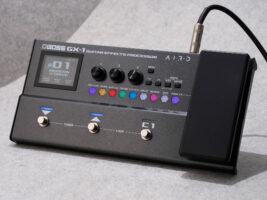
Boss GX-1 review: A gateway to bigger sounds without the bigger price tag?
$229 / £219, boss.info
In the 49 years since the brand first blessed the world with a compact effects pedal, Boss has been the musical equivalent of a bandmate that always turns up on time, has learned the material perfectly, and offers to be the designated driver home.
READ MORE: Fender Studio Pro 8 and Quantum LT 16 interface review: a guitar-recording match made in heaven?
The best Boss products tend to hit the sweet spot that has made the compact format such an enduring and popular icon of guitar – they’re not too expensive, they’re very well built and they sound great.
Into that equation comes the latest affordable multi-effects processor, with a simple but compelling mission statement: a unit that’s fully loaded with effects, has a user-friendly interface, and contains enough sonic flexibility to keep you knob-turning until you feel the need to upgrade – if ever.
With an SRP of just $229, it’s also eyebrow-raisingly affordable in a world of four-figure multi-effects units. Obviously, this is not meant to go toe-to-toe with Helix or Neural, but so many other players in this space are trying to be that on a budget, leading to a glut of menu-heavy and often clunky equipment that can fry the brain of a newbie to the world of multi-effects.
This, on the surface at least, looks like a much more gentle introduction…
Boss GX-1: what is it?
The GX‑1 is an all‑in‑one guitar effects processor aimed squarely at entry‑level and intermediate players on a budget. It bundles together all the usual suspects of classic effects – overdrive, distortion, modulation, delay and reverb – alongside an intriguing collection of built‑in amp models, all housed within a solid, yet lightweight and portable unit.
Think of it as a guitarist starter kit that’s been lovingly curated rather than hastily assembled. The GX‑1 offers a full buffet of tones, enough to help you discover what you like with ease.
Accessibility is clearly at the forefront of the design process here. You’re not expected to understand the complexities of audio, nor do you need a PhD in engineering to set up your own presets.
Instead, it’s about plugging in, scrolling through sounds, and stumbling upon something that makes you want to keep playing, which, ultimately, is the whole point, right?
Image: Adam Gasson
Boss GX-1: build quality and usability
If there are two things Boss consistently gets right, it’s usability and solid construction. The GX‑1 continues that proud tradition with reassuring confidence.
The interface is clean, logical and refreshingly inviting. Navigating through presets feels straightforward, and making adjustments is as intuitive as it gets. Hold down the effects button of your choice, and the screen presents your options. Easy. It’s the kind of unit where you can spend more time actually playing and enjoying than puzzling over button combinations and complicated menus.
Image: Adam Gasson
Physically, it’s lightweight but far from flimsy. The chassis has that trademark Boss ruggedness, giving me the confidence to toss it into a gig bag without hesitation. The footswitches are responsive with a satisfying “click”, and the expression/wah/volume pedal invites some Hendrix-esque stomping. I don’t expect it to be as bomb-proof as my precious 1980s OD-1, but then again, that’s not the brief here. It’s less future heirloom and more faithful companion – the sort of unit you might outgrow eventually, but not before it teaches you a few valuable lessons.
For bedroom practice, guitar lessons, rehearsals and even the odd gig, the GX-1 is more than up to the task. It can also be battery powered, though it breaks with the conventions of some contemporary multi-effects to eschew a built-in rechargeable battery in place of four AA batteries. This is perhaps not the most environmentally friendly way to go about things, and the cost of those batteries will add up over time, but you can also see the wisdom of using something that is easily and quickly replaced – it will also likely enhance the GX-1’s longevity. As well as keeping the initial asking price down.
Image: Adam Gasson
Boss GX-1: sounds
Plugging in, you can really get the sense that the sonics will be where the GX‑1 begins to justify its place at the upper echelon of this hotly contested corner of the market.
The range of effects and modulation on offer is impressively broad, especially at this price point. From fuzz, crunch, and high-gain drive to spacious delays and reverbs, there’s a lot here to explore and edit to taste. The effects themselves really are top quality, something I wouldn’t have doubted from Boss-made equipment.
Boss has long been known as the undisputed king of looper pedals, so I was pleased to see an excellent little looper has been included here. It’s a little fiddly to activate, as you have to spread your foot across two pedals to get it started. But from there, it’s more straightforward. It’s an inspiring setup on the effects side, particularly for newer players who are still figuring out what “their sound” might mean, and the possibilities really are endless.However, the 23 included amp models, along with many of the harsher drive tones, are something of a mixed bag. The bright, clean presets are spot on out of the box, with very little adjustment needed. They were more than suitable for live use and even some light recording. Some of the crunch sounds hold their own too, particularly when layered into a full mix.
But push things further, and the cracks begin to show. Higher‑gain tones can feel a touch flat, like a photocopy of a photocopy rather than the original document.
That said, context is key. Through many low-stakes settings, these tones work absolutely fine. They might not fool a seasoned tone purist with a Mayer-like ear, but they’re more than capable of inspiring a player who’s still finding their sound.
Image: Adam Gasson
Boss GX-1: should I buy one?
If you’re just starting out, or looking for a wallet-friendly way to explore a rich tapestry of guitar effects for rehearsals or demo recording, the Boss GX-1 is a strong contender. Its satisfying combination of user accessibility, a wide range of tonal possibilities, and build quality that exceeds its price makes it an excellent choice.
The amp modelling won’t compete with some higher-end units, but the strengths here outweigh the limitations tenfold.
Boss GX-1: alternatives
There’s so much varied and decent competition at this end of the market, the best thing here is probably to look at what you really want if this ain’t it. If you want ultimate screen-free multi-effects simplicity, then the Line 6 POD Express ($179.99/£149.99) is a great option, as is Blackstar’s ID:X Floor One ($269.99/£169). If you want something that’s perhaps a little more in-depth in terms of sounds and editing, Boss’s own GX-10 ($439.99/£349) is very valid, while the HeadRush Flex Prime ($499/£459) goes even further with profiling and all sorts. If you want something that’s directly going against the GX-1 in vibe and price point, NUX’s MG-300 ($169/£129) and Mooer’s GE150 (£149) don’t have Boss’s prestige, but they’re very good for the money.
The post Boss GX-1 review: A gateway to bigger sounds without the bigger price tag? appeared first on Guitar.com | All Things Guitar.
Source: www.guitar-bass.net