Red Panda RD-1 Pitch Delay review – a clever compact delay with multiple note-manipulating tricks
$229/£224, redpandalab.com
The job of a delay pedal is simple: to listen to what you play then repeat it back to you a few times. Some of them do this job very well – but the really good ones do it extremely badly.
READ MORE: Strymon Olivera review – a notoriously lo-fi delay effect gets the hi-fi treatment
The Red Panda RD-1 Pitch Delay is here to wreck stuff, and that word ‘pitch’ is your big clue as to how: from detuned weirdness to cascading octave screeches, this is all about digital manipulation of notes. Not everything it does is strange and discombobulating – there’s a nice reverse function, and plenty of scope for more standard delay sounds too – but that just means you can lower yourself into the madness gently.
Image: Richard Purvis
What is it?
The RD-1 has been designed as an alternative to the Red Panda Raster 2 for more compact pedalboards (and more compact bank accounts). If you’re familiar with that pedal, you’ll have a decent idea of what to expect here; if you’re not, let me just begin by telling you it’s a gem.
The Raster 2 is a stereo pedal with lots of multi-function knobs, a second footswitch for layered effects, and the ability to store and recall presets. You’re not getting any of that with its diddy sibling, but you are getting three different pitch-altering modes and an input for an expression pedal, plus a hidden tap-tempo option.
Those modes are called ‘frequency shift’, ‘detune’ and ‘chromatic transpose’, and they have a radical effect on what happens when you tweak the shift knob on the left. Like, radically radical…
Image: Richard Purvis
Sounds
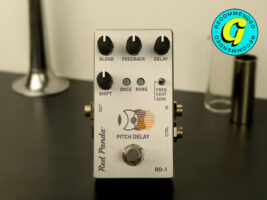
The shift dial pitches downwards to the left and upwards to the right, naturally, so when it’s pointing straight up the RD-1 becomes a simple, non-mangling digital delay with standard controls for time, feedback and dry/wet blend. While this sound is nothing special it is pleasant, and you only have to tap the reverse button to turn it into something much more fluid and ambient.
But we’re all here for the pitch effects, so let’s get a shift on. The first one is the most out-there of the three, with strangely metallic repeats that can sound something like church bells run through a ring modulator. It’s extreme, but again the reverse function is a great sweetener; and while the pitch-shifting is cumulative, so that each repeat jumps off from the shoulders of the one before, hitting the ‘once’ button means it will only shift the first time – a very different, much more manageable effect.
The second mode measures its shifting in cents and only goes a couple of notes in either direction; the best use I found for this was setting the knob just a tiny twist beyond noon, with the ‘once’ button engaged, for subtle thickening with a hint of modulation.
But the third mode is the one that I suspect most people will end up sticking with. This offers fixed semitone intervals, so perfect harmonies – delivered with a pleasing hint of lo-fi jitteriness – are now in play. With a single shift of a fifth or an octave up, this can sound creepily pretty; now start dabbling with those two buttons and the feedback knob (plus an expression pedal if you have one), and you might just find yourself in glitchy pitchy noise-scape nirvana.
Image: Richard Purvis
Should I buy one?
Ideally, no, you shouldn’t buy the RD-1 – you should get the Raster 2. But what’s impressive here is how much of that pedal’s unique magic has survived the transition into a properly compact stompbox.
Of course it’s not as good, but it’s closer than I was expecting; and for some players – those who only ever play in mono and don’t need instant access to more than one or two unorthodox delay sounds – the smaller footprint and cleaner interface might even make it more appealing.
Image: Richard Purvis
Alternatives
It’s infinitely more fiddly than the RD-1, but the Gamechanger Audio Auto Delay (€272/£299/$329) can do extreme pitch swoops among its many digital tricks. A more simple option is the Dreadbox Raindrops (€214/£229/$299) – or you could keep it old-school with the Beetronics BeeBeeDee ($299/£289), an analogue delay with digital control.
The post Red Panda RD-1 Pitch Delay review – a clever compact delay with multiple note-manipulating tricks appeared first on Guitar.com | All Things Guitar.
Source: www.guitar-bass.net