The best pitch shifters for guitarists: from Boss and DigiTech classics to sound-bending oddities
You shift the pitch of your playing whenever you switch frets, bend a string or turn a tuning peg, but the sounds (and pitches!) available via a pitch shifter pedal open up new frequencies – and ways to leap between them.
READ MORE: DIY workshop: adding coil-splitting to humbuckers with push-pull pots
Depending on the pitch shifter, you can add harmonies, shift everything you play up or down by notes or octaves, and sometimes tap into more creative sounds and modulations. You’re a few twiddles and a stomp away from filling out the harmonics of your compositions, adding oomph to riffs, helping melodies cut through, or enriching the texture of your guitar’s sound.
The best pitch shifters range from simpler models that do just one type of pitch modulation, such as drop-tuning or octaving, to more multi-fangled options with textural effects like ring modulation and harmonisation, or additional features such as an in-built expression pedal.
Whether you want a functional pedal to adjust your pitch, or you’re looking for something that will spark creativity and broaden your compositional horizons, you’ve found your way to the right type of effects pedal. You can find ten of our favourites below, from the likes of Boss, DigiTech, Electro-Harmonix and TC Electronic.
At a glance:
Best overall: Boss XS-1 Poly Shifter
Most powerful: Boss XS-100 Poly Shifter
Best for downtuning: DigiTech Drop
Best for classic Whammy sounds: DigiTech Whammy 5
Best compact: Electro-Harmonix Pitch Fork
Best harmoniser: Boss PS-6 Harmonist
Best workstation pitch-shifter: Electro-Harmonix POG3
Best for experimental sounds: EarthQuaker Devices Data Corrupter
Best doubler: TC Electronic Mimiq Doubler
Best ring-modulator: DOD Gonkulator
Why you can trust Guitar.com
Best overall: Boss XS-1 Poly Shifter
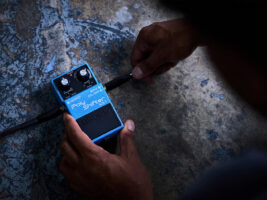
‘Poly’ is right. This small-format pitch shifter from Boss offers extraordinary scope in an impressively navigable package, with drop-tuning, chorus-y detuning, up-tuning, octaving and harmonies. There’s also an expression pedal input, so you can plug one in to produce Whammy-style sweeps.
What blew us away about this pedal was how it delivers its effects in a remarkably pure-sounding form, and with minimal latency, thanks to the world-beatingly clever algorithms under the hood. This translates into crisp drop-tuned riffing, refreshingly clear harmonies, and sweeter melodies than the average pitch shifter can muster. The ’80s-flavoured detune effect is easily accessed via its own switch.
Need more? Read our Boss XS-1 Poly Shifter review.
Most powerful: Boss XS-100 Poly Shifter
The eagle-eyed pedal-enjoyers among you will have noticed that this pedal is closely modelled on the DigiTech Whammy. We dare say it might be even better than the genuine article, with the same smarts and sounds as the XS-1 Poly Shifter (reviewed above), plus a built-in Whammy-style expression pedal and some superior specs. Essentially, it does similar things to a Whammy, but has less latency (delay between hitting your strings and hearing the sound) and purer pitch shifting effects.
Not convinced? The XS-100 has a few extra tricks up its sleeve that just might sway you, including an ear-boggling eight-octave range (that’s more than Mariah Carey), and a swanky digital display that makes it easy to tweak the parameters of its effects.
Need more? Read our Boss XS-100 Poly Shifter review.
Best for downtuning: DigiTech Drop
If you crave the capability to tune your electric guitar extra-low, without spending eternal seconds twiddling with tuning pegs under stage lights, then what you need is a good drop-tuning pedal. This uncharacteristically straightforward option from DigiTech takes your signal and shifts it down, polyphonically, by anywhere from one to seven semitones – or by an octave.
Using the ‘momentary’ switch is key to enjoying this pedal’s creative potential at its fullest. When it’s activated, the footswitch will only activate drop-tuning for as long as it’s pressed, so you can get your pitch to nimbly dip and dive with a press of the toe.
Best for classic Whammy sounds: DigiTech Whammy 5
If you’ve spent much time peering at alt rock pedalboards from the 1990s onwards, there’s a good chance you already know and love the DigiTech Whammy. Radiohead, Melt Banana, QOTSA and countless other guitar bands owe their spikiest, harmonically squelchiest sounds to this ostentatious box of tricks.
There’s much debate over which iteration (or spin-off) of DigiTech’s pitch shifting icon is the best – which one bubbles with the most characterful digital artefacts, which has the nicest tread on its footpedal, and so on. We’re going with the Whammy 5, which sounds much better than its predecessors when chords (not just individual notes or melodies) are played through its harmonising and octaving effects. No other pedal sounds quite like it.
Best compact: Electro-Harmonix Pitch Fork
You get more pitch-shifting capabilities than you might expect from this dinky EHX stompbox. There are three octaves to shift your way through, and you have the rare option to add up and down octaves at the same time for an ostentatiously filled out sound.
Transposition comes in 12 degrees, from a slight detune to a full octave, selectable via the shift dial or a connected expression pedal (sold separately). As with the DigiTech Drop, you can use it in ‘momentary’ mode for precipitous peaks and troughs in pitch, while the blend control allows you to mix varying levels of pitch-shifted signal with your dry input.
Best harmoniser: Boss PS-6 Harmonist
We promise to stop talking about Boss pitch shifters when the brand stops making such outrageously good ones. This Harmonist model is a slightly different beast to the XS pedals above, with a tighter focus on adding harmonies to your signal.
It takes some mastering, but the PS-6 opens up interesting possibilities for adventurous musicians. Set it to produce three-voice harmonies (taking care to use the minor/major selector) and it’ll make your individual notes sound positively choral. Meanwhile, its seven-octave ‘S-bend’ pitch shifting range can transpose your sound further than the average competing pedal, creating astonishing swoops in your frequency. Max out the fall time setting to enter a wonderland of squelchy squeals.
Best workstation pitch-shifter: Electro-Harmonix POG3
If you could make your guitar sound like an organ at will, why wouldn’t you? This is one of the many possibilities wrapped up in the byzantine knobs and faders of the POG3 – the latest and most sophisticated model from EHX’s line of polyphonic octave generators.
Our reviewer loved getting to grips with this workstation pedal, which retains a lo-fi spirit despite its high complexity (and price). It’s easy enough to dive right in with up octaves, down octaves, envelope filtering and more – and once you’ve got to grips with tweaking all of the pedal’s synth-like parameters, you can start saving your creations to its 100 preset slots.
Need more? Read our Electro-Harmonix POG3 review.
Best for experimental sounds: EarthQuaker Devices Data Corrupter
As you may have gathered, we’re now travelling towards the experimental fringes of the pitch shifting universe, and the EQD Data Corrupter takes the bizarro biscuit.
These days, most pitch shifter pedals are (ostensibly) polyphonic – they work with chords – but here we have a monophonic specialist that’s meant for shifting single notes in some of the weirdest and coolest-sounding ways imaginable. It converts the signal to a fuzzy square wave, splits it into octaves or harmonies, and spits a glorious cacophony that’s better heard than described.
EQD pedals are often one of two things: pointedly simple or intimidatingly elaborate. This one’s the latter, with plentiful voicing, sub-harmonics and pitch oscillation controls to exercise the mind, before it’s blown.
Best doubler: TC Electronic Mimiq Doubler
Doubling is a technique that’s been used to thicken guitar sounds in studio recordings since the heyday of Abbey Road. The guitarist is recorded twice playing the same part, and the two subtly different recordings are put together to create a fuller sound.
Subtle pitch shifting – in the form of detuning – is one of several tricks that the clever Mimiq Mini Doubler uses to reproduce the sound of studio doubling in a live context, along with other nods to human unpredictability like variations in timing and attack. You can use the pedal’s ‘tightness’ knob to narrow or widen the gap between the dry and wet signals, which can both be dialled up or down via their own respective controls.
Best ring-modulator: DOD Gonkulator
If you haven’t gonkulated in the last decade or so, then it’s high time to give DOD’s classic ring modulator pedal another stomp. For us, the Gonkulator is at its best when it’s used to add an unhinged, uncanny feeling to riffs, arpeggios and chromatic runs. Some guitarists won’t find much use for this pedal, but our reviewer certainly had fun combining its abrasive, sci-fi sounds with other effects like looping, delay and reverb. Compared to the vintage unit, too, this modern reissue has moved the carrier frequency control to an external knob rather than an internal trim-pot.
Need more? Read our DOD Gonkulator review.
Why You Can Trust Us
Every year, Guitar.com reviews a huge variety of new products – from the biggest launches to cool boutique effects – and our expert guitar reviewers have decades of collective experience, having played everything from Gibson ’59 Les Pauls to the cheapest Squiers.
That means that when you click on a Guitar.com buyer’s guide, you’re getting the benefit of all that experience to help you make the best buying decision for you. What’s more, every guide written on Guitar.com was put together by a guitar obsessive just like you. You can trust that every product recommended in those guides is something that we’d be happy to have in our own rigs.
The post The best pitch shifters for guitarists: from Boss and DigiTech classics to sound-bending oddities appeared first on Guitar.com | All Things Guitar.
Source: www.guitar-bass.net