Harmony Standard Series Comet with Tremolo review: “This is a cool guitar that allows you to do your thing without trying to look like anybody else”
$1,899/£1,899, harmony.co
Since its renaissance in 2018, the Harmony Guitars brand has earned a reputation for intriguing, retro-coded instruments that aim to offer a different personality to a crowded and often conservative guitar buying scene.
READ MORE: Fender Vintera III Late ’50s Telecaster review: “this guitar has really surprised me”
While the brand has mainly concentrated on modernised tweaks of its original solidbody guitars over its first decade of rebirth, it’s arguably the esoteric semi-hollow designs – beloved by the likes of Dan Auerbach, Jack White, Courtney Barnett, and many others – that people associate with the brand.
Therefore, it made all the sense in the world when Harmony then introduced the H72-inspired Comet in 2021 (the brand also launched a full H72 reissue later that year, but that was made in Asia rather than Kalamazoo, Michigan), and very nice it was too. Now, however, the Comet is getting an overdue bit of wobble, courtesy of a Göldo LT1 tremolo – can it make a good guitar even better?
Image: Adam Gasson
What is it?
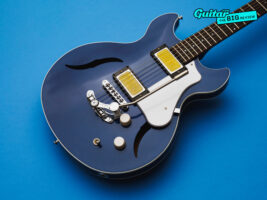
The Comet is a double cutaway semi-hollow electric guitar – think of it as an inflatable SG with twin f-holes. With the exception of the rosewood fretboard the whole guitar body is made from genuine mahogany. So far, so traditional.
We have a cheeky 25” scale which sits nicely between the Gibson and Fender standards and makes for a guitar that balances well and feels comfortable across the player’s body. The neck has a gentle C carve, a 1 11/16” nut width and a 12” fretboard radius.
As with previous Harmony models, the electronics offered are also very retro-flavoured: a pair of custom gold foil humbuckers with single master cupcake knobbed volume and tone controls and a three-way selector switch which is set to the rear of the control array. Hidden in the volume control is a push-pull coil tap giving the player access to slinky single-coil content, which is very welcome.
The main attraction to this model, however, is the Göldo LT-1 vibrato (which Harmony insists on calling a tremolo) system. Göldo originally developed the Les Trem vibrato for its sister brand, Duesenberg, but in recent years the unit has become a popular aftermarket alternative to the mighty Bigsby for Gibson-accented instruments, while also seeing OEM use on a variety of other guitars, most notably Eastman’s Romeo and Juliet electrics. Needless to say, we’re expecting emotive wobbles rather than full dive-bombs here.
Finally, we have a sturdy MONO Vertigo gig bag (MONO and Harmony are both part of the same parent company) which will get you where you need to go and keep the guitar safe and sound.
Image: Adam Gasson
Build quality & usability
Given that it’s almost unheard of to see a USA-made instrument hitting the market without a “2” at the start of its four-figure price tag these days, we could reasonably expect to see some compromises in fit and finish in one coming in at $100 under that bar. However, the quality of the build here is impressive – it’s clean, tidy and well-sorted throughout. It must be said that alone is a huge improvement on many of the original Harmony guitars churned out in the 1960s.
Despite the retro stylings, this does feel like a modern instrument – sleek, immediate and responsive. It is noticeably comfortable. The nitrocellulose finish is well applied, though the Midnight blue finish is definitely a choice. I would have expected something several shades closer to black for ‘Midnight’ personally, it’s all rather royal to my eyes, but that’s all down to personal taste.
Now, if you are expecting Bigsby-like action from the Göldo LT-1 system, you may be in for a surprise. While the Bigsby has a firmer response, the Göldo feels a lot more like the sort of floating vibrato more commonly found on Fender offsets.
Plenty will enjoy how it responds to the slightest touch, though I found it rather too easy to move accidentally – especially given how close the mechanism is to the bridge. Still, if you’re looking for something that allows for a lighter touch, it certainly does that.
What it also does, regrettably, is get in the way of the controls. The bar and the spring are right in the way of the volume control, so it’s much harder than you’d like to adjust on the fly, and it makes activating the coil-split downright fiddly.
Image: Adam Gasson
Sounds
Let’s be real here – no one really knows what a gold foil pickup is supposed to sound like. Yes, we’ve seen them all over the place in recent years – although that fervour seems to be dying down a little now – but the fact that so many USA catalogue guitars and Japanese oddities came with starkly differing versions of these pickups has muddied the waters in terms of what to expect from a guitar toting these retro beauties.
Quite whether these pickups are ‘real’ gold foils then, is rather academic. What we have here are two very capable humbuckers with gold foil covers, which offer a pleasing variety of semi-hollow tones.
The neck pickup is warm and velvety with a smooth jazz voice. Smacking it around a bit with a Bigfoot Engineering King Fuzz reveals dark delights, and a quick flick of the tone knob gets us well into chaotic fuzz territory with added beeps and octaves.
The bridge pickup is snappy enough to get the point across. This is not a 335, but it does still growl when you dig in, even when clean. Slipping a Thorpy Bunker into the equation reveals enough aggression for retro-flavoured grunge and blues–rock at best, but it’s extremely unlikely that our cloven-hoofed brethren will be looking at this guitar to get their thrills.
Popping the push-pull volume knob gives me a voice that is closer to a Tele than a Strat – it’s up to you to decide whether that is what you’re looking for. It’s a useful enough sound within a full band mix, but it doesn’t carry like the full-fat humbuckers when it’s soloing time.
The vibrato system does work well in practice, and thanks to the locking tuners the whole experience is very solid no matter how irresponsible you get with that awkwardly placed bar.
Image: Adam Gasson
Should I buy one?
Are you looking for someone outside the norm that still delivers in both sonics and build quality? Are you sick of sunbursts and Cadillac-inspired finishes? Fancy some vibrato action but in a guitar that can easily be converted to a stop tail if you like? How about a modern take on a design that goes back to the 1960s? Well, the Harmony Comet with Tremolo will give you all of this in a comfortable and engaging instrument.
This is a cool guitar – and let’s not pretend that isn’t important – one that allows you to do your thing without trying to look like anybody else. And as Wallace Stevens reminds us: “Things as they are, are changed upon the blue guitar.”
Alternatives
Looking for a bright blue semi on a budget? The non-trem Comet ($/£1,799) is a very good guitar without many of the usability issues the retro-fit trem has added. The Chinese-made Epiphone Emperor Swingster ($/£799) in Delta Blue Metallic features retro styling, a Bigsby and a pair of Retrobucker pickups. Eastman Guitars offer the strongest direct competition to the Comet with the Romeo LA ($1,979/£1,769). This Chinese-made guitar has build that can go toe to toe with most US makers, and even sports the same LT-1 trem. Feeling flush? The Duesenberg Starplayer TV Phonic model gives you semi-hollow maple construction, gold foil pickups and an own-brand version of the LT-1, while gently relieving you of $4,599
Editor’s note: Guitar.com and Harmony Guitars are both owned by the Caldecott Music Group.
The post Harmony Standard Series Comet with Tremolo review: “This is a cool guitar that allows you to do your thing without trying to look like anybody else” appeared first on Guitar.com | All Things Guitar.
Source: www.guitar-bass.net