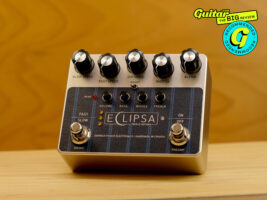
Dawner Prince Eclipsa review – a new spin on the rotary speaker simulator
£499/$589.85, dawnerprince.com
There are some pairs of words we use more or less interchangeably: ‘dial’ and ‘knob’, ‘delay’ and ‘echo’, ‘bassist’ and ‘disappointment’… and also ‘rotary’ and ‘Leslie’. But this last one is complicated, because not every rotary simulator pedal wants to sound like a Leslie.
READ MORE: T-Rex FuzzTopia review – an unorthodox combo of raw fuzz and smooth distortion
While Donald Leslie might have invented the rotary speaker cabinet, other companies later came up with their own variations on the formula. And now, pedal makers are coming up with their own variations on the variations. The Dawner Prince Eclipsa is one of them: a tribute to the near-forgotten Yamaha RA-200.
What is it?
If there’s one guitarist who can bring out the unhinged tone-freak in any mild-mannered music listener, it’s David Gilmour. And among his legion of obsessive admirers is Dawner Prince founder Zoran Kraljevic, whose love of the Pink Floyd man’s tones has already been expressed through the Boonar delay and the Pulse – which is where our ‘alternative rotary’ story actually begins.
The Pulse is based on Gilmour’s Doppola rotating speakers from the 90s (a custom-built take on the Maestro Rover RO-1 design). So the Eclipsa is a logical next step – this time recreating the sound of the Yamaha cabs he was using at the end of the 70s, as well as the Alembic F-2B valve preamps that powered them.
If you are one of those Floyd obsessives, this means what you’re looking at here is the sound of The Wall (well, some of it). If you’re not, a more significant factor is probably the RA-200’s unusual configuration, with three vertically rotating horns at the top and four fixed drivers below. Either way, this is not just another Leslie sim.
Image: Richard Purvis
Build quality and usability
The bit about build quality won’t take long: this is a Dawner Prince after all, made in Croatia to a reliably sky-high standard of workmanship. It’s fairly compact but weighty, with classy knobs and two soft-touch footswitches.
As with most rotary sims, one of those switches is for bypass and the other is for ramping between fast and slow spinning speeds. You can also hold that one down for a couple of seconds to bring the virtual horns to a stop (and then once more to wake them up again), but what happens when you hold down the bypass footswitch is more interesting: the LED changes from red to green, and this signifies that the Alembic preamp will remain active in bypass. Why? So you can use it as an always-on tone improver, and turn the rotary effect on and off without a noticeable shift in tonality or output level.
The preamp has four mini-knobs of its own – volume, bass, middle and treble – plus a bright switch. But the really important stuff is going on up top, where you’ll find the rotary controls: slow speed, fast speed, virtual microphone distance, inertia (up and down ramping speed) and blend. This latter gives you all rotary when fully clockwise, and all static when fully anticlockwise; it’s centre-notched for an even balance between the two.
Image: Richard Purvis
Sounds
Yeah, sure, making sounds is great – but wouldn’t you rather spend the evening watching three little orange LEDs flashing on and off? These represent the three horns, and they’re not quite in sync – which makes them much more interesting to look at (alright, maybe not for a whole evening) and might also create some extra-complex modulation as they constantly shift in and out of phase.
First of all, though, the Eclipsa has absolutely got ‘the rotary thing’, simulating the uniquely fruity swirl that happens when moving sound sources create a layered Doppler effect. As with a good Leslie sim, the slow mode sounds better on the bridge pickup with some overdrive, carving out a swooshy arc that’s doubly immersive in stereo; the fast mode sounds better on the neck pickup for sweet and shimmery wibblage; and the stealthily ramping transitions are weirdly mesmerising.
The next question is whether it really does sound distinct from a Leslie type. My reference here is the Strymon Lex v2, and the difference in voicing is pronounced: while the Lex has a soft, almost watery quality in the midrange, the Eclipsa is less coloured and more solid. It’s not harsh but it can get metallic, in a way that could make you wonder if it’s been hanging out with some flangers.
This isn’t categorically better or worse, but it is its own thing – and it’s not the only unique feature the Eclipsa has to offer. At times you might also notice an added element of quivering fast modulation even when it’s in slow mode – a result, I’m guessing, of the aforementioned phase shifting between the not-quite-synchronised horns. It’s subtle, but it’s very cool.
And then there’s the preamp. This isn’t an extreme tone-mangler by any means, but the three-band EQ is plenty powerful and can easily be set up to thicken the lower mids or maybe give your top end a polish. What it won’t do is bring the scuzz: push the volume and it will get much louder, but with only a moderate amount of breakup. For the full-on rotary roar, you’ll have to stick a drive pedal in front.
Image: Richard Purvis
Should I buy one?
The Eclipsa is another predictably excellent pedal from Dawner Prince, and the question of whether it’s worth getting is complicated only by its spit-yer-drink-out price. Its all-round quality is undeniable, and the sounds it makes are like nothing else out there, but if there’s only room in your life for one rotary sim pedal then you might have a hard time justifying it ahead of a cheaper Leslie-based model.
On the other hand, if you’re a serious Gilmour worshipper – or simply someone who wants all the best tones and can afford to pay for them – then you might consider this an essential purchase.
Alternatives
The Dawner Prince Pulse ($339.95/£286) is a simpler device with no preamp modelling, but its five-knob layout matches the Eclipsa. Back in Leslie land, the Strymon Lex v2 ($349/£319) and Neo Instruments Mini Vent II (€369/£295/$399) are both superb-sounding options, and the latter is also available in a more pedalboard-friendly Micro version.
The post Dawner Prince Eclipsa review – a new spin on the rotary speaker simulator appeared first on Guitar.com | All Things Guitar.
Source: www.guitar-bass.net