Meris Ottobit X review: “how much is a truly unique and creative sonic experience worth to you?”
$599/£599, meris.us
Big box pedals are often where the rubber hits the road in terms of guitar effects innovation – with processing power and control surfaces aplenty to work with, it’s here that we’ve often seen some of the bigger boutique brands really swing for the fences over the last decade.
READ MORE: Death By Audio x Rainger FX Amp Crash review – an amplifier, a speaker, a microphone and multiple effects… all inside one pedal
Meris has been at the forefront of this for some time now. And it’s easy to see why – after all, the brand was founded by one of the founders of Strymon, an engineer who helped develop the legendary ToneCore pedals at Line 6 and a designer with a raft of blue-chip companies in her portfolio.
This rare fusion of talent has led to the brand creating some truly mesmerising pedals over the last decade, and in recent years Meris has been pushing the boundaries into big box pedals in a way that few have before. With the likes of the LVX modular delay and the Mercury X reverb, it’s shown an ability to take everything you thought a pedal should be capable of and push those ideas headfirst into pedalboard-friendly experimentalism.
So when Meris launches a new big box pedal, you should really pay attention, and in the Ottobit X, we might have its most ambitious pedal yet.
Image: Press
What is it?
Most of Meris’s big pedals have their foundation in one of the brand’s smaller pedals, and so it should come as no surprise that the Ottobit X is built upon the Ottobit Jr. The Jr was effectively a bitcrusher and filter that promised “audio in, video game out”. The X version builds on that theme and takes the nostalgic sounds and textures of yesteryear and pushes them into the future.
At its core, it’s a full stereo lo-fi and bit-crushing texture machine that can transform your guitar into everything from worn-out VHS sounds and glitchy warbles to something that feels ripped straight from your favourite NES or SNES-era video game.
But calling the Ottobit X simply an elaborate lo-fi bit crusher is selling this pedal’s capabilities short. There’s a lot more going on here, with pitch-shifting, modulation, glitch effects, filtering, ambience, and even some wonderfully weird vinyl-inspired sounds all living under the same roof.
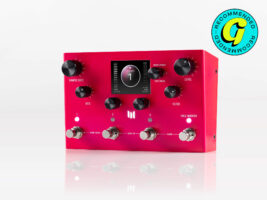
Appearance-wise, the Ottobit X is very much in line with Meris’ other big box offerings, with the same exact footprint and GUI. You also get stereo I/O, expression control, MIDI, and switchable instrument and line levels. Thankfully, navigating everything doesn’t feel like trying to program your parents’ VCR without the manual, which is especially important once you realise just how much Meris has packed into this thing.
There are five pitch types, five modulation types, four preamps, three filters, six glitch effects, and a bit crusher that can take your signal from 32-bit all the way down to wonderfully disgusting 1-bit territory. You also get Tape Mod, Ring Mod, Grain Freeze, Stutter, Tape Stop, and the wonderfully named Wikki Wikki for vinyl-style scratching.
Then there’s VHS Delay and VHS Reverb, which are probably two of my favourite additions here. Especially if the idea of making your guitar sound like an old tape that’s been played about 400 times sounds appealing. These two effects fit perfectly with the overall nostalgic nature of the Ottobit X and help push it beyond simply being a really elaborate bit crusher.
There are 99 preset locations spread across 3 banks. You can dive even deeper with the Modifier section, MIDI, and assignable expression control, while the Hold switch gives you another way to manipulate things on the fly. There’s even a built-in tuner because underneath all the glitching, pitch shifting, bit crushing, and VHS nonsense, apparently Meris still expects us to occasionally play guitar.
Image: Press
Build Quality And Usability
In terms of usability, one of the most appealing things about Meris’ big box offerings is that they can be as simple or as complex as you want them to be. You can turn a knob, scroll through a few presets, find something you love, and call it a day. Or, for the more sonically adventurous out there, you can get into Blade Runner with questioning-the-purpose-of-existence levels of menu diving.
Yes, things can get deeply complex, but it’s still friendly enough for newcomers who just want a thought-provoking creative experience without all the world-building fatigue of a Ridley Scott movie. And in that regard, the Ottobit X is no different.
That balance is especially important here because the Ottobit X has a lot going on beneath the surface. You can spend an afternoon digging into parameters, modifiers, and all the strange ways its effects can interact with each other, or you can stumble across something inspiring within a few minutes and just start playing.
It never feels like you have to understand every single thing the pedal is capable of before you’re allowed to have fun with it, which is something that is definitely appreciated.
Image: Press
Sounds
Running the Ottobit X between a Jazzmaster and a Vox AC15, I decided to jump into the deep end and put this pedal through its proper paces, starting where most people probably will: the presets. Luckily, there are a ton on tap, and they really show off just how tonally diverse “lo-fi” can actually be.
The artist presets from Yvette Young, Emily Hopkins, The Pedal Zone, and others especially push the warble, bit crushing, and degraded textures into some really interesting places. NOSTALGICA was an immediate favourite, with this wonderfully hazy, almost synth-like 80s texture that’s perfect for channelling your inner Vangelis.
It’s cinematic, weird, and just nostalgic enough without feeling gimmicky. Its slow tape stop also makes it one of the easiest ways to experience what the Modifier can do in action.
On the flip side, Hopkins’ aptly named REMEMBR preset gives you this beautifully degraded tape warble with an almost whimsical quality that immediately made me think of the huge, nostalgia-drenched background ambience of Mellon Collie-era Smashing Pumpkins. It’s thick without being overbearing and, more importantly, surprisingly musical.
But if there’s one thing the Ottobit X really excels at, it’s capturing the sounds of 80s and 90s gaming and somehow making them musically useful. I never thought downsampling or pitch-shifting notes to achieve these Nintendo-like sound effects would be something I’d seriously consider incorporating into my pedalboard in 2026, but here we are. As the old adage goes, what’s old is new, and what’s new is old.
As fun as the presets are, creating your own is where things can get a little daunting. For anyone unfamiliar with Meris’ other big-box offerings, the user interface can initially feel a bit head-scratching and cumbersome. It’s not a bad design by any means.
In fact, it’s highly creative, and scrolling through each submenu is visually vibrant and surprisingly smooth. There’s just a lot going on, and taking the time to understand the controls and GUI is probably the biggest barrier to entry with the Ottobit X.
Once you understand the basics of the layout, though, tweaking sounds and creating new presets becomes less of a hassle and more of that uniquely Meris experience. There’s certainly a learning curve, and your mileage may vary, but once everything starts to click, so does the creative potential of the pedal.
Should I Buy One?
Without a doubt, this is one of the most ambitious lo-fi big box offerings on the market. Sonically, it does more than just about any other pedal in the same category, while offering a level of creative flexibility that seems to embrace what we love most about nostalgia. Not just how those old sounds looked or sounded, but how they made us feel in our youth.
And while the Ottobit X is among the best of what’s out there, that ambition comes with a retail price of $599. In this economy, that price might make it financially unattainable for some. But for those willing to pay the asking price, you’re getting arguably the closest thing we’ve gotten to a pedalboard flux capacitor.
It doesn’t simply cash in on nostalgia like a bad remake. Instead, it allows you to curate all of those auditory imperfections that made the past so charming, while employing enough modern features and technology to take you squarely back to the future. Or, in this case, the present. Doc Brown would be proud.
Alternatives
Meris Ottobit Jr ($/£299) – if you want much of the basic functionality of the X but without the eye-watering price tag and a more compact form factor. It lacks the sheer depth of its bigger brother.
Source Audio Artifakt ($369/£349) – another powerful lo-fi pedal, though one that’s focused more on general granular fun than anything else. There’s loads to appreciate here in a very compact footprint, however.
Chase Bliss Lossy ($399/€469) – if you want your retro sound replication to have a more 2000s internet tint than a retro video game one, the Lossy is a fantastic pedal that makes your guitar sound like it has all the audio artefacts of a heavily compressed mp3.
Specs
Product Name: Merris Ottobit X
Price: $599/£599
Type: Stereo lo-fi and bit-crushing texture workstation
Controls: 4x multi-function footswitches, 3x control knobs, 4x LED buttons, sample rate, filter, bits, level
IO: 2x stereo input, 2x stereo output, Exp, MIDI in/out, USB-C
Power: 9V DC center-negative, 300mA, 2.1mm jack
Bypass: Selectable True Bypass (Relay) or Analogue Buffered Bypass
Dimensions: 180 x 110 x 50.8mm (7.25 x 4.5 x 2”)
Weight: 0.68kg/1.5lbs
The post Meris Ottobit X review: “how much is a truly unique and creative sonic experience worth to you?” appeared first on Guitar.com | All Things Guitar.
Source: www.guitar-bass.net