
Beyond the hype: are we entering a new era of guitar technological innovation?
Talking about innovation in the world of guitar is a slippery topic at the best of times. On the one hand, the instrument has endured as a key vehicle for popular musical expression for over 70 years – with each new generation finding new ways to use the instrument to express themselves. On the other hand, many of the tools of the trade that we use today are nearly identical to the ones artists were using in the 1950s – in some cases they are literally instruments that were made in that period.
But despite the inherent conservatism of guitar players, there have been clear moments of innovation and technological breakthroughs that have stuck in one way or another – effects pedals would be one example, whereas digital emulation is clearly another.
READ MORE: Positive Grid Reactor review: does your guitar amp really need an AI chatbot?
The first modelers were primitive. Fine for sketching ideas or practice, but their tones weren’t convincing enough for players to fully switch over. They always defaulted to the tried-and-true practice of using gear that moved real air.
But over the last few decades, that has changed dramatically. Whether that’s via the huge leaps forward in digital modelling, or the development of profiling technology, it’s now totally normal to see guitar players use digital rigs and sound just as good as their tube-amp counterparts.
But what’s going to be the next sticky guitar innovation that will change the way we play in the same way that pedals or modellers have done? Could it be new endlessly customisable instruments, or something that uses machine learning to enhance and expand our palette of sounds?
The wisdom of the last 70 years would indicate probably neither, but people were pretty quick to write off the Maestro FZ-1 until Keith Richards used it on Satisfaction – you never know what’s going to capture the musical collective imagination.
Modular mayhem
Modular guitars have been around in some shape or form almost as long as people have been modding their instruments. People forget that asides from the whole lucite body thing, the most interesting thing about Ampeg’s Dan Armstrong guitar was its innovative swappable pickup modules.
In the last decade though, the idea of what a modular guitar can be has flourished and expanded in ways we’ve not seen before. On the more conservative side of things, Swedish brand Relish has developed a pretty innovative pickup-switching system that has since been adopted by other brands – most notably Cream T.
At the other end of the spectrum, the Boaz One promised to be a modular guitar in the truest sense but before that project had a chance to prove its worth things got weird – really weird.
But there are clearly a growing cohort of builders who believe that modular builds are the future, or as Bayram Tekçe of modular maker Shark Guitars tells it, “Guitar V2.0”.
And you can see why on the face of it – modular designs let players hotswap elements like pickups, bodies, necks, nuts, and bridges. Some even include onboard effects. For studio guitarists that need access to a variety of tones it’s a unique value proposition, but introduces complications for live use.
Some might feel that the nature of modular designs compromises the feel and soul of the instrument. Ian Reddick, founder of Reddick Guitars and creator of the modular Voyager states, “I believe the soul lives in the craftsmanship and history of the instrument”.
The idea is fascinating, but where does it fall short? Aaron Maisler, founder of Fern Guitars says, “There are some limits. Primarily alternate tunings in a live setting. [But] with a modular setup, two guitars cover the same territory [of six] since you can freely interchange the electronics.”
Modular guitars offer seemingly endless tonal possibilities, and the idea is appealing. But that modularity is tied to the maker – what happens when something breaks down? You can’t just take it to any luthier for repair. What happens if you want something that the maker doesn’t offer?
The promise of distilling all your guitars into one is captivating, sure – but do any of us really want just one guitar? Isn’t part of the magic of this hobby the fun of trying new instruments, new looks, new everything?
The Smart And Not So Smart Guitars
For decades now, people have been trying to cram technology into guitars in often innovative but usually doomed ways. Built-in effects and onboard MIDI controllers are perfect for someone like Matt Bellamy, but they don’t have a lot of mainstream appeal.
When you try to tell the man or woman in the street their guitar needs to be loaded with onboard technology the answer seems to be well, remember what happened to the Firebird-X…
Still, there are plentiful modern examples of how technology and guitar is starting to blur into one thing. Lava’s smart guitar platform has won it scores of fans around the world for the way it makes learning and practice more fun and interesting. Positive Grid’s Spark amps have brought technology and player together to create the ultimate practice amps. Enya Music’s Sonic integrates a bluetooth speaker and onboard effects into the body of the guitar itself.
Next-gen guitars are addressing issues like tonewood sustainability and sound versatility, but the burning question is do players actually want their guitars to be connected?
Not long ago a guitar player’s main concern was feeding their gear dirty power. But smart guitars introduce concerns about WiFi dropouts and signal weakness, not to mention vulnerability to hackers.
Are modular and “smart” guitars the instrument’s future or just a flashy fad? It could come down to longevity. Traditional guitars work with proper upkeep, no firmware or software updates required.
When manufacturers stop product support or fold altogether, a guitar with an end-of-life OS or modeler can become effectively useless. The appeal of modular guitars is obvious, but carries risks traditional guitars don’t, especially regarding repairs.
Proprietary systems depend on manufacturer support and survival. Investing in technology-dependent instruments comes with uncertainty. Also consider resale value. Vintage guitars are proven investments that appreciate worth. Technology-dependent guitars likely depreciate in value as the tech ages or turns obsolete.
Neural Networks
There’s little doubt that the word “AI” is a polarising one in the guitar world at the moment, with many musicians being reflexively opposed to anything that has those two letters in them. And clearly there are legitimate and valid ethical and environmental concerns about the use (or indeed imposition) of large language models in our modern lives.
And there are unquestionably some products that are using AI as a means to float some pretty uninspiring products under the noses of an unsuspecting musical public – the less said about the TemPolor Melo-D the better.
But machine learning has been benefitting guitar players for a long time now, and many of the most jaw-dropping leaps forward in digital modelling technology in recent years has been enabled on some level by artificial intelligence operating under the hood.
AI amp modeling is moving fast, and neural networks are the new movement. The most notable one of these is perhaps the open-source Neural Amp Modeler platform. NAM uses advanced neural networking to learn the sonic behavior of a real world amplifier – it’s different to what the likes of Neural and Kemper do with profiling, but the results are impressively similar.
The result is amp tones that sound and feel much closer to the real thing than most modellers can offer – and various brands from Poly Effects to Two Notes to Blackstar are starting to incorporate it into their pedals and amps.
Increasingly, guitar players are coming to accept the blurred lines between digital and analogue, but there are plenty still who feel that digital is still not quite there in terms of replicating the true feel of a valve amp – the pick attack response, playing articulation, and acoustic space response are physical elements that contribute to the experience just as much as the sound.
There’s also the question of the long term viability of such things. Your valve amp from 50 years ago still works because it’s easily repaired by any qualified tech – like any other modern piece of consumer electronics, there’s a big question over how long the companies building these connected products will continue to support them.
There’s also the question of what happens when everyone is using the same digitally recreated tones – anyone who has played through a lot of amps knows that there’s a great deal of variation even between identical models. Democratization of tone is an exciting concept, but puts sonic distinction in jeopardy.
Text prompts vs. twisting knobs
If there’s one area of guitar technology that isn’t afraid of progress and innovation, it’s effects – the digital and boutique revolutions have transformed the stompbox arena into something where some of the weirdest and most wonderful ideas have come from small builders trying interesting things with modern technology.
But with talk of “Peak Pedal” being mooted in recent years, after a decade of huge expansion and innovation, where is the next pedal frontier?
Increasingly, some makers are looking to AI as a means to enable creative experimentation – and in the last year or two we’ve seen AI-enabled pedals from makers as diverse as Quilter, Chaos Audio and newbie Groundhog Audio.
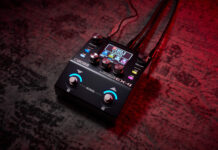
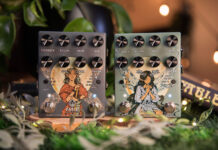
Polyend is another manufacturer leading the charge. The brand’s Endless pedal turns ideas into effects by describing them through text prompts or hardcoding. But do players really prefer inputting text prompts over twisting knobs? It’s an interesting idea.
The company deliberately distances itself from the buzzword “AI” for practical and philosophical reasons. Founder/CEO Piotr Raczyński posits, “AI has become a very overloaded term. It often creates expectations that don’t match what the system actually does.”
Endless works by generating DSP structures from natural language akin to LLMs like ChatGPT, but that’s where the comparisons end. This opens up worlds of new sounds not available in standard pedals, but the trouble is in getting there.
Inputting text prompts is simple enough, but hardcoding takes a certain acumen. Another element of AI built into effects is that the more it’s used, the more it learns user preferences. Either way it’s not as easy as turning pots or flipping switches.
Raczyński continues, “We’re not interested in using AI tools for imitation. We’re interested in enabling people to create original tools they couldn’t build before”.
There’s a laudable aim of putting more creativity in guitarists’ hands at play here – the question is does it actually make sense in the real world? As our review of the Positive Grid Reactor recently alluded to, prompting an LLM to do what you want can be more frustrating than twiddling knobs ever was.
Complexity can also be an enemy of creativity – text prompts open up worlds of new sounds, but require extra effort. In that regard, knobs and switches will beat menus and touchscreens every time.
It’s really intriguing to use an LLM to offer unique features that aren’t available in traditional pedal designs, but option paralysis is a real thing for many guitar players as it is – if you effectively give them a blank slate, is that really going to help all but the smallest percentage of creative musicians?
Culture clash
This is far from the first time guitar has faced rapid technological changes. Modelers were supposed to replace analog amps altogether. They didn’t. Guitar synths were supposed to revolutionize the instrument. They became a niche.
Guitarists adapt to changing technology on their terms. Ideas with the biggest hype around them may only find a select audience. Healthy skepticism around “revolution” in guitar tech isn’t hesitance, it’s pattern recognition.
The overarching question is will the traditionalist guitar culture embrace how fast, and in what ways, technology is changing?
Disruption or distraction?
As time proves, new doesn’t equate to better. Oftentimes it’s the opposite. Some products don’t catch on until they’re out of production, and some never do.
Plenty of voices in the guitar industry are shaping the conversation around evolving guitar tech, particularly AI inclusion. Josh Scott, founder of JHS Pedals, argues that AI gear might be solving the wrong problem altogether. “AI gear is optimizing for speed in a domain where speed was never the constraint.”
But there are as many proponents as detractors. Edward “Bud” Cole, CEO of Fender, says “I strongly believe that AI will create opportunities that are unimaginable today for players to learn, create, record, and express themselves”.
It’s human nature to focus on the novelty of technology before examining its efficacy and necessity. That might speak more to the “invisible hand of the market” than inferior design. But hit or miss, creators keep creating.
New horizons
The future of guitar is here, and the technology is changing faster than ever.
Some gear catches on, some gets relegated to time. But one thing is certain. No matter what innovations and advancements come out, the venerated gear and tools guitarists have relied on for the past 75-plus years will always be in style.
Great tone has never required more technology. Historically, constraints drive creativity, they don’t inhibit it. Where guitar technology is going – and what will stick – will always be uncertain.
But there’s one direction it’s not moving. Backward.
The post Beyond the hype: are we entering a new era of guitar technological innovation? appeared first on Guitar.com | All Things Guitar.
Source: www.guitar-bass.net