
Boss OC-5 review: what makes a great octave pedal?
boss.info
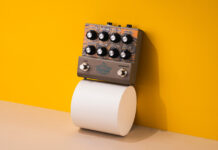
What makes a great octave pedal? That question is a bit of a pandora’s box, but we can at least prop the lid open for a bit with one of the most popular modern octave pedals out there: the Boss OC-5, which folds in nearly 40 years of Boss octave history, while remaining a lot more accessible than octave workstations like the Pog 3.
READ MORE: Electro-Harmonix POG3 review – the wildest pedal EHX has ever made
The OC-5 was released in 2020, superseding the very vintage (and analogue) OC-2 Octaver from 1982, and 2003’s OC-3 Super Octave. The OC-3 was notable as it was the first polyphonic octave pedal – meaning it could accept chords without completely destroying its ability to track. The OC-5 contains a more modern polyphonic mode, as well as a recreation of the OC-2’s glitchy, dual-sub-octave tracking.
OC-5 control overview
The OC-5’s controls are pretty straightforward, with the exception of the multi-function range/-2 oct knob on the right. This varies its function depending on if you’re in vintage or poly mode – in vintage mode, it blends in an ultra-low sub-sub octave, while in poly mode, it controls how the -1 octave signal tracks. On its lowest range, this sub-octave will only follow the lowest note of a given chord – turn it up, and more of your signal will join the low-octave mix. Other than this control, there’s dry blend, which ranges from completely killing the signal to a fairly hefty boost, the blend for the upper octave and the blend for the sub octave.
Vintage mode
True to the goal of recreating the OC-2’s rudimentary tracking, the Vintage Mode is purely monophonic. But even with single note inputs, it can struggle to find what you’re actually playing, resulting in glitchy artefacts as the octave sound jumps about. This mode is still a lot of fun, although unless you’re in a two-piece, the -2 octave sound is absolutely bound to get lost in a full band mix.
Poly Mode
This is the main event, really, and realistically the far more usable of the two modes. The improved tracking makes it obviously much more tight and responsive to play – and thanks to that cleaner tracking, the mix controls are a lot more useful in dialling in what output you want.
The upper octave here is a lot of fun, especially on leads – one of the main uses of an octave pedal is to make your guitar sound like a synth or an organ, and while the OC-5 isn’t quite as built for that approach as, say, the new Pog 3, there are still plenty of big synthy sounds on tap, especially with some gain and power chords.
Some aggressive use of the upper octave is perhaps the most fun you can have with the OC-5, though – especially on leads, adding a screaming, Jack White-style edge to things.
Digital vs analogue octave pedals
While the original OC-2 was analogue, the power of the OC-5 comes from its digital nature. But if you’re in the market for a compact octave pedal, you may well have come across a modern analogue option like the EQD Tentacle, an updated version of the Dan Armstrong Green Ringer, or something like MXR Blue Box.
These pedals rely on the fact that you can do some very simple maths with analogue equipment – either folding the signal over to double its frequency, or using flip-flop circuits to recreate every other wave peak to half the frequency. This leads to a much more chaotic and fuzzy sound, hence vintage octaves are so closely associated with octave fuzzes rather than cleaner “pitch-shifting” units.
A/Bing the OC-5 (with only its upper octave engaged) and an EQD Tentacle is particularly illuminating in this regard – even with an amp set clean, the Tentacle introduces audible distortion – and while it “handles” chords, anything more complex than a power chord gets messy – even basic thirds get crunched apart.
On the other hand the OC-5 in its modern Poly mode introduces no distortion at all, with a sparkly-clean recreation of the exact same sound, only one octave higher, blended in. So keep this in mind if you’re looking to make a decision between an analogue and a digital octave pedal in 2025.
Can you stack the OC-5?
The OC-5 is an excellent pairing with some heavy full-spectrum distortion – especially something super-saturated like a Big Muff. If you’re a fan of, say, Jack White, you may already know that a digital octave run into a Big Muff Pi is one of the best sounds out there – and thanks to the OC-5’s clean tracking, big riffs will gain a synthy, powerful character rather. We’ve seen this sound get a lot of love recently with Keeley’s Octa Psi and Eventide’s Knife Drop, the latter a collaboration with White himself.
But combined with impedance-sensitive fuzzes, however, things are less ideal – the Boss buffer will present problems even in bypass, and the digital nature of the tracking is not a fond pairing with the more uncontrolled nature of a raspy, vintage-voiced fuzz.
Another trendy pairing in recent years has become an octave pedal and a RAT, a combo made famous by Sunn O)))’s albums Life Metal and Pyroclasts, immortalised in the band’s signature Life Pedal. This sound is definitely doable with the OC-5 – run into a RAT, you get a thick but harmonically complex wall of sound. However, the cleanliness of the OC-5 means that, in comparison to using an analogue octave up, things don’t quite develop and shift over the course of a (very long) note – arguably the appeal of that sound.
Who is the OC-5 for?
The world of pitch-shifting is a massive and expansive one – and the OC-5 only represents a small part of it. The clean, full sound of an octave harmony is a very distinct thing to the more evocative sound of a scale-based harmoniser, or the free-form pitch ramps of something like a Whammy. And the OC-5 offers a good amount of control, but nowhere near as much as some of the bigger workstation pedals out there – but for guitarists looking to explore the benefits of cleanly mixing in octave-shifted sounds into the mix, whether that’s for otherworldly synth parts or for massive Jack White impressions, the OC-5 is a great, affordable compact option.
OC-5 alternatives
We’ve already mentioned a lot of the different styles of octave pedal already, but for posterity let’s establish some directions to go – using the OC-5 as a starting point. Given its affordable and compact nature, a starting point is a good way of looking at it – for many, it’ll be all they need – for others, a gateway drug into the world of octaves.
If the OC-5 is too clean for you, and you want raspy unpredictability, you can go for the Earthquaker Devices Tentacle for an analogue upper-octave sound. In the other pitch direction the MXR Blue Box is a sub-octave fuzz, and is completely gnarly.
If you want more control over your octaves, most iterations of EHX’s POG line will give you that – not least the incredibly extensive new POG 3. Until boss makes an OC-200, it’s probably the most fully-featured octave pedal you’ll be able to find – but keep in mind its price and its size make it a pretty big commitment.
The post Boss OC-5 review: what makes a great octave pedal? appeared first on Guitar.com | All Things Guitar.
Source: www.guitar-bass.net