EHX Pico Intelligent Harmony Machine review: impressive tracking hampered by inevitable compromise
$149, ehx.com
Pitch shifting is all well and good – but what happens when you want to stay in key? A wild idea for some, perhaps, but if you want to go beyond power-chord intervals and octaves in your harmonised playing and remain within a scale, you’re going to need a smarter harmoniser pedal. Electro Harmonix’s Intelligent Harmony Machine has now been folded into the NYC DSP range – the brand’s lineup of extraordinarily dinky four-control multi-mode mini-pedals. It’s this Pico version of the IHM I’m taking a look at today.
READ MORE: ADDAC System Mixology review: “it really can breathe new life and modern utility into old pedals”
EHX Pico Intelligent Harmony Machine – how does it work?
The Pico IHM offers a frankly impressive range of different pitch-shift modes, probably more than even the most enthusiastic harmonised guitar fan will need in the average live set. There are two main modes – single and dual, with 10 different harmonies in each. Single cycles through the available intervals, and dual cycles through a set of combined dual intervals, such as a fourth up and a sixth up, or a third down and a third up. There’s a discrete blend control for your dry signal, and a volume control for the pedal as a whole.
Because the pedal harmonises diatonically, you need to tune your guitar to A=440Hz (sorry 432Hz truthers) and select a key. All of the keys on the dial are major – you need to do a little on-the-fly transposition in your head (or with the lookup table in the manual) for the relative minor. To get to the sharps, you tap the mode switch once – a long-press switches between the single and dual modes.
Image: Press
EHX Pico Intelligent Harmony Machine – build quality and layout
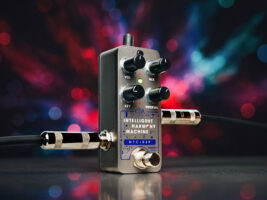
Mini pedals might make you think cheap-and-cheerful – but not here. It’s safe to say that EHX has become somewhat of a dab-hand at constructing things like this – it’s a fairly heavy little thing, with sturdy knobs and jacks, particular the audio jacks, which are the type that lock onto your patch cables with the strength of a thousand black holes.
As for the visual design – it’s fine. It’s a bit of an uninspiring colour, but the abstract computery elements are pretty neat and do a good job of evoking the whole “intelligent” thing they’re clearly going for here. The layout in general is visually pleasing enough and what information is actually on the pedal is very readable – however the physical layout leads us to usability, which I want to put a big pin in – first, let’s talk sounds.
Image: Press
EHX Pico Intelligent Harmony Machine – sounds
In general, the Pico Intelligent Harmony Machine sounds ok. Sometimes it even sounds great – particularly in the octave and fifth modes. It will do the job of harmonising your signal at the set intervals, and the quality of the pitch shifting is for the most part acceptable. I wouldn’t want to record with it, but when it’s working best it’s definitely good enough for live usage. However, being an intelligent harmoniser, the pedal in some intervals has to track your playing. You may remember earlier in this paragraph where I said that the modes where it just blindly shifts your playing up a fifth or an octave sound the best – there’s a reason for that.
The tracking is, of course, the key selling point, but here we run into the inherent problem of intelligent harmonising in a guitar pedal: a meeting of theoretical perfect pitches, and the physical reality of a guitar. Guitars are not synths. Their output is pretty messy, pitch-wise, especially if you play with gusto – which means the Pico IHM can have a hard time keeping track.
Even if you anticipate these difficulties and play deliberately and gently, the diatonic modes falter in the face of bends, panicking and chirping between two scale notes in the mid-point. This is more of a limitation of the category itself, but it’s important to note that for some obvious use-cases – such as big, harmonised solos – there’ll be a few moments where you get glitchy splutters rather than clean harmonies.
That also brings me to distortion – if you were hoping to go all Iron Maiden with the Pico IHM in particular, its form factor introduces a bit of a frustrating limitation – there’s no dry output, making you choose between two less-than-ideal placement options. I found that placing the Pico IHM after my dirt for the most part led to a better sound, with a cleaner mix of harmonies – but worse tracking with far more ‘chirps’ up and down, as the pedal tried to latch onto the core note of a far more harmonically busy signal. On the other hand, placing it before distortion led to better tracking, but a far messier sound, as the distortion would then amplify the IHM’s digital artefacts and intermodulations.
A dry output could let you have the best of both worlds, with separate signal paths for wet and dry signals – meaning you could track your clean playing, and then distort the harmonised and non-harmonised signals individually, either mixing them back down post-distortion or using separate amplifiers for each.
With that said, this is a mini pedal, and if you’re space-strapped enough to need to get this rather than the full-sized pedal, such an involved setup may be beyond what you want to put together – and the sonic payoffs may be worth the simplicity for you. However it’s not just the sounds being compromised here…
Image: Press
EHX Pico Intelligent Harmony Machine – usability
Ok, back to that pin we put in usability. One of the most notorious things about miniature pedals like these is that they’re not very good at being complex, and not just because they lack processing power. In 2026, they can be pretty damn powerful. Instead, the main issue is just how multi-layered and obscure the interface has to be when you’ve squished all of the features of a multi-mode intelligent harmoniser into a four-knob mini pedal.
There’s the basic physical stuff here – such as the fact that the knobs are very close together and smooth, meaning that actually adjusting them is quite fiddly. But more frustratingly, the controls to select your key and the interval of the shifting are both continuous pots rather than discrete rotary selectors. The lack of reassuring tactile feedback is just, well, not great – it’s mildly annoying on the key selector, but borderline unacceptable on the interval selector, which has no markings to delineate what you’ve selected. You need to watch for a flash of the bypass light to tell you when you’ve hit a new interval, but this doesn’t tell you what you’ve selected – you need to consult the manual or just memorise the list of intervals and where your preferred setting is within it.
For home playing, this is a bit annoying, but changing to a different interval mid-set on a dark stage, it becomes fraught with risk of mis-selection. The frustrating thing is, the full-size pedal has actually solved this problem, listing out its harmonies on its face, and offering dedicated switches for sharp/natural and major/minor – not to mention that dry output. Which sort of begs the question – are all of these sacrifices made for the Pico version actually worth the size payoff?
Potentially not – I personally would take the real-estate hit for the signal-chain flexibility and reassurance that I’d actually selected what I wanted to select, and it’s also worth remembering that mini pedals only save so much space, particularly if you need to hit the footswitch without also hitting something else.
Image: Press
Should I buy the EHX Pico Intelligent Harmony Machine?
In terms of getting harmonised guitar parts without having to resort to something so drastic as adding a band member, the Pico IHM does work well enough for some use-cases – cleaner players who aren’t worried about lots of on-the-fly key and interval changes will do just fine with it, and hey, save some space to boot. But it’s not like the full-sized IHM is a mega-pedal behemoth, nor is it substantially more expensive – so I would urge most players towards that.
EHX Pico Intelligent Harmony Machine alternatives
Outside of the obvious EHX alternative, you could also explore the Boss PS-6 Harmonist, or the TC Electronic Quintessence, both of which are standard stompbox sized. If you’ve recently robbed several banks, you could also explore the Eventide H9 Harmonizer, which is a hell of a lot pricier, but powerful enough to launch a Mini Cooper into the orbit of Callisto.
The post EHX Pico Intelligent Harmony Machine review: impressive tracking hampered by inevitable compromise appeared first on Guitar.com | All Things Guitar.
Source: www.guitar-bass.net