T-Rex TwinBlaze review – one tube-driven pedal to cover all your rocking needs?
€299/$289/£249, t-rex-effects.com
The T-Rex TwinBlaze is the kind of stompbox that might just save the world. Okay, a piece of guitar gear isn’t going to do much about climate change or global conflict, but it takes an issue that’s just as polarising – single pedals versus multi-effects processors – and finds a way to combine the best aspects of both sides.
READ MORE: Source Audio Pathways review: “a pedal that sits comfortably between the worlds of modernity and tradition
In spirit, this is a proper old-school dirt pedal for the purists, made in Europe and powered by a real preamp tube… but it also brings the simplicity and efficiency of having three effects in one: two switchable overdrive/distortion circuits plus a separate clean boost. Maybe that means everyone will love it, and the human race can live in harmony again?
Image: Adam Gasson
What is it?
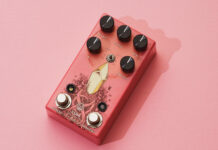
Proudly bearing the words ‘handcrafted in Denmark’, the TwinBlaze is part of an expanding range of homegrown pedals from a company that used to be pretty much all-in on Chinese production. I’m a big fan of the Danish-made reissue of the Mudhoney distortion, which has been around since 2018, so this neatly designed green metal box certainly has pedigree.
It’s billed as “a tribute to the 1980s golden era of rock” – and while you might struggle to match the word ‘golden’ to the bulk of the music of that decade, you can’t ignore the enduring appeal of the (mostly Marshall) amps that powered it. So what you’re getting here is two channels of old-school rock drive, plus a boost circuit to give it a kick up the jacksy on the way out.
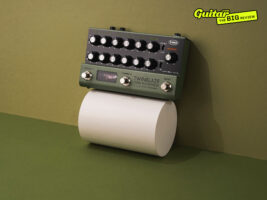
Each channel has a control array that follows the Marshall JCM800 template – preamp gain and output level plus bass, middle, treble and presence – plus a toggle switch for ‘crunch’ or ‘lead’ mode. Both channels are voiced the same, so if you match up the settings there’ll be no difference when you flip between A and B.
As with the new T-Rex RoomMate D’Luxe reverb, a 12v power supply is included in order to supply enough juice to get the JJ ECC83S properly cooking – and again that valve has a slightly silly LED at its base, just in case you feel shortchanged by the low-key orange glow of the real thing.
Image: Adam Gasson
Usability
Look at the control panel of the TwinBlaze when it’s in bypass and you’ll see two rows of six unmarked knobs – what is this, Russian roulette for tone-tweakers? Luckily, once a channel is engaged its corresponding row of markers lights up for easy visibility – in yellow for crunch mode, or orange for lead. It’s a smart system, just as long as you don’t need to make changes while the pedal is off.
The boost circuit gets its own orange light, and beyond that the functionality of this unit is as simple as it could possibly be. Just make sure you use the right output: there’s a second one with speaker cab emulation for plugging directly into an audio interface.
Image: Adam Gasson
Sounds
The obvious place to start is with channel A in crunch mode and channel B set to lead. That gives you a total of five sounds accessible by footswitching alone: crunch, crunch plus boost, lead, lead plus boost, and boost on its own. Nice, although I can’t help wondering why the two channels haven’t been voiced differently – say, Marshall on one side and Fender on the other – for even more flexibility.
Anyway, that JCM-style voice is a pleasing one – and, running through a clean black-panel amp, uncannily accurate. Start chugging away on palm-muted power chords and within a few seconds you’ll feel your hair starting to perm: it is that 80s sound, kicking out plenty of raspy midrange but with enough saturation and compression to avoid any harshness.
In crunch mode you can go from light breakup to moderately hairy overdrive, while the switch to orange lighting brings a corresponding fieriness that sounds superb on attention-grabbing solo runs. The boost switch can prove really useful here, giving a tonally neutral lift of up to 20dB – and it works pretty well on its own if your amp is running anywhere close to the crunchy zone itself.
If anything, it seems T-Rex has copied the classic Marshall template too closely in terms of the EQ controls: they work OK, but somehow never quite as emphatically as you want them to. Don’t expect total tone-sculpting power, then – but if you just need to dial in the right amount of treble and bass for your rig, and maybe give the mids an extra shunt for the heavy stuff, they’ll do the job.
I did give the speaker-emulated output a spin, just to see if this pedal could also serve as a standalone recording preamp, and the results were… well, alright. My guess is there’s nothing more than a simple EQ treatment going on in there, which keeps things balanced but doesn’t stop it sounding DI-ish.
Image: Adam Gasson
Should I buy one?
If you’re still trying to get your head around that “1980s golden era of rock” thing, let it go. Yes, the haircuts were unforgivable, but for guitar tones that rocked harder than the sounds of the 70s, without yet going to the ultra-high-gain extremes of the 90s, this was indeed a perfect moment – and T-Rex has captured it.
For most players, a simpler pedal that can create one or two sounds in that tonal area will probably be enough; but if your idea of classic rock is more Def Lepp than Led Zepp, and you want one unit to cover all levels of dirt, the TwinBlaze is a persuasive candidate.
Image: Adam Gasson
Alternatives
A high-class option that flips the formula by having one drive and two boosts is the Dinosaural Cogmeister (£359.99/$399). If you’re just after a dual overdrive with a Marshall-ish flavour, try the Browne Amplification Protein ($299/£349) or Warm Audio Throne of Tone ($229/£219).
The post T-Rex TwinBlaze review – one tube-driven pedal to cover all your rocking needs? appeared first on Guitar.com | All Things Guitar.
Source: www.guitar-bass.net