Walrus Audio Lüm review – one small box, three colossal reverb effects
$279.99/£259, walrusaudio.com
The story behind the Walrus Audio Lüm tells us that guitarists are a bloody nightmare. Dammit, do we want a multi-mode soundscaping reverb pedal with presets in a compact enclosure or don’t we?
READ MORE: Source Audio Pathways review: “a pedal that sits comfortably between the worlds of modernity and tradition”
When Walrus Audio decided to discontinue the Slötva because of poor sales, the answer to that question appeared to be a clear no. But then, finding itself with a bunch of leftover PCB assemblies for Slötvas that nobody wanted, it did a bit of firmware tweakage and came up with last year’s limited-edition Lüm – mostly to avoid chucking all that unused hardware away. This time, though, it did sell… so much so that the Lüm is now back as a permanent fixture of the Walrus range.
In truth, the words ‘a bit of firmware tweakage’ are probably understating the efforts that were made to turn a relative flop into such an in-demand pedal. Anyway, the Slötva is now consigned to the past – is the Lüm the future of stompbox atmospherics?
What is it?
There’s more to the story of this pedal – because before the Slötva came the Slö (similar but without presets), after it came the Slöer (excellent but far from compact), and along the way we also got a trio of more adventurous ambience generators in the Lore, the Fable and the madcap Melee. All of these, to one degree or another, have fed into the character of the Lüm.
So we’re not dealing with a simple spring-style reverberator here. The emphasis is on otherworldliness, and there are three different modes to take you away from this ghastly planet to somewhere more sublime: a ‘grain cloud’, a ‘grain verb’ and a forward/reverse reverb. That word ‘grain’ means we can expect some randomised stuff, as the reverb is chopped up into bits and spat out again.
Image: Adam Gasson
Build quality and usability
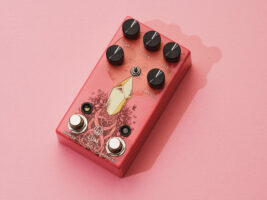
The full-production Lüm has had one major enhancement from the original limited edition: it’s pink instead of blue. This is good news because pink pedals sound better, it’s a FACT, and I will hiss menacingly at anyone who says otherwise. Mind you, it’s also available in plain black, which you might prefer if you’re all about the doom.
A low-pass filter control means you can opt for full-frequency shimmeriness or something more moody, and holding down the right footswitch makes the reverb glide up to a secondary setting at one of three speeds: almost instantly, over a second or over five seconds.
Explaining exactly what the ‘X’ and ‘stretch’ knobs do is a little more tricky, so it might be best to just stomp away and see where the celestial winds take us. Getting started is easy enough because of the three editable factory presets – just hit both footswitches to scroll through them, and use each one as a starting point for exploring the modes.
Image: Adam Gasson
Sounds
There’s one factory preset for each mode, which makes sense – and the first one uses mode 1, which also makes sense. It’s a big and dreamy reverb, with a nice bit of grainy fluttering that adds interest but feels tastefully embedded in the ethereal wash. In this mode the X knob makes those grains bigger or smaller – from bouncy to jittery – and this is very useful for getting the texture just how you want it.
The second preset – using, you guessed it, mode 2 – is not massively different, but here the grains have been softened up much more by the reverb, a bit like the rice in a well-cooked risotto, resulting in a noticeably smoother effect. And mode 3 is smoother again, combining a ‘regular’ reverb with one that swooshes around in rhythmic waves.
There’s plenty of blissed-out fun to be had with all three modes, either clean or with masses of distortion; but if you are about to fuzz things up, you have a big decision to make about pedal order. Distortion before reverb is ‘correct’, but how about the other way round? An interesting reference point here is the aforementioned Melee, which includes both effects and lets you switch them around. Here’s what I wrote about its reversed combination back in 2023: “There’s so much harmonic overload, even when playing single notes, that you end up with an almost glitchy feel to the snowballing surface roar, snatches of melody struggling to rise above the swirling morass.”
How I didn’t win some sort of award for that sentence I’ll never know. But anyway, all of that is equally true of the Lüm if you run it through something very gainy indeed. Heavy shoegazers (by which I mean My Bloody Valentine fans) will be extremely happy here.
So that just leaves the stretch knob. Its role is to alter the sample rate of the pedal, and in normal use this has a fairly minimal effect. Where it really becomes a feature, though, is as the source of the secondary setting reached by holding down the ‘moment’ footswitch: this adds a ramping pitch-shift to the wet part of the signal, which can be subtle or extreme.
I had some good times with this set to a slow rise of just a semitone or two, using my whammy bar to push the dry signal in the opposite direction for quasi-atonal strangeness… and then I had some not-so-good times trying to find any other uses for the function that didn’t feel a wee bit gimmicky. It’s a pity you don’t get more options here – say, an eternal freeze setting, or changes to multiple knobs instead of just one at a time – but as an emergency messer-upper it’s certainly worth having on board.
Image: Adam Gasson
Should I buy one?
The Lüm is a fine pedal, sure enough, but it has rivals that are arguably even finer – and I’ve listed three of them below. The only thing is, one of them doesn’t do presets and the others aren’t compact – so that’s the gap in the market where this little pink stomper fits very neatly.
I don’t think it’s a perfect ambient soundscaping device by any means – there are compromises in its design that some players will find limiting, not least the fact that you only get three modes to play with. But if you’re looking for a simple and practical shortcut to astral mind-expansion, you might not need anything more than this.
Alternatives
Anyone willing to sacrifice presets for the joy of only having a single footswitch to worry about has a top-class alternative in the EarthQuaker Devices Afterneath V3 ($249/£225). If, on the other hand, you have a bigger chunk of pedalboard space to fill up, you might as well go for something truly cosmic like the Old Blood Noise Endeavors Dark Star Stereo ($329/£339) or Source Audio Encounter ($399/£369). Those two are both stereo.
The post Walrus Audio Lüm review – one small box, three colossal reverb effects appeared first on Guitar.com | All Things Guitar.
Source: www.guitar-bass.net