The 10 best boost pedals for guitarists 2026, from budget to boutique
Ever felt like you need a boost? And not the slightly obscure Cadbury’s chocolate bar? Yes, these perhaps underrated pedals can really bring a pedalboard together, and despite their often simple operation, can offer surprisingly versatile shake-ups to your sound. Not all boosts are created equal, though, so let’s explore ten different excellent stompboxes that’ll give your tone a lift.
Why do I need a boost pedal?
So, before we dive in – what makes a boost a boost and not an overdrive? Essentially, a boost’s main purpose is to increase the level of your signal, without adding a significant amount of distortion. Overdrives will also include a stage (or stages!) that adds distortion in the process, which will limit the output level.
You’ll see a lot of boosts designated as “clean” boosts – these have the goal of linearly lifting the level of your signal across the board, with mostly a flat response across the bass, midrange and treble. If you have a the headroom for it, this can lead to a simple increase in volume (great for something like a solo boost). However if you use a clean boost in front of something that’s already limiting the signal, like an overdrive or a low-headroom amplifier, engaging it won’t lead to as much of a volume uplift – but it will increase the level of saturation. Using a clean boost right at the start of the chain isn’t always about getting more distortion, though – if you’re using two guitars over a set with vastly different output levels, a clean boost can help a quieter guitar play better with the rest of a rig.
Some boosts are more characterful than “clean” boosts, and will focus on certain frequencies. The Dallas Rangemaster is an early example of this approach, and it’s often cited as tonal inspiration for more modern pedals. It’s designated as a “treble booster”, but in reality a circuit like this often focuses on boosting the upper mids while cutting a little bit of bass. A boost like this can add clarity to a more distorted tone thanks to that bass cut, while also adding saturation to those pleasing midrange frequencies. (For tonal reference, Brian May and Tony Iommi’s early sounds both revolved around the use of one).
So, why not an overdrive? There are lots of reasons – overdrives themselves can work as great character boosts (TubeScreamers and Klons both do a commendable job here), but dedicated boost pedals are compelling in their simple operation (sometimes paired with a smaller footprint), and not every overdrive will put out the volume increase you need. So let’s dive into 10 fantastic pedals that’ll suit any budget or use-case!
At a glance:
Best mini boost: TC Electronic Spark Mini
Best budget boost: Electro-Harmonix LPB-1
Best op-amp boost: MXR Micro-Amp
Best Echoplex-style boost: Xotic EP Booster
Best modern treble boost: CatalinBread Naga Viper MkII
Best premium mini boost: Keeley Electronics Katana Mini
Most aggressive boost: ZVEX Super Hard-On
Best vintage-style treble boost: Vox VTB-1
Best vintage-style preamp boost: Boss BP-1W
Best multi-mode boost: Crazy Tube Circuits Super Conductor
Why you can trust Guitar.com
Best mini boost: TC Electronic Spark Mini
If you need a flawless, transparent volume lift without coloring your tone, this $50 micro-pedal from TC Electronic is a steal. Built around a high-headroom op-amp architecture, it’s ideal for matching guitar outputs or kicking in a pure solo boost. Its momentary switching lets you accent certain phrases or short solos with ease, too.
Best budget boost: Electro-Harmonix LPB-1
This simple transistor-based boost is a reissue of EHX’s 1968 design – it’s great for fattening up single-coils and pushing vintage tube amps into thick saturation, with a little bit of a warmer, low-mid focused sound when compared with the more truly transparent Spark boost.
Best op-amp boost: MXR Micro-Amp
The MXR Micro Amp is one of those ‘industry standard’ pedals, with an op-amp-based design that incredibly reliable, flat-EQ volume. It works just as well as an always-on buffer and signal strengthener as it does as a massive solo boost. With just a single knob on the standard version (the Micro Amp+ offers bass and treble controls as well) and MXR’s solid-as-hell build quality, it’ll be a reliable and easy-to-use pedalboard companion for years to come.
Best Echoplex-style boost: Xotic EP Booster
Rather than offering a flat frequency response, this discrete JFET circuit from Xotic intentionally colors your signal with the magical, EQ-sweetening shimmer of a vintage Echoplex EP-3 tape echo. Lots of players favour it as an always-on sweetener, or a tool to add three-dimensional depth to sterile solid-state amps – but its preamp-esque character can do a great job of making a solo stand out too!
Best modern treble boost: CatalinBread Naga Viper MkII
Vintage Dallas Rangemasters are hard to come by, but CatalinBread’s modernised four-knob take on the format offers all of the upper-mid bite without having to shell out hundreds (or more!) for a finicky vintage original. It swaps the germanium for a silicon transistor tuned to emulate classic a Dallas Rangemaster’s character, and adds in an attenuator to bring out the pedal’s character without overloading it with hot modern pickups or gain pedals placed before it.
Best premium mini boost: Keeley Electronics Katana Mini
Achieving tube-like dynamics from a tiny enclosure is no small feat, but this $120 pedal from Keeley Electronics pulls it off using dual cascaded JFET transistors. It delivers an exceptionally transparent boost that preserves your core EQ while adding just a hint of harmonic richness, like a single. With internal micro-switches for added overdrive, it’s ideal for pristine soloing or pushing a clean amp into sweet saturation.
Most aggressive boost: ZVEX Super Hard-On
Don’t let the name fool you – this is more than just a juvenile allusion to increased power! With high impedance, high brightness and a staggering amount of volume, the ZVEX SHO is a discrete MOSFET circuit that can breathe brilliant life into dark or dull signals. Its explosive headroom and top-end sparkle make it an aggressive tool for pushing amps into natural overdrive or reviving complex pedalboards. The bias-based output may crackle when you adjust it, sure, but that musical quirk hasn’t stopped stadium-rocking guitarists like Matt Bellamy and J Mascis exploiting its massive, cutting clarity.
Best vintage-style treble boost: Vox VTB-1
Designed to capture the sound of Rangemaster-style treble boosters, this re-voices a silicon BC109 transistor to echo some of that germanium character. It is tailor-made for driving a Vox AC30 or AC15 into screaming, touch-sensitive British rock overdrive. While it is a modern release, it meticulously recreates the edge-of-breakup dynamics and volume-knob cleanup that saw the original used by legends like Rory Gallagher and Brian May.
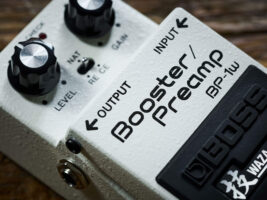
Best vintage-style preamp boost: Boss BP-1W
Priced around $169, this Waza Craft pedal is a highly versatile preamp boost. It authentically recreates the legendary, tone-sweetening analogue preamp circuits found in the CE-1 Chorus Ensemble and RE-201 Space Echo. With a level and a gain control, you can adjust how much light saturation and tonal colouration you want to add, and there’s also a third mode that offers a more natural flavour if the vintage preamps are a little too characterful. Thanks to being built in the ever-reliable Boss format, too, the pedal offers reliable silent switching and pretty bulletproof build quality.
Best multi-mode boost: Crazy Tube Circuits Super Conductor
Why settle for one circuit topology when you can have four? At roughly $180, this premium pedal from Crazy Tube Circuits packs a silicon Rangemaster, a JFET Echoplex, an op-amp Micro Amp-style circuit, and a discrete MOSFET boost into a single box. Offering adaptable EQ profiles and varying input impedances, it is perfect for players switching between vastly different guitars and amps. That doesn’t come cheap, as it’s quite a boutique offering, but the flipside is a broad set of voices that could mean it’s the last boost pedal you buy!
Why You Can Trust Us
Every year, Guitar.com reviews a huge variety of new products – from the biggest launches to cool boutique effects – and our expert guitar reviewers have decades of collective experience, having played everything from Gibson ’59 Les Pauls to the cheapest Squiers.
That means that when you click on a Guitar.com buyer’s guide, you’re getting the benefit of all that experience to help you make the best buying decision for you. What’s more, every guide written on Guitar.com was put together by a guitar obsessive just like you. You can trust that every product recommended in those guides is something that we’d be happy to have in our own rigs.
The post The 10 best boost pedals for guitarists 2026, from budget to boutique appeared first on Guitar.com | All Things Guitar.
Source: www.guitar-bass.net