Fender Made In Japan Traditional 60s Jazzmaster review: “this visually polarising guitar is anything but traditional”
£1,419, fender.com
Here’s a strange one for you – despite being without question the coolest guitar the company has ever made, Fender doesn’t seem to understand why people like Jazzmasters. That’s a ballsy claim, I’ll admit, but as a fully paid-up member of the Offset Tragics committee, let me tell you why.
If you love a Jazzmaster, chances are what captivated you about them were the guitars made in the 60s – especially those with various delightful custom colour options. Lake Placid Blue? Hell yes. Firemist Gold? Don’t mind if I do. Fiesta Red? I should think so. In fact, if you go onto Reverb, search ‘Jazzmaster’ and sort prices from high to low, you’ll find that all the most expensive offsets on there are early 60s Jazzers in a variety of beautiful shades.
And yet despite Fender churning out enough guitars to clog the Strait of Hormuz on a daily basis, you simply cannot buy an authentically early 60s Jazzmaster with Fender on the headstock.
READ MORE: Eastman Fullertone Offset ’62 review – “it has a unique sonic voice and retro feel all of its own”
The American Vintage II 1966 Jazzmaster is a stunning guitar, sure, but that has block inlays and a big matching headstock – a different genus of Jazzer if ever there was one. The Vintera II Jazzmaster guitars are 50s models, and so it’s all sunbursts and gold pickguards – again, beautiful instruments, but it’s not what I want. The American Professional Classic guitar looks the part, but under the hood it’s a modern guitar in 60s clothing. In fact, the only way to get something that properly looks and feels the part without going to the Custom Shop is the Squier Classic Vibe 60s model… and that doesn’t have the right name on the peghead.
Thank goodness, then, for Fender Japan. In the 90s and early 2000s it kept the faith with the Jazzmaster when nobody else was making them, constantly reminding the world that Fender’s offset remained achingly cool with some wonderfully quirky takes on the form. It’s no surprise, then, that among the small range of Fender Japan guitars that the brand chooses to share with the wider world, there’s always a couple of quirky Jazzmasters in there – that’s real heritage.
Most relevant for this discussion, one of the more recent entries is this – a proper early 60s spec’d Jazzmaster… is this the traditional guitar I’ve been waiting for?
Image: Adam Gasson
Fender Made In Japan Traditional 60s Jazzmaster – what is it?
Crafted in Fender’s mysterious Nagano factory (the specific details of which they refuse to share publicly), this Jazzmaster might have “Traditional” in its name, but in a lot of ways it’s anything but.
We’ll come back to the visuals in a minute, but even a glance at the spec sheet reveals this to be very much its own thing. So, for starters the body is basswood rather than the more traditional alder you’d expect to see in a Fender guitar. There’s nothing wrong with basswood of course – everyone from Steve Vai to Eddie Van Halen has found it a perfectly acceptable option, but well, it’s not very ‘traditional’ is it?
Then there’s the neck, which is a classic maple/rosewood affair at least, but with a U-shaped neck profile and 9.5-inch fingerboard radius – again, there’s nothing wrong with either of those things, but that certainly wasn’t what Fender was doing in the 60s.
And then there’s the visuals, which if you’re not reading this via some sort of screen-reading software, is likely to be old news – and something about which you’ve probably made your mind up about already.
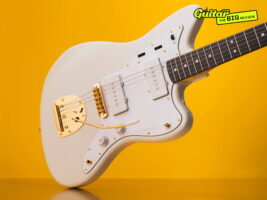
Because yes, while you can get this Traditional 60s model in a rather fetching sunburst with a competition stripe (lordy) or Black Pearl, the powers that be have deigned to send me one in this rather polarising White Pearl finish, complete with matching headstock and gold hardware.
And in some ways, I have to take my hat off to the folks at Fender Japan – they’ve managed to craft a Jazzmaster that I absolutely would not take out in public, and I think that might be a first. Which is a real shame, because the White Pearl, with its rather charming hint of iridescence, is kinda awesome – especially when looking at it up close – but the mood-killer here is that gold hardware.
Look, gold hardware in the right context can look awesome – stick it on a big ol’ Gretsch or a Les Paul Custom and I will buy that all day long. Doubly so if that gold has got a bit dulled and tarnished in an authentic way.
But there’s just something… wrong… about the gold here. I don’t know whether it’s the pristine nature of it all alongside that ultra-shiny poly finish, the specific shade of gold Fender has chosen, or just the fact that it’s on a Jazzmaster at all but… it’s an absolute car-crash. It feels about as premium as a Claire’s Accessories jewellery haul, and that is NOT what we want especially from, and I feel the need to reiterate this – a Traditional 60s Jazzmaster.
Looks are subjective of course, but everyone I’ve shown this guitar to over the last few weeks has universally agreed that this would be a massively better-looking guitar with silver hardware.
Image: Adam Gasson
Fender Made In Japan Traditional 60s Jazzmaster – build quality and playability
Putting my aesthetic reservations aside, respect is due to the fine folks at Fender Japan for the level of craftsmanship and the attention to detail that comes off every millimetre of this instrument.
With a finish this shiny – especially one that catches the light in the way that the Pearl does – any hint of imperfection or rushed workmanship would show up, but this guitar really is perfect from top to bottom. The immaculate edging around the painted headstock and the transition from neck to peghead is also flawlessly done. The neck’s glossy finish is also smoothly applied, while the rosewood fingerboard is a lovely dark brown, with 21 impeccably installed vintage-style frets.
As it happens, I have a pair of similarly-priced alternative Jazzmasters to compare the MIJ one to – the Road Worn Vintera II 50s model I reviewed earlier this year, and my trusty 60s Lacquer model from 2012.
One striking aspect of this MIJ model is the weight: both of the Mexico-made guitars read at bang on 8lbs, but the Traditional 60s guitar barely scrapes 7lbs. This is no doubt down to the lightweight basswood body compared to the alder used on the other two, but it’s still eyebrow-raising to pick up a Jazzmaster and find it has the displacement of a good Strat or Tele.
The neck is another obvious point of difference – obviously you get a flatter and more bend-friendly experience from the MIJ’s 9.5-inch radius (though I never have too many issues with a 7.25 in that regard personally), but the profile itself is a strikingly different experience.
Both the Mexico guitars have a classic C-shaped neck and, comparatively, the pronounced shoulders and flatter back of the U-shape on the Japan model definitely offer a different vibe. It’s not any less comfortable, but it’s one that feels more set up for lead playing and precision than the perhaps more generic comfort of the MIM models I have for comparison.
It’s also a slightly deeper neck at the first fret (20mm to 21.5mm) but graduating to a roughly identical 22mm at the 12th fret – combined with the extra shoulder, it makes for a chunkier proposition when playing open chords.
Despite the gloss finish however, it’s impressively un-sticky under hand, and while the ‘board edges aren’t rolled as they are on the Vintera II, the fretwork is nicely finished and it’s a smooth, comfortable player.
Like literally everyone else who’s ever owned a Jazzmaster, my guitar has had a bridge change from the dreadful threaded saddles that make original guitars from the 60s such a tricky prospect to set up right.
I’ve had to learn to live with Fender’s baffling determination to inflict the original bridge on modern players on its vintage-inclined instruments, but given how fast and loose Fender has played with the ‘Traditional’ tag on this guitar elsewhere, it’s utterly baffling to see an ugly gold example situated here. Especially as it seems to be more prone to rattling than the bridge on the Vintera II does. The worst part is, if you were planning to buy the damn thing, your upgrade options are limited. As far as I can tell neither Mastery, Staytrem, Tuffset or Bensonite – the most trusted options for aftermarket bridges – offer a gold option. That means you’re stuck with a generic Mustang option that probably won’t quite match the shade of gold to the rest of the guitar. Nightmare.
Mercifully, the rest of the setup works nicely, the push-fit trem arm is a welcome addition, and it’s a smooth, fluid operator out of the gate – with tuning stability as acceptable as you could hope for a JM trem.
Image: Adam Gasson
Fender Made In Japan Traditional 60s Jazzmaster – sounds
Given that this guitar is loaded with a set of Fender’s Vintage-Style Jazzmaster single-coils, you might very well expect that we’d be greeted by a traditional Jazzmaster sonic experience when plugging in… well, not so fast, my friend.
Played clean, there’s plenty of woody low-end warmth that you’d expect to find from a Jazzmaster, but rather than pair that with the usual high-end sparkle you’d expect, we get more of a strident midrange and general clarity in terms of note definition. Even with the idiosyncratic rhythm circuit, this is a guitar that seems unwilling to muddy up – which depending on what you want to use it for, may be a good or bad thing.
If I had to guess, I’d say that this is probably more down to the basswood body than the pickups themselves – basswood is quite similar to mahogany in terms of the way it pushes the mid frequencies, compared to the brighter attack of alder, after all.
It’s a sound that’s unquestionably very usable – it doesn’t have much of the wooliness that can plague a Jazzmaster in the wrong hands, and if I were to put my hand on my heart I’d say that it’s probably a more widely usable palette of tones for the average player, especially if you’re pushing things on the distortion front.
Even with the rhythm circuit engaged, there’s a pleasing amount of midrange here that works well as you dial the gain up, adding punch and power without any shrill high-end issues. We’re not going crazy here – this is still a single-coil pickup guitar – but if you’re a Jazzmaster fan looking for a more general rock voice, this could be exactly what you’ve been after. “Traditional” though? Well…
Image: Adam Gasson
Fender Made In Japan Traditional 60s Jazzmaster – should I buy one?
I feel like I’m boring myself at this point by continually pointing out that this guitar has been bafflingly named. If you’re looking for an authentically early 60s guitar like me, then your search continues here as it doesn’t have much of that about it – whether that’s the looks, the playability, or indeed the sound.
With that in mind, maybe the sensible thing is just to park that particular misnomer and take this guitar on its own merits. If you’re a more rock-inclined player looking for something that has some Jazzmaster mojo but with a playability and sound that will make light work of lightning-fast runs and heavier tones, this might be the perfect offset for you.
It’s also built extremely well, with an excellent level of fit and finish throughout, and the price is compelling given how rapidly the price of Mexico- and USA-made Fenders have crept up in recent years: at barely 200 bucks more than a Vintera II Road Worn and almost a grand less than a USA guitar, it stacks up very well.
It’s a less fun equation if you’re in the USA, sadly: while Fender Japan guitars are widely available (including direct from Fender) outside of the US, the guitars seem to be an import-only affair in the Land Of The Free currently. Maybe it’s a tariffs thing, but either way it’s a shame.
The subjective question of the looks here on this particular finish / hardware combo is the biggest sticking point for me. I’m sure someone will love it, and I am nobody’s idea of an authority on style, but I can’t really understand some of the choices made here. And that, much more than the inaccurate name, is the thing I just can’t get over.
Image: Adam Gasson
Fender Made In Japan Traditional 60s Jazzmaster – alternatives
As you might well expect, Fender offers most of the ready-made alternatives to this guitar, and perhaps its closest competitor is the American Professional Classic Jazzmaster (£1,599 / $1,599) – that offers a 9.5-inch radius fingerboard and various other modern conveniences with a classic (and very early 60s) look, and vintage-style pickups. If you want something that’s much more accurate on the vintage side (albeit in the later 60s incarnation) the American Vintage II 1966 Jazzmaster ($2,799 / £2,379) is a fantastic guitar from top to bottom. If you wanna embrace the rock with your offset, the EVH Wolfgang Special ($1,499) has a pair of humbuckers to pair with the same basswood body as the Jazzmaster.
The post Fender Made In Japan Traditional 60s Jazzmaster review: “this visually polarising guitar is anything but traditional” appeared first on Guitar.com | All Things Guitar.
Source: www.guitar-bass.net