Fender Vintera III Mid ’60s Jaguar review: “this is the guitar Jaguar fans have been asking Fender to make for years”
$1,349/£1,149, fender.com
It feels like only a few months ago that I was reviewing a Fender Vintera II guitar, and that’s because, well, it was. But the arrival of the limited edition Road Worn guitars at the tail end of last year was perhaps always destined to be a final hurrah for Fender’s second iteration of its vintage-inclined Mexican – a fun and inspiring way to clear the decks of the last of the previous generation before the new hotness that is Vintera III.
READ MORE: Fender Studio Pro 8 and Quantum LT 16 interface review: a guitar-recording match made in heaven?
Fender has been on the Vintera train since 2019, with the stated aim of offering a slice of vintage-vibed Fender goodness for a fraction of the price you’d have to drop to get yourself one of the brand’s US models attempting the same trick (in 2026 parlance, that would be the American Vintage II).
It’s barely three years since Fender launched the Vintera II range, which headlined things by reintroducing proper rosewood boards to the mixture after a few years of CITES-induced pau ferro misery.
There’s nothing quite so headline-grabbing about the Vintera III range, but there was very little wrong with the Vintera II, though, cosmetically at least, the Jaguar was the weak link in a strong lineup. Suffice to say, that isn’t going to be a problem with the 2026 model.
Image: Adam Gasson
Fender Vintera III Mid ’60s Jaguar – what is it?
Fender has a real blind spot when it comes to giving the morally correct amount of love to its offset guitars – especially its short-scale models. I’ve grumbled on more than one occasion on this website about the 50s sunburst cul-de-sac that Fender seems determined to leave the Jazzmaster to rot in, and the poor Mustang and Jaguar have received even shorter shrift.
With Vintera II, for example, the only Jaguar offered was a 70s model that was as baffling as it was unappealing. I know that aesthetic is coming back in a big way in guitar circles, but I’ll be amazed if anyone actually bought a vintage white Jaguar with a maple neck, big headstock and black block fretboard inlays on purpose. It was, as we’d say in South Wales, honking.
For 2026, then, Fender has sensibly not gone anywhere near the 1970s with any of its guitar entries, and instead has opted to zero in on specific periods rather than generalisations of decades. It’s even more sensible of them to pick the mid-1960s as the option for the Jaguar.
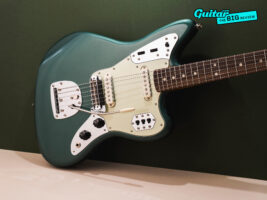
Straight off the bat, this means that in every way imaginable this is a more beautiful guitar than its predecessor by many, many degrees. Because in addition to the unavoidable sunburst, we get to choose between an upsettingly lovely Shell Pink with matching headstock, or this magnificently attired Sherwood Green Metallic option. There are no wrong answers here, friends.
Image: Adam Gasson
The new colours might be reformulated to be more vintage-accurate, but they are obviously not the sole reason for Fender to stick an extra roman numeral on the model name (which doesn’t appear anywhere on the guitar itself, natch).
If you remember reading any reviews of the Vintera II guitars, you will have probably seen some mention that in the venn diagram of price, quality and appointments, they were perhaps the best guitars Fender made. There really was not a whole lot wrong with them.
So for Vintera III then, the focus here is on details. Whenever Fender releases a vintage-inclined guitar, the internet comment sections soon fill up with a chorus of nays ready to tell the brand all the ways in which they are not quite right, actually.
These are never intended to be perfect vintage repros of course – that’s what the Custom Shop is for – but they do address a lot of the things that some people may have got hot under the collar about in the past.
So, for example, the headstock decals are now placed on top of the finish, rather than under it, making it feel a bit more authentically hand-made and accurate. More meaningfully, the nuts on these guitars are now bone instead of synthetic, as they would have been back in the day. The fingerboard inlays are now period-correct, whether that’s clay, black or in this case, pearloid, while the rosewood board itself is a round-laminated version, rather than a slab (as would have been the case with a 60s Jag).
The pickups across the range have been revamped and revoiced to better reflect the specific era they’re aiming for, while you also get various other period-correct features. In the Jag’s case that includes a vintage-style floating lockable tremolo, “period-correct” rhythm circuit and even a foam mute to lock into place should you be into that sort of thing.
As with the rest of the Vintera range, it comes with Fender’s ‘that’ll do’ soft gigbag, which is about as reassuring as a parasol in a hurricane, but at least it has something for you to bring it home from the guitar shop in.
Image: Adam Gasson
Fender Vintera III Mid ’60s Jaguar – build quality and playability
Sliding the Jaguar out of its gigbag, it’s honestly quite hard not to just end this review and give the thing a 10 purely on looks alone. Your mileage may vary I suppose, but I happen to think that there are few things more downright beautiful in the guitar world than a Fender offset in a non-standard Dupont colour.
The Sherwood Green Metallic here is deep, rich and inviting – Fender says it’s reformulated the colours to look more ‘classic’ and this certainly looks the part. The polyester finish is also expertly applied to both the body and the peghead, without any overspray roughness around the edges, and yes, the decal sticker going on top of the finish might be a little thing, but it does help maintain the illusion that you’re playing something genuinely old.
The only issue with going headlong into the world of vintage accuracy is that the neck does have the full gloss treatment. Some players don’t mind this, of course, but the otherwise supremely comfortable Mid ’60s “C” profile neck is slightly hampered by occasional stickiness as you’re moving around.
Image: Adam Gasson
It’s easily rectified with a bit of wire wool of course, but lots of people won’t want to do that sort of thing to their guitar out of the box, so you’d best be aware of what you’re getting into here before you pull the trigger.
That slight stickiness doesn’t prevent this guitar being a comfortable and fluid player, however, with the Mustang’s shorter scale length making string-bending a breeze – anyone who tells you you can’t bend on a 7.25” fretboard radius hasn’t spent enough time with a properly set-up instrument.
Speaking of set-ups, while the overall factory job is pretty decent, I did raise my eyebrow at the bone nut, and especially the cutting of the high E slot. It’s just about okay, but it really is right on the borderline of being too shallow.
While it didn’t happen in the course of my playtest, the string feels a bit too easy to knock out of its slot, and it doesn’t bode well for overall stability when combined with the thrice-damned (but vintage-correct) barrel saddles if you have a heavy right hand.
Image: Adam Gasson
Sonically, the string sounded broadly as expected (Jaguars aren’t exactly known for their sustain after all), but I did notice an issue when I activated the mute – while the other strings offered a nicely dulled sound, the ‘plonk’ on the high E was pretty unusable – probably something that’s exacerbated by the shallow nut slot.
Again, this is the sort of issue that you can fix with a nut file in about 30 seconds, and is clearly an isolated incident (I’ve tried multiple other Vintera III guitars that have been fine), but this is a $1,300 guitar – you’d hope for the QC to be a bit better at this price point.
If you spend any time on offset forums and subreddits, you’ll hear a lot of chat about even new vintage-style guitars needing a neck shim. In the Jag’s case, I’d say it’s fine for most people’s everyday use – if you’re really going to give it the beans, maybe you’d want to increase the break angle with a shim, but it definitely doesn’t need it out of the box.
Given the amount of metal and hardware involved in a Jag, they’re not always the most svelte of guitars, and this one isn’t featherlight, but at 8.1lbs it’s certainly no dead weight either, and is lighter than some vintage examples I’ve played.
Image: Adam Gasson
Fender Vintera III Mid ’60s Jaguar – sounds
I’ve had conversations with people inside Fender who will admit, off the record, that Johnny Marr’s interpretation of the Jaguar is a significantly better way to make this guitar usable and practical in the real world than Leo Fender’s crack at it… but that sort of tweaking is not what people are coming to Vintera for, and so this is about as stock and classic as you might expect, for good and for ill.
So that means you’re stuck with the legendarily counterintuitive Jaguar switching arrangement here, for good or for ill. In truth, once you spend a few minutes training your brain to remember that the middle switch activates the bridge pickup, and you need to hit two switches at once to cleanly transition between the bridge and neck pickups, it’s not exactly rocket science.
There is an element of this that is absolutely and correctly just part of the unique mojo of a vintage-style Jaguar – to mess with that would have meant this guitar failed at what it’s trying to do, and I’m not gonna damn it for that. If you’ve been charmed by the looks of this guitar without considering the practicalities of it – and look, no judgement here, I’m right there with you – then this is just a reminder to be forewarned and prepared.
In terms of sounds, again I feel like I should remind people that a Jaguar’s single-coil pickups are their own thing and tonally quite a departure from other Fender guitars. The term ‘ice pick’ perhaps doesn’t sound particularly flattering in the metaphor-laden world of describing guitar tones, but with the Jag it’s kinda bang on.
Image: Adam Gasson
There’s an immediacy and punch to the treble on the bridge pickups that is very classically Jaguar but also unapologetic – it requires careful marshalling of the rest of your rig to not sound shrill, but the punchy, jangly quality it affords when you do is wonderful.
Add a bit of dirt to proceedings and you instantly start to understand why Jaguars found common cause with various members of the grunge community – it snarls and cuts through with power and venom, though deployment of the much-maligned strangle switch can take some of the mids down and make it a more conventional rocker.
The neck pickup is a woodier and plummier affair. It doesn’t have the warmth and roundness of a Strat’s, and you feel that sharp attack and lack of sustain more here, especially with gain involved, but it can be an exhilarating place to get fuzzy and unchained in.
The rhythm circuit is a subtle beast here compared to some I’ve played – adding a soupçon of muddiness to the neck pickup, making the bass frequencies that little bit more flappy. It’s not something that many of us will use very often, but it certainly has utility for jazzier sounds and if you want to really make your distorted sound have that 70s bloat to it.
Another feature that’s not going to be getting a huge amount of attention from most users is the string mute. When activated, the foam hugs the strings to give a dulled, decay-free sound to proceedings. You might look at it and expect a rubber bridge-esque tone, but it’s definitely not that, with the foam giving even less chance for the strings to ring.
One unfortunate side-effect of that narrowly cut E-string was that engaging the mute made the string sound like it had very much popped out of the slot – I don’t imagine that was intentional, but it sure isn’t pleasant.
One useful benefit of the mute being in place is that it stops the bridge from moving around so much, which is good news for tuning stability.
Image: Adam Gasson
Fender Vintera III Mid ’60s Jaguar – should I buy one?
In many ways, this is the guitar Jaguar fans have been asking Fender to make for years – a Mexico-made, vintage-appointed Jaguar in a selection of achingly cool colours. For that reason alone, I imagine that Fender will have sold plenty of these guitars without so much as a play-test.
And if what you really want is a vintage Jaguar experience – eccentricities and all – this is a very good and very faithful take on the concept. There’s definitely a question to be asked about whether you really DO want that, however, and hopefully the various foibles I’ve pointed out in this review can help you get to that point.
What’s less acceptable is the QC issue. I’ve played enough of these guitars to know that it’s an isolated case, and it’s the sort of thing that likely wouldn’t cause any issues with a Telecaster… but the Jaguar is a more temperamental feline, and so the need to ensure things are fettled properly is even more important.
That aside, this Jag is a useful example of what Fender is trying to do with Vintera III as a whole. It’s not looking to reinvent the wheel, but in a variety of small ways, it’s nudging the Mexico-made experience ever closer to what the brand is doing in the USA, and that’s pretty exciting, no matter what kind of Fender fan you might be.
Fender Vintera III Mid ’60s Jaguar – alternatives
If you want much of the same sonic mojo but without the various electronic and constructional eccentricities, then Fender’s Player II Jaguar ($879/£819) is a well-sorted option – no weird switching, no wonky bridge, all fun. If you want a similarly ‘fixed’ Jag but with a US build, the American Professional Classic Jaguar ($1,599/£1,529) is not a whole lot more money than this, remarkably. If you want a unique offset with less fiddly switching but some fun and individual sounds, Harmony’s mini-humbucker-loaded Standard Series Silhouette ($1,499/£1,499) is a US-made steal.
The post Fender Vintera III Mid ’60s Jaguar review: “this is the guitar Jaguar fans have been asking Fender to make for years” appeared first on Guitar.com | All Things Guitar.
Source: www.guitar-bass.net