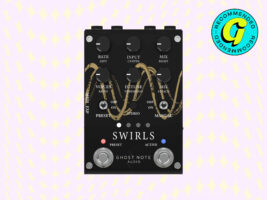
Ghost Note Audio Swirls review – much more than a chorus pedal
£160, ghostnoteaudio.uk
The 1980s haven’t been this big since, well, the 1980s. Blame Stranger Things, blame a few viral TikTok videos, blame the ever-shortening cycles of trend repetition engendered by the accelerating death-spiral of western culture under quasi-oligarchical free-market capitalism, but the fact is this: people are using chorus pedals again.
READ MORE: MXR Rockman X100 review – it’s the 80s in a box
The Ghost Note Audio Swirls, however, is not just a chorus pedal: it’s billed as “an entire 80s rack in a pedal”. That includes two modulation effects, a built-in compressor and true stereo output. Seems like pretty good going for £150 when you consider it’s made in the UK… and has a radical shape-shifting trick thrown in.
Image: Press
Ghost Note Audio Swirls – what is it?
You might want an introduction to Ghost Note first. Based in West Sussex, this maker of guitar pedals, studio gear and software plugins recently launched a range of three digital stompboxes called the Daedalus Series, of which the Swirls is one. Or is it, in a sense, all three?
Because you see, the Swirls, the 3 Bit Fuzz (a bitcrusher) and the Amverb (a rack-style stereo reverb) are all built on the same hardware platform – and if you want to change one of them into another, all you have to do is download the firmware and pipe it in via USB-C. Interchangeable faceplates are £20 each, but the firmware is free.
I tested out the brain-swap process and it worked without any issues… so here goes with a couple of micro-reviews: the bitcrusher is excellent, offering tight yet belligerent fuzz with lots of control over the EQ; and the reverb is equally nice but, a little weirdly, not suitable for use with guitar amps.
And what was the other one? Oh yeah, the Swirls! Inspired by old rackmount devices, specifically the Dyno-My-Piano Tri Stereo Chorus, this is a pedal for people who like their modulation rich and syrupy enough to serve for dessert at a Roman orgy. It includes a ‘detune’ effect that can be added to the main three-channel chorus and controlled separately, plus a compressor that Ghost Note describes as “very fast and aggressive”. It has mono and stereo ins and outs, and can store two user presets.
Image: Press
Ghost Note Audio Swirls – is it easy to use?
It doesn’t look easy to use, does it? Not for those of us who generally like our chorus pedals with a maximum of two knobs and maybe, if we’re feeling really extravagant, a switch for vibrato mode. And indeed, this is a tricky stomper to navigate at first.
The key is to see the six knobs as two lines of three: the top row controls the main chorus, and the bottom row is for the detune effect. Secondary functions are accessed by holding down the button in the middle: now the top row gives control over the left, centre and right channels of the chorus, and the bottom row runs the compressor.
In summary, this is not your Boss CE-2. But the good news is, it should be able to do a whole lot more than any basic chorus pedal…
Image: Press
Ghost Note Audio Swirls – what does it sound like?
It’s tough to break the sound of the Swirls down into its constituent parts, because the overall effect is such a seamlessly integrated audio concoction. The short version is that it sounds every bit as retro-tastically sweet and shiny as you might hope.
By modern chorus standards you might find it ever so slightly cold in tonality, because the emphasis here is all on the shimmering trebly sheen. The two modulation types are broadly similar in character, except that the detune has a much less pronounced ‘wave’ effect, but the real magic happens when you mix them together… and then press the stereo button.
With any chorus pedal, you can get a nice stereo effect by sending a dry signal to a second amp; what you get from the Swirls’ dual outputs, though, is a sense of scale and immersion that’s on a whole different level. It can sound like the Cocteau Twins, it can sound almost like a Leslie speaker, and it can sound so overwhelmingly luscious that after a while you start to feel a bit queasy.
And the compressor? It will add a gentle thump to the transients if you want it to, but mostly it just does what compressors do best: making everything seem louder than it really is. And is this context, that just means more lushness and more hugeness.
Image: Press
Ghost Note Audio Swirls – should I buy it?
The Swirls prodded my nostalgia glands much more forcefully than I was expecting it to. It did also remind me of why I ended up getting sick – quite literally – of the chorus effect, but that’s not the pedal’s fault: you just need to show some restraint when working with this kind of ultra-sweetness.
For simply adding a bit of wobble to a clean guitar, there are simpler options that will do just as well or better – and without generating anything like as much background hiss. But if you want to go all-in on the whole immersive 80s thing, this is where it lives.
Ghost Note Audio Swirls alternatives
A couple of other options for that extra-swirly multi-chorus effect are the Eventide TriceraChorus ($279/£249) and Free The Tone Tri Avatar (¥39,500/£269). Or if you really want to feel like a time-traveller from 1984, try the combined chorus, compression and distortion of the MXR Rockman X100 ($245.99/£249.99).
The post Ghost Note Audio Swirls review – much more than a chorus pedal appeared first on Guitar.com | All Things Guitar.
Source: www.guitar-bass.net