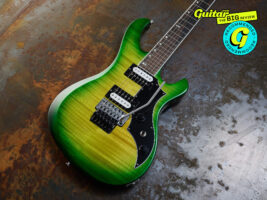
Gibson Victory Floyd Rose review: “this is a fantastic addition to the Gibson line”
$2,799/£2,399, gibson.com
The 1980s were an interesting time for the guitar industry. The decade saw a new generation of players who demanded instruments that were quite a departure from the electric guitars that had been front and centre for most of the previous thirty-plus years. That in turn enabled small makers like Kramer, Charvel and Jackson to become the big-time brands they are today.
READ MORE: Gretsch Electromatic CVT Baritone review – long-scale downtuned heaviness from Gretsch hits the mark
It was a trickier period for the established big guns, however. While Gibson had some guitars that were ready-made for this new, more aggressively styled era – notably the Explorer and Flying V most notably – both the brand and Fender understandably wanted to make some guitars that were designed for this new era.
Unfortunately, none of these new models really caught fire at the time, and you imagine that there was a collective sigh of relief in both Nashville and Corona when the 90s rolled around and MTV was replete with Golden Era guitars once again.
But time has a funny way of changing perceptions. And just like it took wider guitar culture a few decades to really appreciate the V and the Explorer, so it has been with some of the more unloved guitars from the 80s.
While nobody seems to be falling over themselves to demand a Corvus reissue (yet!), the Victory has long had a bit of a cult following. And looking at it with 21st-century eyes, you can see why – like so many underappreciated guitar designs, it was ahead of its time, offering a double-cut solid-body take on the Gibson recipe that has since become a huge part of the modern heavy guitar firmament.
All this meant it was a big deal when the brand relaunched the Victory into the core line back in 2024. Clearly this time around the concept has found a more receptive audience too, as it has been followed up two years later by this brand new version that puts it even more squarely in the wheelhouse of today’s technical guitar players.
Image: Press
What Is It?
Like its hardtail sibling, the Victory Floyd Rose is a solid-body, double-cut electric guitar with a pair of humbucking pickups, and – you guessed it – a Floyd Rose vibrato. Gibson says that the original Victory has been a big hit with its audience, but one of the most common bits of feedback was, “Can you add a Floyd Rose?” Request granted.
Other than that, it’s pretty much identical to the figured top version of the hardtail Victory. That means you get a solid mahogany body with a beautifully figured maple top, finished in either Deep Ocean Burst, Ebony Burst or the eye-catching Iguana Burst.
The neck is also mahogany, with a classic 80s hockey stick headstock. Despite its super-S-type-adjacent origins, there are no bolts here – this is a through-neck, glued-in neck construction, and interestingly the Victory comes with a longer-than-usual 25.5-inch scale length – most Gibson electrics ship with a 24.75-inch scale.
The neck itself has a shred-ready 10-14-inch compound radius, with Gibson’s SlimTaper profile, and you’ll find 24 medium jumbo frets on its mahogany fingerboard. Above the locking Floyd Rose nut are a set of Grover Mini Rotomatic tuners, not that you’ll be needing to mess around with them too much.
In terms of the noise-making stuff, the Victory ships with a pair of zebra-bobbin’d 80s Tribute humbuckers, and these both have coil-splits – pull up on the volume pot to engage the split on your selected pickup, and pull up on the tone to select whether you want the inner or outer coil.
Image: Press
Build quality and playability
Gibson has upped its game considerably in the years since the brand was reborn out of bankruptcy in 2018, and so it’s perhaps no surprise that upon pulling the Victory Floyd Rose out of its (very cool blacked-out) hard case I was very impressed with it from a build and finishing perspective.
Iguana Burst isn’t going to be to everyone’s tastes, but it’s also the sort of colour that doesn’t give any hiding place to overspray or sloppy finishing. And yet every inch of the body, neck and headstock is finished expertly, and there’s a really inviting three-dimensional quality to that figured top that really pulls you in.
Picking the guitar up, I’m immediately impressed by the offset double-cut body – it really hugs the player from an ergonomic perspective, and invites you to explore the full length of its neck. At just under 7lbs, it’s lightweight and balanced, too.
That extra scale length does make this a different kind of ride to a Les Paul – it has a little more resistance when you’re bending, for one – but this is still a very slick player that’s set up low and fast, and encourages you to blaze up and down that neck.
Speaking of the neck, I found the combination SlimTaper profile and compound radius to be slim, but not too slim. A baseball bat this obviously ain’t, but it’s not so skinny that it feels insubstantial either – a nice middle ground.
The Floyd does what a Floyd does – giving you smooth and expressive control of your vibrato while keeping perfect pitch. The less said about restringing it, the better, of course, but that is the rub when it comes to a locking trem.
One slight bone of contention might be the frets. The playability is top notch, and I found the fretwork excellent throughout – there are no dull frets or rough patches to be seen. That said, many more technically minded modern players won’t get out of bed for anything less than stainless steel these days, and jumbo ones at that. It’s not a deal-breaker for me, but others may see it as an opportunity Gibson should be taking, following the move towards stainless steel frets in its Epiphone Futura line.
Image: Press
Sounds
Gibson knows a thing or two about making great dual-humbucker guitars, and even in an unconventional format here, there’s some real Gibson magic to be found in these Alnico V-magneted 80s Tributes.
As befits their name, these are not ultra-high output modern humbuckers that are full-send all the time. There’s a nuance here – obviously these are great-sounding pickups that come ready to play with heavier rock and metal genres, but they’re not so lacking in subtlety that they don’t have character when you roll the volume off.
Ultimately though, these are pickups that are born to be distorted, and so that’s my first port of call. They sound absolutely fantastic as you dial the drive up, delivering warm harmonics and sustain with a depth that I haven’t heard from a new guitar in a while.
It’s hard to imagine too many people picking this guitar up and going for a crystal clean tone, and so it’s not a surprise that its un-gainy tones are perfectly fine, if unlikely to become the bedrock of anyone’s John Mayer tribute.
Equally, while the coil-split modes aren’t going to convince anyone that you’re playing a bona fide SSS or HSS guitar, they will do a solid job – especially in a live situation. Having the flexibility to select the inner-coils sounds is great, as they’ll do a passable out-of-phase sound, further enhancing your sonic options. This is a guitar that can cover a lot of bases without needing too much tweaking.
Image: Press
Should I Buy One?
If you’re a hard rock or metal guitarist who wants to stand out from the crowd, it’s very easy to see why the Victory is proving such a popular option. The heavier end of the spectrum doesn’t lack for weird guitar shapes, but there’s something timeless and refined about the Victory that makes it feel much more palatable. Perhaps the Gibson inlay on the headstock speaks volumes here.
Because you know what you’re getting with a Gibson guitar, and it must be said that even by modern standards, this feels like a very well-built and well-thought-out instrument. It has a level of fit and finish that I would have expected from the Custom Shop a few years back, but at a price that makes it very competitive in the world of US-made hard-rocking guitars.
Okay, it might look a little weird if you trot out with it for an Eagles cover at your next gig, but there’s a lot to be said for a guitar that understands what it is and doesn’t try to be all things to all people. You probably already know if the Victory is for you just by looking at it, and this Floyd Rose version simply puts the icing on the cake of a shredder’s delight.
Image: Press
Alternatives
It speaks to the impressive value proposition the Victory offers that to get a similar US-made guitar from a rival brand will cost you a lot more. Closest of all is perhaps the Jackson USA Signature Chris Broderick Soloist 6 ($5,549/£4,779) – which sports a mahogany body with a maple cap, twin DiMarzio humbuckers and a Floyd. When it comes to twin-humbucker mahogany-bodied electric guitars with flame-topped finishes, it would be remiss not to bring PRS into the conversation, though the Core line Custom 24 Floyd model is not cheap at $4,940/£3,999. More in the ballpark of the Victory is Mark Lettieri’s Fiore HH ($2,649/£2,499), though it’s just got a non-locking vibrato. ESP’s E-II Horizon FR ($2,789) is another guitar that dukes it out with the Victory in terms of build, spec and vibe. It’s made in Japan, not the USA, but that’s more a question of geography than guitar-making ability at this level.
The post Gibson Victory Floyd Rose review: “this is a fantastic addition to the Gibson line” appeared first on Guitar.com | All Things Guitar.
Source: www.guitar-bass.net