Gigahearts SiIiface MkII review – a silicon Fuzz Face with some handy bonus features
£115/$156, gigaheartsfx.com
On balance, it’s probably for the best that we aren’t living in 1968. Yes, civilisation is on the brink of collapse and the planet is basically a fireball, but at least we don’t have to wear flared trousers… and we don’t have to make do with only two knobs on our Fuzz Face pedals.
READ MORE: Butterfly Effects Dobbo review: “there’s a wonderfully creative reward waiting for you”
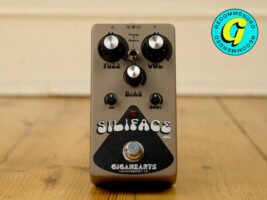
Of course, there’s a strong argument that simplicity is king when it comes to fuzz; but the Gigahearts SiIiface MkII is here to give you a different option, packing in five knobs and a toggle switch… at a strikingly low price for a British-made stompbox.
Image: Richard Purvis
What is it?
Like a billion other fuzz pedals before it, this one is based on the silicon version of the Arbiter Fuzz Face – known for being a little brighter and raspier than the original germanium model. But unlike most of those other pedals, it brings the circuit clattering into the 21st century with a host of tone-tweaking options.
So as well as fuzz and volume knobs, you get an extra one for setting the bias of the second transistor, plus mini-knobs for adjusting the input gain and the bass response. And, tucked away in the middle, there’s a switch marked ‘vintage/modern’ – this lets you choose between keeping things just how Hendrix liked them, or reconfiguring the output stage for more headroom.
Image: Richard Purvis
Build quality and usability
Despite the un-boutique price, there’s nothing cheap about the way this pedal is put together, and that extends to details such as the bypass switching: it’s a relay-based soft-touch footswitch, with an option to hold for momentary use (so it reverts to bypass as soon as you let go). It does pop a bit, but that’s only audible if you’re not playing.
The manual suggests starting out with fuzz at maximum – which I was going to do anyway, because it’s the law – and then adjusting the other controls to taste. Yes, that’s right, there’s a manual, but you surely won’t need it for such an intuitive setup. There is one more thing to mention before we get noisy, though: an internal trimpot for adjusting the intensity of the bypass LED. That’s nice, and not the sort of feature you expect to find on any pedal at this price point.
Image: Richard Purvis
Sounds
My first mission is to get a classic silicon Fuzz Face sound… and as missions go it’s not exactly the quest for the holy grail, because it’s done in seconds. Sticking to vintage mode with the mini-knobs both pointing north, you get a smooth blast of nicely balanced fuzz: powerful but not crazily gainy, sweetened in the midrange but not massively scooped. Maybe it’s missing just a hint of the easy freshness you get from a thoroughbred silicon FF, but the payoff comes with all that tone-shaping power.
Turning up the ‘in’ dial is a bit like turning down the volume on your guitar, gently cooling things down for a more open feel (note: actually turning down the volume on your guitar is still worth doing too, for a much more dramatic clean-up). And increasing the ‘body’ does exactly what you’d expect, thickening up the low end to bring the whump when required.
The mode switch also does its job just as promised, boosting the output and bringing a clearer, more strident tone; but the bias knob is the real star here. Extreme splutterage is there if you want it, but set this control right on the edge of the gating point – easily found by listening out for the drop-off in background hiss – and you can get a beautifully sticky sound for thick but controlled chords.
Image: Richard Purvis
Should I buy one?
The Siliface feels like much more than just another Face in the crowd. For anyone considering their first move into the wondrous world of 60s-style fuzz, it’s got to be on the shortlist simply because it offers so many options.
And what’s more, if you happen to be in the UK it also represents a chance to support a home manufacturer without having to spend big for the privilege.
Alternatives
SolidGoldFX If 6 Was 9 MkII ($199/£199) – another option for enhanced twiddlability, this is a silicon Fuzz Face with added bias, voltage and saturation knobs
Strymon Canoga ($199/£199) – if you’re looking for something a little more straightforward that still sounds killer, this two-knob fuzz takes some beating
Crazy Tube Circuits Triptychon (€299/£269/$359) – on the other hand, if you want something less simple, this beast of a pedal combines a silicon-based FF circuit with three Tone Benders, an overdrive and more
The post Gigahearts SiIiface MkII review – a silicon Fuzz Face with some handy bonus features appeared first on Guitar.com | All Things Guitar.
Source: www.guitar-bass.net