Gretsch Synchromatic Nashville review – “it’s an exhilarating ride but not for the fainthearted”
$1,259/£1,149, gretschguitars.com
How close should a budget copy come to the original design? Not too long ago you could rely on some sort of tell to give the game away – a slightly off headstock, obviously cheaper hardware or even a sub-brand label and logo. Less so now.
READ MORE: Gretsch Synchromatic Falcon review – “this guitar is going to make Falcons a much more common sight on everyday stages”
Gretsch has traditionally been happy to use the company’s name at a variety of price points, and relied on line extension to differentiate the various different strands of the family tree. Some models have, however, been reserved for the pricey stuff – until now.
Hot on the heels of the Synchromatic Falcon comes the Nashville – another entry into the Synchromatic series, which bridges the gap between the brand’s Indonesian and Korean-made Electromatics, and the Japanese Professional series.
Image: Adam Gasson
Gretsch Synchromatic Nashville – what is it?
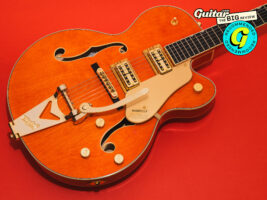
To give it the typically over-verbose full name, the Gretsch Synchromatic Nashville Hollow Body with Bigsby is based squarely on the company’s original 6120 model. It was perhaps the most unapologetically orange guitar of the 1950s electric pantheon, and an iconic voice originally designed for Chet Atkins, subsequently seen in the hands of Duane Eddy and Brian Setzer, who also had signature versions of the design over the years.
This looks at first glance, if not like a vintage original, then very much like a Japanese-made one. We’ve got a deep orange stain finish on the all-maple body and the whole guitar is festooned with gold hardware from the Bigsby licensed B60 vibrato to the open back machine heads. There’s a pair of Hi-Fidelity Filter’Tron pickups and an Adjusto-Matic bridge with a pinned ebony base, too.
Controls-wise this is standard fare for a Gretsch with a treble bleed master volume knob, individual volumes for each pickup and a master tone. The shoulder-mounted three-way selector switcheroo feels positive and engaging. Did I mention this looks legit? The scratchplate even says Nashville on it.
There are some interesting things going on under the hood too. First we have the 24.6” scale length, which, while entirely appropriate for this model is considerably shorter than a Tele or Strat and a smidge less than you’d expect on a Les Paul or SG.
Also, while this is indeed a full-fat 2.5” depth hollow body guitar, there is some joined-up thinking going on with the inner architecture in the form of the Semi-Arc bracing – a modified take on trestle bracing with two ‘feet’ under the bridge but no need for the neck block feet seen in the traditional approach. The maple neck is carved to a soft C shape and features a genuine ebony fingerboard housing 22 frets. It feels immediately familiar and comfortable, now let’s plug in.
Image: Adam Gasson
Gretsch Synchromatic Nashville – playability and sounds
Pulling the guitar out of its included heavyweight hard case, and I’m instantly perturbed as to why the bridge is set quite as high as it has been – it’s a very quick and easy job to fettle it down to an acceptable height for comfortable playing, but still, odd.
That minor hiccup dealt with, and it’s onto the fun stuff. Few guitars respond to a straight into the amp approach like a Gretsch and I start by plugging directly into an old Cornford Hurricane with a curly lead. With all dials set at noon and the neck pickup engaged, a very convincing on-edge clean sound fills my studio.
On vintage models – often with heavy flat-wound strings – this evocative texture can easily get indistinct and woofy, but here we have much of the girth with none of the mud. Dial up the reverb and slide a tremolo in there somewhere and you are most of the way towards a very nice time indeed.
The middle position on any guitar is there for much more than funk and Hendrix-style double stops. That said, you can thoroughly enjoy both approaches here. It’s an exceedingly pleasurable in-between sound with enough poke to get through a mix while picking up the pieces or line dancing in a burning room.
It’s also the place to be when it comes to blending the pickup volumes to find new and delicious textures. Options are limited by the single tone control, but the guitar still responds well to changes in pick attack and hand position – you will get by, believe me.
The bridge ‘Tron on a Gretsch hollowbody is an iconic voice and this golden beauty gets us from Duane Eddy twang to Spaghetti Western in a heartbeat. This is très bon and encourages the player to unleash their inner Vic Flick. You can also get some very convincing Velvet Underground textures out of it which may well appeal to players who favour indoor sunglasses.
Aficionados may miss the “mud switch” tone control common to some models of the 6120 and there may also be those who would prefer nickel hardware to the spangly gold. A classic case of de gustibus etc. Nevertheless, this is very strong stuff indeed when played clean – time to filth it right up with a Crowther Hot Cake.
A sly helping of classic rage is all it takes for the Nashville Hollowbody to start grunting very nicely. There’s a sweet spot with big hollowbody guitars when it comes to dirt – less is more as everyone from Billy Duffy to Sylvain Sylvain and Richard Fortus will attest. The way a larger instrument vibrates encourages all sorts of belligerent whoops and howls that you just don’t get with a solid body – it’s an exhilarating ride but not for the fainthearted.
Back to the neck pickup and yes, things do get a bit mushy when we swap out the Hot Cake for a Bigfoot Engineering King Fuzz in search of saw-toothed glories. Engaging the bridge pickup, however, gives me an immediate shot of trouser-flapping violence that makes it all worthwhile. You can wreak havoc behind the bridge, you can Bigsby it to within an inch of its life and it will come up smiling every time.
In all the fun I realise I haven’t even fed it any Chet Atkins – I can confirm that it loves a thumbpick-driven Taste Of Honey.
Image: Adam Gasson
Gretsch Synchromatic Nashville – should I buy one?
Not long ago the idea of a Chinese-made instrument commanding a four-figure price tag would have raised eyebrows. While there remains a palpable difference between this and the Professional series, there is a strong argument that the Gretsch Synchromatic Nashville Hollowbody represents extremely good value for money, regardless of the country of origin.
Image: Adam Gasson
Gretsch Synchromatic Nashville – alternatives
Another Asian-made guitar with real big brand pedigree is the Epiphone Swingster ($799/£799), while Eastwood’s Bill Nelson Astroluxe Cadet DLX ($1,599) is a fine example of relatively affordable rockabilly fun. Another brand that has its roots in the big-bodied jazz guitars of ol’ New York is the D’Angelico Excel 59 ($1,999).
The post Gretsch Synchromatic Nashville review – “it’s an exhilarating ride but not for the fainthearted” appeared first on Guitar.com | All Things Guitar.
Source: www.guitar-bass.net